As an Amazon Associate I earn from qualifying purchases. Links in this article may be affiliate links. How we choose gear
Buy the wrong tool and you pay twice: once at checkout, and again when a bronze scraper snaps, a pivot loosens, or an airport checkpoint keeps the thing. The best military multi tool in 2027 depends on the job, not the badge. For rifle upkeep, the Leatherman MUT leads. For a plain belt tool that opens with one hand, the Gerber MP600 is the long-running choice. For leverage at a lower price, SOG’s PowerLock EOD earns a place, and the Leatherman Wave+ covers general work when weapon-specific parts aren’t the point.
Maker spec sheets, Task & Purpose and Military Times write-ups, owner comments on retailer pages and forums, and the TSA’s own carry rules shaped every claim below. Each one traces back to something you can read yourself. The guide starts with six checks that separate a duty tool from a gift-shop gadget. Then it covers cost, fit, wording traps and common mistakes before it lands on four picks.
In a hurry: Gerber’s MP600 for broad value. The MUT if guns are your daily work.
Six checks that separate a duty tool from a gift-shop gadget
- Name the job before you name the brand.
What does “military” actually buy you? Mostly a different toolset, not a mysterious metal. Leatherman describes the MUT as a tool that maintains military gear through a bronze carbon scraper, a disassembly punch and a bolt override tool. Task & Purpose explains that the name stands for Military Utility Tool and that the toolset targets weapons maintenance. A Gun Mart review adds that two Army sergeants from the Marksmanship Unit at Fort Benning approached Leatherman with the idea.
SOG took another road. Retailer pages say the PowerLock EOD’s crimper produces crimps that meet government fuse well specifications, which is a real job for bomb-disposal technicians and an irrelevant one for almost everyone else. Gerber’s MP600 sits in the middle, a general pliers tool that the maker calls its top-selling multi-tool platform to the US military (a maker’s claim, so weigh it as one). A regular multitool, like the Wave+, aims at repairs, camping and work benches. It can still ride on a belt. It just won’t clean a bolt carrier.
Brand questions come up a lot, so here’s the sourced version. Gerber’s MP600 variants carry NSN stock numbers. One is 5110-01-394-6252 on the carbide-cutter model, and a police-gear retailer lists 5110-01-604-2057 on the sight-tool model. That’s the nearest thing to proof of government buying. Leatherman built the MUT with Army input. SOG’s retailers lean on GSA wording. Victorinox equips Swiss soldiers with the Soldier’s Knife 08, a knife-style tool without pliers. Those are four different meanings of “military spec,” and none is a formal grade you can look up for the others.
- Count what you can run with one hand, in gloves.
Duty gear gets used half-blind, cold, and often with one hand free. That’s why one-hand operation decides more than tool count. Gerber’s MP600 uses a patented one-hand opening plier and a Saf.T.Plus lock. SOG lists one-handed flip opening, piano locks and its Compound Leverage pliers on the PowerLock. Leatherman says every Wave+ feature except the plier head locks, and outside-accessible tools open without unfolding the handles. OutdoorGearLab’s reviewer wished the pliers locked too.
People hunting for a tactical pliers tool for soldiers usually want the same trio: pliers that open with a flick, locking blades, and a sheath that fastens to webbing. The MP600’s flick-open pliers and the PowerLock’s compound-leverage pliers are the two designs built around that idea. The Wave+ opens in the usual hand-over-hand way, though its blades open from outside.
Weight matters next. Listed figures run from 8.5 ounces for the Wave+ to 9 for the MP600, about 9.6 for the PowerLock and 11.2 for the MUT. That 2.7-ounce spread sounds small until the tool rides a belt or a vest all day. Bits matter for vehicle work too: the PowerLock has a foldable quarter-inch socket drive, while the MUT has a large bit driver and a separate wrench accessory.
- Read the steel and the finish.
Four of the picks here use stainless steel with a black or satin finish, and most blades are 420HC. Leatherman’s own write-up on that steel credits toughness, reliable corrosion resistance in everyday conditions and easy sharpening, then admits saltwater needs more upkeep. The MUT’s materials list adds 154CM stainless, which GearJunkie describes as a balanced steel used in nicer knives. Wave+ blades are listed at 55 to 59 HRC, while a retailer lists the PowerLock’s body hardness at 51 to 53 HRC.
Finish is the other half. ProToolReviews says the Gerber’s black oxide coating is only about a micrometer thick and works well against corrosion but wears under abuse. Forum members on Bladeforums argue about whether 154CM resists rust better than 420HC, which is a reminder that steel names don’t settle the question alone.
A stock number is a fact; a slogan isn’t. Gerber lists NSN 5110-01-394-6252 on one MP600 variant. That’s something you can verify, unlike “military grade.”
- Know the carry rules before you click.
Flying is where military-style tools get confiscated. The TSA’s multi-tool page says scissors under 4 inches are fine in a carry-on, blades are not, and checked bags need any sharp item sheathed or wrapped. The final call rests with the officer at the checkpoint. Gerber sells a bladeless MP600 and describes it as compliant with no-knife workplace policies, which is the only version of the four that suits a carry-on.
On the law side, federal text is narrow. 15 U.S.C. § 1241, hosted by Cornell Law School, defines a switchblade as a knife whose blade opens automatically by a button or by inertia or gravity. It says nothing about pliers tools or assisted openers, and state and local rules differ, so a tool legal in one county can be a problem in the next. Your unit or installation may set its own carry rules as well.
One more TSA detail: its sharp-objects page lets tools of 7 inches or less into a carry-on and points travelers to local law enforcement about the item. That length rule is measured end to end, and none of these tools reaches it closed, but the blade rule still decides.
- Plan the care before the first dirty day.
Corrosion is the usual killer. Leatherman’s maintenance page says to rinse in fresh water, dry the tool and add a light oil, and notes that acetone or brake cleaner can damage plastic parts. Mineral spirits handle tar. That’s the whole routine. (Salt air and sweat shorten the gaps between oilings.)
Blades need less fuss than you’d think. Leatherman’s own steel write-up says even basic sharpening tools quickly restore a 420HC edge, which suits field conditions. Pivot points and the black oxide coating are the parts that reward a drop of oil, since ProToolReviews describes that coating as thin.
Replaceable parts stretch a tool’s life. The MUT has a maintenance kit for swapping the cutters, punch, scraper and cutting hook, according to a Bladeforums review. The Wave+ and the MP600 carbide version both use replaceable wire cutters. A buyer’s review on a retailer page notes that SOG’s hex-head screws let owners swap components. Sheaths wear too, and OutdoorGearLab’s reviewer saw the hook-and-loop flap on a Gerber holster wear out after years of use.
- Read the warranty’s fine print before the price tag.
Leatherman backs its tools with a 25-year limited warranty. Its warranty page states the coverage is for tools bought for personal use, not commercial accounts or bulk purchases, and that rust, oxidation and corrosion aren’t covered. Sheaths, accessories and color finishes sit outside it too. Members of the free Insider program get 40 years. Gerber offers a limited lifetime warranty, while SOG’s wording ties its lifetime guarantee to the original purchaser.
Those terms cover defects. A retailer support page makes the distinction plain: a break caused by opening a paint can is misuse, not a defect. Claims run online. Leatherman’s process is to submit a form and send the tool in for evaluation, and a repaired tool comes back with its original functionality, without partial fixes. If the tool is retired, a comparable model replaces it, and individual parts aren’t mailed out. Treat any warranty as a safety net for factory flaws, not a license to pry.
Price per warranty year: what each tool costs to own
Sticker prices mislead when warranty lengths differ. To compare them fairly, the table below divides a typical price band by the warranty length, treating each “lifetime” promise as 25 years purely so the math lines up. That’s an assumption, not a legal reading, and no warranty here covers loss, abuse or rust.
| Tool | Typical price band | Warranty | Cost per warranty year | Sheath |
|---|---|---|---|---|
| Leatherman MUT | about $160 to $230 | 25-year limited | about $6 to $9 | MOLLE sheath included |
| Gerber MP600 | about $60 to $125 | Limited lifetime | about $2 to $5 | Nylon sheath included |
| SOG PowerLock EOD | about $75 to $100 | Lifetime, original purchaser | about $3 to $4 | Nylon pouch included |
| Leatherman Wave+ | around $130 | 25-year limited | about $5 | Varies by seller |
Price bands come from Task & Purpose’s review of the MUT, Leatherman’s own product pages, Gerber’s site, and specialty and sporting-goods retailer listings. The MP600 range is wide because the needlenose, bluntnose, carbide-cutter and leather-sheath versions are priced differently.
So where does the extra money go? On the MUT, mostly to parts a non-shooter never touches: scraper, punch, cleaning-rod adapter, wrench. Military Times’ 2014 write-up called its reliability hit or miss. One reader on The Truth About Guns reported a scraper that snapped on first use. Premium here buys specialization, not proven fewer failures. The Wave+ costs more than the PowerLock yet carries no weapon-specific parts. What it buys is outside-accessible tools, a 4.8-star average across 80 REI reviews, and best-overall rankings from GearJunkie and Reviewed.
Budget versus premium comes down to use, not prestige. Spend more when the extra parts match your routine, such as the MUT for a weapons-maintenance schedule. Spend less when the job is pliers, a knife and a screwdriver, because an MP600 or PowerLock covers that for a fraction of the cost. Paying for features you won’t touch is the only truly wasted money.
Is anything newer worth waiting for? These are long-running designs: a Multitool.org review of the Gerber MP600 dates to 2006, and the same site calls the PowerLock still in production almost a quarter-century on. That age gives you years of owner reports to read, which a brand-new model can’t offer.
A cheap military multitool is a real category. Under about $100, the PowerLock EOD and the basic MP600 do the core job. Tractor Supply shows 4.5 stars from 21 shoppers on the PowerLock, and the Navy Exchange shows 4.75 from 16 on a V-cutter version. Past about $200, you’re paying for the MUT’s specialized kit.
Sheath math: a worked fit check for one MOLLE pouch
Say a soldier wears Leatherman’s XL MOLLE sheath, whose internal capacity is listed at 5.00 by 1.50 by 0.90 inches. (The sheath is hypothetical here, and the numbers are the published ones.) The MUT is 5 inches closed, 0.79 inch thick, and its EOD sibling lists a 1.5-inch width. Subtract: length margin 0.00 inch, width margin 0.00, thickness margin 0.11. It fits, snugly, with nothing to spare.
Now try the 4-inch Wave+, 0.7 inch thick. It slides in with an inch of length to spare, though Leatherman also sells a Large sheath for 4-inch and 4.5-inch tools that suits it better. The PowerLock and MP600 run 4.6 to 4.9 inches closed according to different listings, so they sit between those sizes, and they ship with their own nylon pouches.
The takeaway: a MOLLE-first loadout belongs to the MUT, because the sheath was sized for it. Everything else wants its own pouch. Skip this step and you’ll end up with a tool that rattles loose or won’t seat.
What “tactical,” “military grade,” and “USA built” really tell you
Listing language hides limits. A few phrases deserve a second look.
“USA Built w/ Global Parts” appears on Gerber’s own MP600 pages. A reseller page tied to an Amazon storefront says “Proudly made in the USA at Gerber’s Portland, Oregon factory.” Both can be true of final assembly, but the maker’s wording is the more careful one. “GSA-approved*” shows up on SOG PowerLock pages at several retailers with its asterisk intact, and no listing explains what the asterisk means. Treat it as a retailer claim.
“Lifetime warranty” is never unlimited. “Tool count” is flexible too. The MUT is listed as 16 tools on Leatherman’s page, while a comparison table on Leatherman’s corporate-gifting site shows 15. Task & Purpose counted 11 on the MP600 that Gerber lists as 14, noting the flat-head screwdriver appears three times. “Complies with no knife policy” simply means a bladeless version. And “#1 selling multi-tool platform” refers to a family of MP600 variants, not a single product.
“Tactical” says nothing measurable. Tool counts, locks, weight and warranty do.
Three numbers that change from page to page
Specs disagree across sources, and the disagreement usually comes from versions.
The MP600’s closed length is 4.6 inches on Gerber’s own page, 4.92 at Dick’s Sporting Goods, and 5.04 in Military Times’ coverage of a sight-tool version, which also weighed 8.2 ounces against Gerber’s 9. The PowerLock EOD’s weight is 9.6 ounces on most pages. Its place of manufacture isn’t: one retailer says made in the USA, while Boker’s listing says Taiwan. And the Wave+ is described as sold with a nylon sheath at Adorama but “sheath sold separately” on Leatherman’s page.
Needlenose or bluntnose, carbide cutters or not, a leather sheath or nylon: each changes the tool’s size, weight and price. Match the version in the listing to the version a review describes before you compare numbers.
Matching the duty to the tool: four hypothetical assignments
Names and units don’t matter here, only the pattern of use. Each assignment below maps to one pick and gives the reason.
- A rifle armorer who cleans and adjusts weapons weekly gets the most from the MUT, since the scraper, punch, cleaning-rod adapter and sight accessory are built for that routine.
- A technician who crimps blasting caps in an authorized role has a use for the PowerLock EOD’s crimper, which retailers describe as meeting government fuse well specifications. Everyone else is paying attention to the wrong feature.
- A vehicle or motor-pool mechanic wants bits and reach. The PowerLock’s quarter-inch socket drive and the MUT’s large bit driver both help, and the lighter Wave+ suits the same work with a bit driver of its own.
- A traveler who flies on orders or for work is better served by a bladeless MP600, because blades can’t ride in a carry-on.
Buying mistakes that cost money, and the fix for each
Buying for the badge. A tool with rifle-specific parts is dead weight if you never clean a rifle. One reviewer on Leatherman’s own MUT page also called the extra-long bits so hard to pull from the handle that they were nearly useless. The fix is to list the five jobs you do most, then buy against that list.
Trusting the warranty to cover rust. Leatherman excludes corrosion outright. The fix is the rinse, dry and oil routine from check five, plus a dry place to store it.
Packing it in a carry-on. The TSA keeps blades out of the cabin. The fix is a checked bag, or the bladeless MP600.
Ignoring the sheath. See the fit check above. A snug MOLLE pouch or a loose belt pouch changes how often you’ll actually carry the thing.
Skipping the version. A reviewer at More Than Just Surviving found a bladeless MP600’s cutters disappointing on electrical wire, while ProToolReviews noted the later carbide-insert version as an improvement. The fix is picking the cutter type deliberately.
Using it as a pry bar. Breakage from prying a paint can isn’t a defect. The fix is carrying a real pry tool.
Eating tools, corkscrews, motor-pool jobs, cheap options, and flights
Is there a tactical multi tool that doubles as an eating tool?
Are corkscrew multitools for military officers only?
Which multitool suits motor-pool or vehicle work?
Can a military multi tool go in carry-on luggage?
What's the cheapest military-style multitool worth owning?
Four picks, each tied to one of the six checks
Reviewers who rank the best multitool for military use tend to agree on a short list of traits: tools that lock, pliers that open fast, and a sheath that stays put. Task & Purpose calls multitools popular with service members and veterans, Reviewed names the MP600 its best-value pick and the Wave+ its best overall, and OutdoorGearLab praises the Gerber’s sliding-pliers design. For duty and infantry use, the useful filters are weight under about 11 ounces, a MOLLE-friendly sheath and one-hand operation. Higher quality in a tactical multi-tool shows up as locks, replaceable parts and warranty terms, never in the word itself.
1. Leatherman MUT — built around rifle upkeep
Check one points here. The MUT carries a replaceable bronze carbon scraper, a bolt override tool, a replaceable firearm disassembly punch, a cleaning-rod adapter, a hammer and a 420HC knife. It arrives with a MOLLE sheath and a front-sight adjustment accessory. Closed, it’s 5 inches long and 11.2 ounces. Leatherman’s own product page averages 4.66 stars across 276 reviews, though individual reviewers dislike the stiff hinges and the hard-to-pull long bits.
The main drawback is size and price. It’s the heaviest tool here and the most expensive, and the weapon-specific parts do nothing for a buyer who never cleans a rifle. Military Times’ 2014 write-up called its reliability inconsistent, so keep the 25-year warranty in mind.
Pros:
- Rifle-maintenance tools no other pick has
- MOLLE sheath and sight accessory included
- Replaceable scraper, punch and cutters
Cons:
- Heaviest and priciest of the four
- Long bits are hard to remove, per reviewers
2. Gerber MP600 — plain one-hand belt tool
This one answers check two. Open the pliers with a flick, lock the tools, and move on. Gerber lists 14 tools, a closed length around 4.6 inches, a weight near 9 ounces and a limited lifetime warranty. Task & Purpose’s review describes it as a no-frills tool with almost none of the fancy stuff, and the same write-up noted that its cutters splayed two strands of steel cable.
Its weak spot is the cutter. One reviewer found a bladeless version disappointing on electrical wire, and ProToolReviews said the black oxide finish isn’t built for abuse. Weapon-specific parts only come on the sight version, which is a separate model.
3. SOG PowerLock EOD — leverage at a lower price
That is the price-per-year winner among the picks with extra grunt. SOG lists 18 tools, 420 stainless steel construction, a black oxide finish, 9.6 ounces, a 4.6-inch closed length and Compound Leverage pliers. Sporting-goods retailers describe the crimper as meeting government fuse well specifications, and an Adorama reviewer who says he served in the Marines reports using a PowerLock since 2001. A buyer on a Woot forum liked it but disliked that the accessories can’t be reached while closed and that the sheath rides high on the belt.
The weak spot is polish. The listing wording (“GSA-approved*”) needs a grain of salt, and the black oxide finish will wear like any other coating.
Pros:
- Strong leverage from the compound pliers
- Quarter-inch socket drive for bits
- Typically the lowest price among the four
Cons:
- Accessories aren’t reachable when closed
- Sheath sits high on the belt, per owners
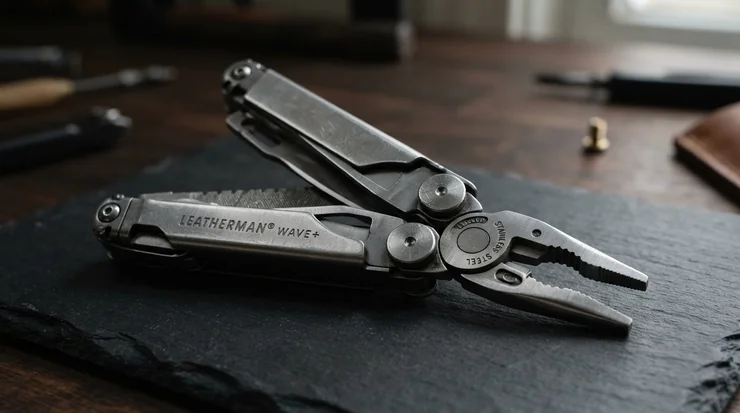
4. Leatherman Wave+ — lighter all-rounder, no gun parts
Check five points here: replaceable wire cutters, outside-accessible tools and a 25-year warranty make it an easy tool to maintain. It weighs 8.5 ounces, closes to 4 inches and carries 18 tools with every feature but the pliers locking. REI shows 80 reviews averaging 4.8 stars, and GearJunkie and Reviewed both rank it best overall in their roundups.
It isn’t military-specific. There’s no scraper, no punch and no MOLLE sheath in the box, depending on the seller, and OutdoorGearLab wished the pliers locked. One buyer on Leatherman’s page also reported arriving with a bit of rust, which echoes the finish questions in check three.
For most buyers asking which is the best military multi tool, the answer splits three ways. The MUT suits weapons work, the MP600 suits a lean belt tool, and the PowerLock EOD wins when leverage and price matter most. The Wave+ fills the gap for everyone else. Pick one job, and the rest follows.
Recommended for You
- Military Multi Tool: 7 Best Tactical Picks 2025
- Best multitool for military: 7 top picks 2025
- 7 best Gerber military multi tool options for 2026
Measure the closed length against your sheath pocket first, then let the job decide the tool.