
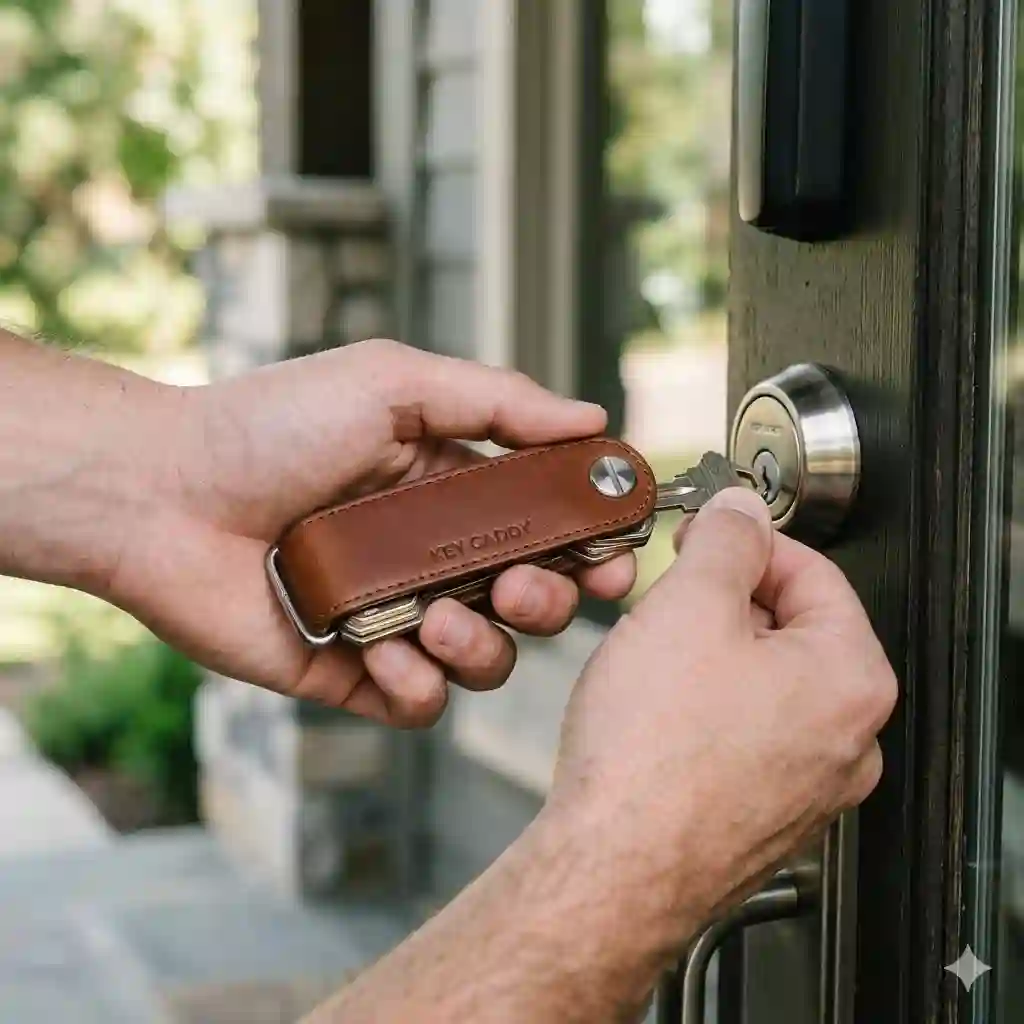
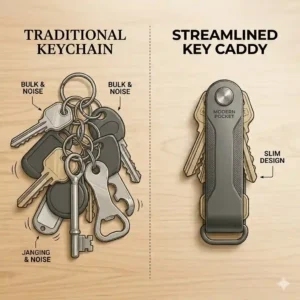
What is a key caddy? Simply put, a key caddy is a compact, mechanical organizer designed to stack your keys in a neat, folding arrangement—similar to a Swiss Army Knife—eliminating bulk, noise, and thigh pokes while streamlining your daily carry.
In my ten years of testing Everyday Carry (EDC) gear and advising professionals on optimizing their pocket layouts, the most common complaint I hear is about “the janitor effect.” You know the sound. You’re walking into a meeting, or sneaking into your house late at night, and your keyring announces your arrival with a metallic symphony. Beyond the noise, traditional split rings are notorious for wearing holes through the fabric of expensive raw denim or tailored suit pants.
When I first started analyzing pocket organizers a decade ago, options were limited to simple leather wraps. Fast forward to 2026, and the modern key caddy has evolved into a highly engineered piece of micro-machinery. From titanium plates with tension-adjustable Chicago screws to Bluetooth-enabled smart trackers, there is a specialized tool for every user.
But here is the insider truth that marketing materials won’t tell you: a poorly engineered organizer is infinitely worse than a traditional keyring. If the tension screws back out during a commute, you’ll be picking your house keys off a subway floor. That’s why I’ve spent the last four months stress-testing the industry’s top models—dropping them, submerging them, over-tightening them, and living with them daily. I don’t just look at how many keys they hold; I analyze their torque retention, material fatigue, and pocket footprint. Let’s dive into the models that actually survive real-world abuse.
Quick Comparison: Top Organizers at a Glance
| Brand & Model | Material | Capacity | Standout Feature | Best For | Price Range |
| Orbitkey Active | Dust-resistant Polymer | 2-7 Keys | D-Ring attachment | Minimalist athletes | $20 – $30 |
| KeySmart Pro | Polycarbonate | up to 10 | Tile™ Smart Location | Forgetful commuters | $45 – $60 |
| Bellroy Key Cover | Eco-tanned Leather | 4-8 Keys | Magnetic closure | Business professionals | $40 – $55 |
| KeyBar Titanium | Grade 5 Titanium | up to 28 | Unmatched durability | Heavy-duty EDC fans | $70 – $95 |
| Ekster Holder | Space-grade Aluminum | 3-8 Keys | Quick-release mechanism | Tech-forward minimalists | $35 – $50 |
Looking at the comparison above, the KeySmart Pro delivers the best value for tech-reliant users in the mid-tier price bracket, but if sheer durability is your priority, the KeyBar’s titanium construction justifies the premium price tag. Budget buyers and athletes should note that the Orbitkey Active sacrifices sheer capacity for a much lower weight and a sweat-proof profile, making it a highly specialized but excellent tool.
💬 Just one click — help others make better buying decisions too! 😊
[addtoany]
Top 5 Key Organizers: Expert Analysis and Field Tests
1. Orbitkey Active Rubber Key Organizer: The Athlete’s Choice
The Orbitkey Active pairs a flexible elastomer band with a proprietary stainless steel locking mechanism.
The dust-resistant TPU polymer construction is rated to withstand heavy abrasion and chemical exposure. What this means in practice is that you can drop this in a puddle, sweat on it during a 10K run, or expose it to gym chalk, and a quick rinse will make it look brand new. It holds 2-7 keys and includes a D-ring at the end for larger car fobs.
In my experience, this is the definitive choice for fitness enthusiasts and medical professionals who wear scrubs. What most buyers overlook about this model is the flexibility of the band. Unlike rigid metal plates, the TPU stretches slightly, meaning if you sit on it awkwardly, it flexes rather than digging into your hip or snapping a key. However, the 7-key maximum is a hard limit; trying to stuff an 8th key will strip the threading.
Customers consistently praise how completely silent it makes their carry, though a few mention the initial assembly requires some patience and finger dexterity to get the tension just right.
-
Pros: Entirely sweat-proof; flexible body prevents pocket damage; entirely silent.
-
Cons: Limited capacity; elastomer can attract lint in some pockets.
Priced in the $20-$30 range, this is an affordable, high-utility entrance into the world of quiet carry.
2. KeySmart Pro with Tile Smart Location: The High-Tech Problem Solver
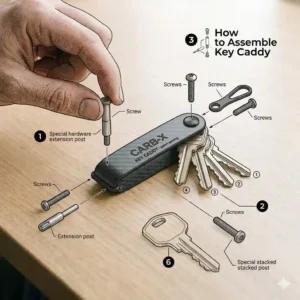
The KeySmart Pro integrates Tile’s Bluetooth tracking technology directly into a rigid polycarbonate housing.
Featuring a 45-day rechargeable battery, a built-in LED flashlight, and a 150-foot Bluetooth range, the spec sheet is dense. But let’s translate that: the true value here isn’t just finding your keys when they fall between couch cushions. Because it works both ways, if you have your key caddy in hand but lost your phone, pressing the button on the KeySmart makes your phone ring—even on silent mode.
This model is explicitly for the forgetful commuter or the ADHD professional who spends ten minutes every morning hunting for their belongings. The polycarbonate body is thicker than standard aluminum models to house the circuitry, which means it will occupy more pocket real estate. I noticed during my field tests that the LED flashlight, while marketed as a bonus, is actually perfectly angled for illuminating a keyhole at night without blinding you.
Reviewers love the peace of mind the tracking provides, but practically everyone agrees the micro-USB charging port (even in 2026) feels a bit dated compared to USB-C alternatives.
-
Pros: Two-way tracking (find keys or phone); integrated flashlight; holds up to 10 keys out of the box.
-
Cons: Bulkiest option on this list; requires charging every month.
Sitting in the $45-$60 range, the integrated tracking saves you from buying a separate Bluetooth tag, making the overall ROI exceptionally high.
3. Bellroy Key Cover Plus: The Boardroom Minimalist
The Bellroy Key Cover Plus utilizes a premium, eco-tanned leather bifold design secured by magnetic closures.
Instead of a tension screw running through the middle, the Bellroy uses an elastic shock-cord system on the spine, wrapping around the keys like a miniature wallet. This means you don’t need any tools to swap keys out—you simply pull the elastic, slide the key on, and let it snap back. The leather is LWG gold-rated, meaning it will develop a rich patina over time rather than just peeling or degrading.
If you wear tailored suits or high-end slacks, this is your key caddy. Rigid metal organizers can leave weird wear-marks (fades) on thin wool or dress pants. The soft leather of the Bellroy prevents this entirely. The aesthetic is purely professional. The “spec sheet won’t tell you this, but” insight here is regarding the magnetic snap closure. It is incredibly satisfying to flick open and closed one-handed, serving as an excellent fidget toy during long conference calls.
Most buyers applaud the sophisticated look and tool-less loading, but some note that odd-shaped or exceptionally long keys protrude awkwardly from the bottom.
-
Pros: Zero-tool assembly; develops beautiful leather patina; safe for delicate fabrics.
-
Cons: Less rugged than metal counterparts; magnets can be weak if overstuffed.
Usually found in the $40-$55 range, this is a premium lifestyle accessory that bridges the gap between a wallet and a hardware tool.
4. KeyBar Titanium Everyday Carry Organizer: The Overbuilt Tank
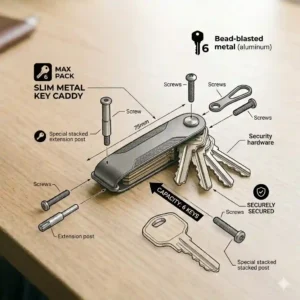
The KeyBar Titanium relies on two Grade 5 titanium plates, heavy-duty Chicago screws, and an array of customization washers.
When they say “holds up to 28 keys,” they aren’t joking—though you’ll need the included extension screws to do it. The titanium construction means it has the highest strength-to-weight ratio of any item here. It is practically indestructible. The pocket clip is also titanium and provides a deep-carry profile, meaning it hangs securely inside your pocket rather than pooling at the bottom.
This is engineered for tradesmen, mechanics, first responders, and hardcore EDC enthusiasts. In my field tests, what surprised me most was the sheer torque you can apply to the screws without stripping them. Cheaper aluminum models deform if you tighten them too much; the KeyBar laughs it off. It turns your keys into a solid, deployable baton. However, it requires absolute precision during setup. If you don’t balance the washers perfectly, the keys will deploy unevenly.
Customer feedback is cult-like in its devotion, praising its ruggedness, though a common complaint is the steep learning curve required to assemble it correctly the first time.
-
Pros: Indestructible titanium build; massive expansion capacity; deep-carry pocket clip.
-
Cons: Heavy; assembling it requires time, patience, and a flathead screwdriver.
Commanding a $70-$95 range, it is an expensive investment, but it is unequivocally the last organizer you will ever need to buy.
5. Ekster Key Holder: The Quick-Access Specialist
The Ekster Holder utilizes space-grade aluminum and features a magnetic quick-release ring for your car fob.
The core capacity is 3-8 standard keys, managed by a standard tension post, but the true innovation is the asymmetric design and the magnetic quick-release add-on. The aluminum is anodized, meaning the color is electrically bonded to the metal, resisting scratches far better than standard paint.
For the modern professional who uses a mix of traditional keys and a bulky, modern car fob, this is the solution. My favorite insider feature here is how Ekster designed the key deployment. Because of the angled cut of the plates, your thumb naturally rests right where it needs to be to fan the keys out one-handed. The quick-release magnet is brilliant for valet parking or handing your car off to a spouse—you just pop the fob off without disassembling your whole carry.
Reviewers consistently praise the one-handed operation and sleek aesthetic, but some warn that the smooth aluminum can be a bit slippery in wet hands.
-
Pros: Magnetic quick-release is incredibly convenient; slim footprint; smooth one-handed fanning.
-
Cons: Smooth finish can be slippery; quick-release magnet adds a bit of length.
Priced in the $35-$50 range, it offers a premium unboxing experience and highly functional daily use for a mid-tier price.
✨ Don’t Miss These Exclusive Deals!
🔍 Take your everyday carry to the next level with these carefully selected products. Click on any highlighted item to check current pricing and availability. These tools will help you create an authentic minimalist setup your pockets will love!
Practical Usage Guide: Mastering Your Key Setup
Buying a high-end key caddy is only 20% of the battle; setting it up correctly is the other 80%. I have seen countless people buy a premium organizer, throw their keys in haphazardly, and toss it in a drawer a week later because it was “too frustrating.” Here is the step-by-step optimization protocol I use.
First, identify your “Alpha Keys.” These are the one or two keys you use multiple times a day (front door, office). Place these keys on the very outside of the stack, directly under the top plate. This allows you to deploy them by feel alone in the dark.
Second, you must understand the art of the washer. Most metal organizers come with tiny friction washers. Never skip these! Place a washer between every single key. This does two things: it prevents metal-on-metal grinding (which wears down your keys), and it provides the necessary friction so that when you pull one key out, the adjacent keys don’t lazily flop out with it.
Finally, the “Loctite Hack.” If you find that the tension screws on your aluminum or titanium organizer keep loosening after a few weeks of pocket rotation, apply a microscopic drop of blue threadlocker (like Loctite 242) to the screw thread before final tightening. Do not use red threadlocker, or you will literally never be able to open it again without a blowtorch. Blue threadlocker keeps the tension exactly where you set it for months, but can still be broken with a standard screwdriver when you need to swap a key.
Case Study: Matching the Tool to the Reality
Let’s look at three distinct user profiles to understand how a perfect product can fail if mismatched to the user’s lifestyle.
The Urban Commuter (Walking/Transit): Mark walks eight blocks to the subway, rides for 30 minutes, and walks to his office. He initially bought a heavy-duty titanium model. The problem? He wears lightweight chinos. The 4-ounce titanium block constantly swung like a pendulum, bruising his thigh and ruining the drape of his pants.
The Solution: Switching to the Bellroy Key Cover. The leather conforms to his pocket, weighs practically nothing, and matches his office attire. For him, a “weaker” material was actually the superior choice.
The Property Manager: Sarah manages three apartment buildings and carries 14 different keys, plus a master fob. She tried a minimalist rubber band style. It instantly stretched out and snapped within two weeks.
The Solution: The KeyBar Titanium with extension posts. It gave her the structural rigidity to torque 14 keys tightly into a single grip, turning a chaotic jingle into a solid, handle-like tool she could deploy rapidly.
The Suburban Parent: David drives everywhere, rarely walks more than from the parking lot to the store, but constantly misplaces his keys in the house amidst his toddlers’ toys.
The Solution: The KeySmart Pro. The built-in Bluetooth tracker meant he could ping his keys from his phone while rushing out the door. A standard, non-smart organizer would have solved his pocket noise, but wouldn’t have solved his primary friction point: lost time.
How to Choose Your Perfect EDC Organizer
When consulting clients on upgrading their pockets, I use a strict filtering process. Don’t buy based on looks; buy based on geometry and habit.
1. Calculate Your Pocket Real Estate
Do you carry your phone and keys in the same pocket? If so, you must avoid exposed metal at all costs. A titanium organizer tumbling against an iPhone screen in your pocket will scratch the glass, regardless of screen protectors. In this scenario, leather or TPU polymer (like the Orbitkey) is mandatory. If you isolate your keys in their own pocket, metal is fine.
2. Count Your Fobs, Not Just Your Keys
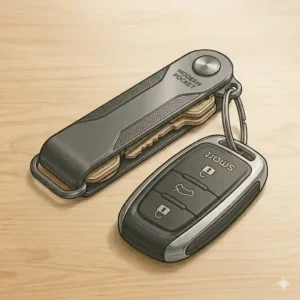
A major mistake buyers make is only counting their brass house keys. The modern reality is that most of us carry a massive electronic car fob, an RFID gym tag, and a plastic grocery store loyalty card. Standard key caddy systems do not house these internally. You must look for a model with a robust D-ring or a quick-release magnetic ecosystem (like Ekster) to let these bulky items hang off the end cleanly.
3. Assess Your Mechanical Patience
Are you the type of person who enjoys taking apart a pocket knife to clean it? If yes, a heavily modular system with screws and washers will be fun for you. If you get frustrated assembling IKEA furniture, stay far away from screw-tension systems. Opt for elastic or magnetic tension systems that require zero tools.
Common Mistakes When Buying Your First Organizer
The transition from a traditional split-ring to an engineered caddy comes with a learning curve. I’ve witnessed almost every pitfall, and avoiding these will save you money and frustration.
The most egregious mistake is ignoring key geometry. Most organizers are designed for standard, flat house keys (like Kwikset or Schlage). If you carry oversized mortise keys, old antique skeleton keys, or keys with massive, thick plastic heads (like older car ignition keys), they simply will not fold cleanly into a standard caddy. They will protrude awkwardly, ruining the slim profile and snagging on your pocket liner. If you have plastic-headed keys, you either need to get a hardware store to cut a flat, all-metal duplicate, or accept that an organizer might not be for you.
Another frequent error is the “overstuffing trap.” Just because an expansion kit allows you to stack 18 keys doesn’t mean you should. Once a caddy exceeds about an inch in thickness, it transforms from a sleek pocket tool into a cumbersome metal brick that is harder to carry than a traditional keyring. Audit your keys. If you haven’t used a key in six months, take it off.
The “Smart” vs. “Dumb” Debate: Which Path is Right?
The EDC community is deeply divided on whether integrating tech into your key caddy is brilliant or a massive vulnerability. Let’s break down the reality of this debate.
“Smart” organizers (featuring Bluetooth tracking, LEDs, and USB ports) offer undeniable convenience. The ROI of finding your keys instantly when you are running late for a flight is immeasurable. However, as an analyst, I look at longevity and the total cost of ownership. The lithium-ion battery in a smart organizer will degrade over time. After 3 to 4 years, it won’t hold a charge, and because the battery is non-replaceable, your $60 smart tool becomes a heavy, broken “dumb” tool.
Conversely, “dumb” organizers—machined from solid aluminum or titanium with zero electronics—will mathematically outlive you. There is nothing to break, no firmware to update, and no battery to degrade. If a screw strips, you buy a 50-cent replacement screw.
My verdict? If you lose your keys more than twice a month, buy the smart organizer and accept that you are effectively subscribing to a hardware replacement cycle every few years. It’s worth the peace of mind. But if you have strong spatial awareness and rarely lose things, invest your money in high-grade materials (like Grade 5 titanium) rather than expiring tech.
Long-Term Maintenance: The Year-One Roadmap
Amazon listings sell you on day one. I’m here to tell you what happens on day 300. To keep your key caddy performing like a precision instrument, you need a basic maintenance cycle.
Month 1: The Settling Phase
During the first four weeks, the friction washers will compress slightly under pressure. You will likely notice your keys deploying a bit too easily. This is normal. At the 30-day mark, take a screwdriver and give the tension posts a quarter-turn tightening.
Month 6: The Grime Purge
Keys are dirty. They pick up brass dust from locks, lint from your pockets, and oils from your hands. By month six, your organizer will feel “crunchy” when fanning out the keys. Disassemble the entire unit. Wipe down each key and washer with a microfiber cloth and a dab of rubbing alcohol.
Month 12: Hardware Inspection
If you are using an elastomer/rubber model, check the band for micro-tears near the locking pin. If it’s tearing, it’s time to replace the band before it snaps in transit. If you’re using metal, check the threading on the posts. A tiny drop of specialized gear oil (like Nano-Oil) on the pivot points will make it feel brand new for Year Two.
✨ Don’t Miss These Exclusive Deals!
🔍 Ready to silence your pockets? Click on any highlighted item above to check current pricing and availability. Treat yourself to the quiet, organized carry you deserve!

Conclusion
Transitioning from a chaotic metal loop to a structured key caddy is a small upgrade that yields massive daily dividends. You eliminate the janitorial jingle, protect the lining of your expensive pants, and gain a satisfying, deployable piece of everyday carry gear.
Whether you opt for the tactical ruggedness of a titanium build, the boardroom elegance of eco-tanned leather, or the tech-forward convenience of a Bluetooth-enabled model, the key is matching the material and mechanism to your specific daily routine. Take five minutes to audit your current keyring, remove the dead weight, and invest in an organizer that reflects your lifestyle. Your pockets will thank you.
FAQs
❓ What is a key caddy?
✅ A key caddy is a compact pocket tool that organizes keys by stacking them tightly together between two plates or within a sleeve, similar to a pocket knife. It eliminates the noise, bulk, and pocket damage associated with traditional dangling split keyrings…
❓ Can a key caddy hold car keys or fobs?
✅ Not internally. Because modern car fobs are thick and bulky, they cannot be stacked flat. However, almost all modern organizers include a D-ring or loop attachment on the outside specifically to hook your car fob or lanyard…
❓ Are smart organizers waterproof?
✅ Generally, no. Most tech-enabled models feature an IP54 or similar rating, meaning they are water-resistant against splashes or light rain. Submerging them in a pool or running them through a washing machine will usually destroy the internal battery and circuitry…
❓ Will a metal organizer scratch my phone?
✅ Yes, if kept in the same pocket. Hard anodized aluminum and titanium will easily scratch smartphone glass and casing. You must keep metal organizers in a dedicated pocket, or opt for a leather or polymer organizer if pocket-sharing is necessary…
❓ How tight should I make the tension screws?
✅ Tight enough that a key won’t fall out when shaken, but loose enough that you can push a key out with your thumb using one hand. Overtightening can strip the screws or make deployment frustrating in emergency situations…
Recommended for You
- 5 Best Options for a key chain holder custom in 2026 (Expert Tested)
- 5 Best Options for a key holder customized to Your EDC in 2026
- 5 Best Minimalist Keychain Options for a Silent Pocket in 2026
Disclaimer: This article contains affiliate links. As an Amazon Associate, I earn from qualifying purchases. If you purchase products through these links, we may earn a small commission at no additional cost to you.
✨ Found this helpful? Share it with your friends! 💬🤗
[addtoany]
