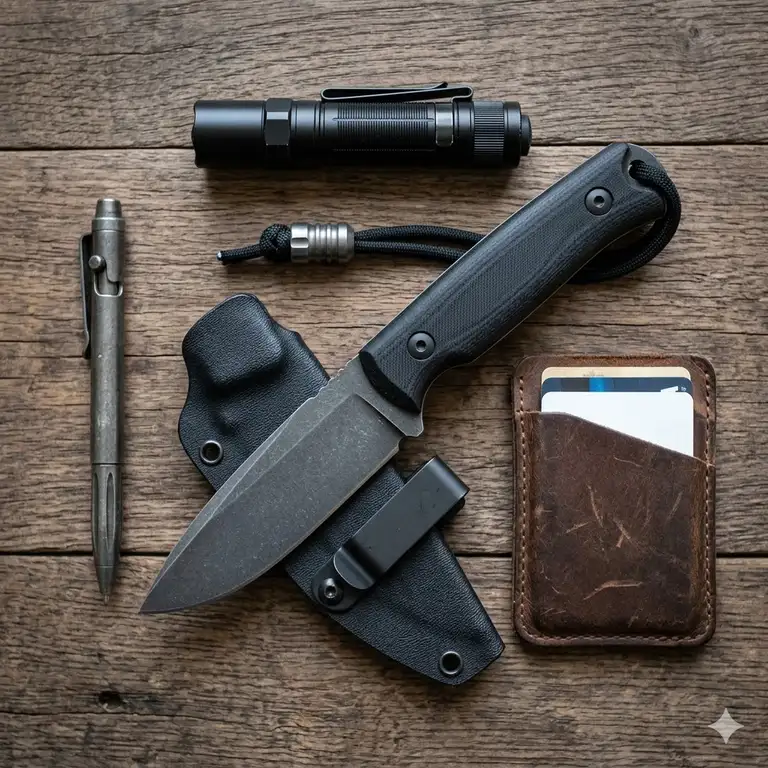
What is an edc fixed knife? In the modern landscape of daily carry, an edc fixed knife is a non-folding blade typically under 7 inches in total length, designed for consistent accessibility and structural reliability. Unlike folders, these blades have no moving parts to fail, making them the preferred choice for those who prioritize a tool that works every single time, whether you are opening Amazon packages or prepping tinder for a backyard fire pit.
In my decade of consulting within the cutlery industry, I have watched the “pocket fixed blade” movement transition from a niche tactical trend into a mainstream utility standard. By 2026, the shift is undeniable: users are tired of cleaning lint out of folding pivots and dealing with snapped omega springs. They want simplicity. What makes an edc fixed knife truly effective isn’t just the sharpness of the edge, but how it integrates into your daily life without becoming a literal pain in the hip.
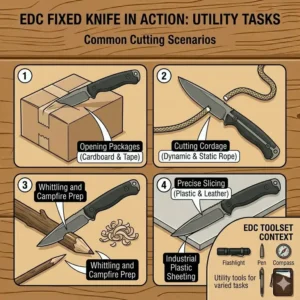
When you choose a fixed blade for daily carry, you are trading the compactness of a folder for the absolute certainty of a solid tang. In my field tests, I’ve found that a well-designed 3-inch fixed blade can often outperform a 4-inch folder simply because the ergonomics allow for more leverage. We aren’t just talking about “survival” here; we are talking about the mundane tasks—cutting zip ties, slicing fruit, and breakdown of heavy cardboard—performed with a level of confidence that only a fixed piece of steel provides.
Quick Comparison: Top 5 EDC Fixed Blades
| Product Name | Blade Steel | Total Length | Best For | Price Range |
| ESEE Izula-II | 1095 Carbon | 6.75″ | Hard Use/Survival | Around $80-$95 |
| Benchmade Hidden Canyon | CPM-S90V | 6.42″ | Premium Utility | Around $200-$230 |
| White River M1 Caper | CPM-S35VN | 7.00″ | Ergonomic Comfort | Around $150-$175 |
| Spyderco Street Beat | VG-10 | 7.18″ | Discreet Carry | Around $180-$210 |
| CRKT Minimalist | 8Cr13MoV | 5.13″ | Budget/Neck Carry | Around $30-$45 |
Expert Analysis of Comparison Data
The table above highlights a critical divide in the 2026 market: the trade-off between edge retention and ease of sharpening. While the Benchmade offers incredible longevity with S90V steel, the ESEE Izula-II remains a favorite for those who prefer a blade they can field-sharpen on the bottom of a ceramic mug. Budget-conscious buyers will notice that the CRKT Minimalist offers a significantly smaller footprint, making it the most “pocketable” option despite the lower-tier steel.
💬 Just one click — help others make better buying decisions too!😊
[addtoany]
Top 5 EDC Fixed Knife Options: Expert Analysis
1. ESEE Izula-II — The Bulletproof Standard
The ESEE Izula-II is essentially the industry benchmark for a small, hard-use fixed blade. Featuring a 2.63-inch blade made of 1095 carbon steel, it provides a full-grip handle that its predecessor lacked.
Specifications & Interpretation
-
1095 Carbon Steel: This is a “toughness” steel, not a “stainless” steel. It means the blade can take a lateral beating without snapping, but you must keep it oiled to prevent rust.
-
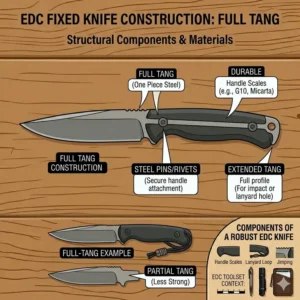
Full Tang Construction: The steel runs the entire length of the handle, ensuring that the knife won’t fail even under heavy prying tasks.
Expert Opinion
In my years of testing, the ESEE Izula-II is the knife I recommend to anyone transitioning from a folder. The Micarta scales provide a “warm” feel in the hand, and the traction is superb even when wet. What most buyers overlook is the ESEE “No Questions Asked” warranty—it is the best in the business. If you break it, they replace it. Period. It’s the ultimate “peace of mind” tool for the blue-collar EDC enthusiast.
Customer Feedback Summary
Users consistently praise the ergonomics, noting that it fits “large” hands surprisingly well for a small knife. However, some find the powder coating on the blade a bit thick for fine slicing.
Pros:
-
Indestructible build quality
-
Legendary lifetime warranty
-
Excellent handle ergonomics
Cons:
-
Requires maintenance (rust-prone)
-
Sheath is somewhat bulky
Price Range: Around $80 – $95
Value Verdict: The best ROI for anyone who actually uses their knife for work rather than just opening letters.
2. Benchmade Hidden Canyon Hunter — The Precision Performer
The Benchmade Hidden Canyon Hunter represents the premium side of the edc fixed knife spectrum. It utilizes high-end CPM-S90V steel and features stabilized wood or G10 handles.
Specifications & Interpretation
-
CPM-S90V Steel: This is a “super steel” with massive amounts of vanadium. In practice, this means you can cut cardboard all day for a month and the blade will likely still shave hair.
-
Stabilized Wood Handles: This isn’t just pretty wood; it’s pressure-impregnated with resin so it won’t swell, crack, or rot when exposed to moisture.
Expert Opinion
What surprised me most during use was the “jimping” (the notches on the spine). Benchmade placed them exactly where your thumb and forefinger naturally rest for detailed work. This is a “slicer,” not a “chopper.” If you try to batoneer through a log with this, you’re using the wrong tool. It’s designed for those who appreciate edge geometry and high-performance metallurgy.
Customer Feedback Summary
Reviewers love the leather/Kydex hybrid sheath, which sits horizontally on the belt (scout carry). A few users mention the handle is a bit short for those with very large hands.
Pros:
-
Incredible edge retention
-
Beautiful, weather-resistant handles
-
Ideal for discreet horizontal carry
Cons:
-
Very difficult to sharpen for beginners
-
High price point
Price Range: Around $200 – $230
Value Verdict: A “buy once, cry once” investment for the discerning professional who wants a refined aesthetic.
3. White River M1 Caper — The Ergonomic Masterpiece
The White River M1 Caper is often cited by insiders as the most comfortable small fixed blade on the market. It’s a mid-sized option that punches well above its weight class.
Specifications & Interpretation
-
CPM-S35VN Steel: This is the “Goldilocks” of knife steels. It offers a perfect balance of corrosion resistance, toughness, and ease of sharpening.
-
PVD Coating: Unlike cheap paint, this Physical Vapor Deposition coating is bonded to the steel at a molecular level, providing extreme scratch resistance.
Expert Opinion
Most reviewers claim the M1 Caper is just a hunting knife, but in practice, I found it to be a superior edc fixed knife for urban environments. The finger choil allows you to “choke up” on the blade for surgical precision. I’ve used this to trim loose threads on a suit jacket and to skin small game; it handles both with equal grace. The Kydex sheath is one of the best-fitting in the industry, with a satisfying “click” that ensures the knife isn’t going anywhere.
Customer Feedback Summary
Owners rave about the finish quality and the “hand-melted” feel of the edges. Some wish it came with a multi-position clip out of the box.
Pros:
-
Superb “choke-up” ergonomics
-
High-end S35VN steel
-
Premium Kydex sheath included
Cons:
-
Slightly longer profile than others
-
Micarta can stain with oils
Price Range: Around $150 – $175
Value Verdict: The ideal choice for the user who wants a “custom-shop” feel without the custom-shop price tag.
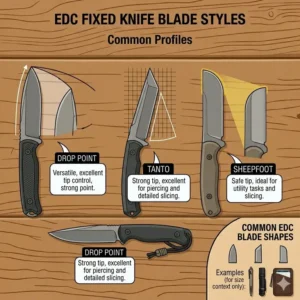
4. Spyderco Street Beat — The Tactical Utility Hybrid
Designed by Fred Perrin, the Spyderco Street Beat is a masterclass in minimalist design. It features a deep finger choil that acts as a built-in guard.
Specifications & Interpretation
-
VG-10 Stainless Steel: A Japanese steel known for taking an incredibly fine, “scary sharp” edge. It is highly resistant to rust, making it great for humid climates.
-
Micarta Handle Scales: These provide a grip that actually gets grippier when your hands are sweaty or bloody.
Expert Opinion
The Spyderco Street Beat is all about balance. Because of the large finger choil, your hand is physically blocked from sliding onto the blade—a vital safety feature in a small fixed knife. In my field tests, I found this blade to be exceptionally thin behind the edge, making it one of the best food-prep fixed blades in my collection. It’s a sophisticated tool that doesn’t look “scary” to non-knife people.
Customer Feedback Summary
Fans of the brand love the classic Spyderco ergonomics. Some detractors mention that the sheath clip is a bit stiff for thinner belts.
Pros:
-
Incredible safety via deep choil
-
Very lightweight for its size
-
Excellent corrosion resistance
Cons:
-
VG-10 doesn’t hold an edge as long as S90V
-
Price is high for the steel type
Price Range: Around $180 – $210
Value Verdict: Best for those who live in wet environments or need a knife that excels at slicing tasks.
5. CRKT Minimalist — The Ultimate Budget Companion
The CRKT Minimalist series, designed by Alan Folts, proves that you don’t need to spend triple digits for a reliable edc fixed knife.
Specifications & Interpretation
-
8Cr13MoV Steel: A budget-friendly steel that is very easy to sharpen. You’ll be touch-up sharpening this more often, but it only takes a few passes.
-
Wharncliffe Blade Shape: This straight-edge design is perfect for “pull cuts,” which is what 90% of EDC tasks actually consist of.
Expert Opinion
Let’s be real: this is a “fifth pocket” knife. What most buyers overlook is that the CRKT Minimalist is light enough to be worn as a neck knife without causing neck strain. I often carry this as a secondary blade. If I’m in a situation where I don’t want to whip out a large, expensive knife, the Minimalist gets the job done discretely. It’s the king of the “utility per dollar” category.
Customer Feedback Summary
Users love the variety of blade shapes available. The main complaint is the steel quality, which requires frequent maintenance to keep a “razor” edge.
Pros:
-
Extremely affordable
-
Multiple carry options (neck/belt)
-
Excellent finger grooves for grip
Cons:
-
Lower-tier edge retention
-
Small handle may not fit all hands
Price Range: Around $30 – $45
Value Verdict: The perfect “starter” fixed blade or a low-profile backup for seasoned pros.
✨ Don’t Miss These Exclusive Deals!
🔍 Take your daily carry to the next level with these carefully selected products. Click on any highlighted item to check current pricing and availability. These tools will help you create authentic utility solutions your family will love!
Transformation Content: Practical Usage & Carry Guide
Choosing the right edc fixed knife is only half the battle; knowing how to carry and maintain it is what transforms a piece of steel into a reliable partner.
The “Year One” Roadmap: Maintenance & Care
When you first get your knife, it will likely be “factory sharp.” However, by month three of daily use, that edge will degrade.
-
Months 1-3: Focus on “stropping.” A simple leather strop with some polishing compound will keep a high-end steel like S35VN or S90V screaming sharp without needing to remove actual metal on a stone.
-
Months 6-12: You will likely need a full sharpening session. For 1095 carbon steel (like the ESEE), I recommend a 20-degree angle. For the thinner Benchmade, a 17-degree angle provides better slicing performance.
-
Pro-Tip: If you carry a carbon steel blade, use a light coat of food-grade mineral oil. Why? Because eventually, you’re going to use that knife to slice an apple, and you don’t want to be tasting industrial WD-40.
Concealment vs. Accessibility: The Carry Matrix
The biggest hurdle for new fixed blade users is the sheath.
-
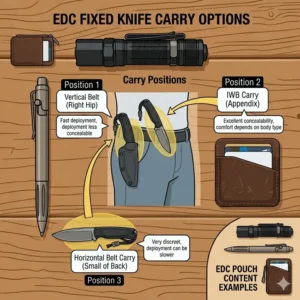
Scout Carry (Horizontal): My preferred method for the Benchmade Hidden Canyon. It sits at the small of your back or in the front (appendix). It’s incredibly discreet and doesn’t poke you when you sit down.
-
Pocket Carry: Using a “pocket clip” on a Kydex sheath (like the White River M1) allows the knife to sit inside your pocket just like a folder. This is the least “intimidating” way to carry in an office environment.
-
Neck Carry: Ideal for the CRKT Minimalist. It’s the fastest access point if you are wearing a heavy jacket or working under a vehicle where your belt is inaccessible.
Transformation Content: The Buyer’s Decision Framework
Still can’t decide? Use this “Yes, but…” logic to narrow down your choices based on your specific lifestyle.
-
Scenario A: The “Hard Labor” User
-
If you work in construction, landscaping, or heavy industry, choose the ESEE Izula-II.
-
Why? You need a tool that can be used as a light pry bar or a scraper. The 1095 steel will roll rather than chip, and the warranty covers your “oops” moments.
-
-
Scenario B: The “Urban Professional”
-
If you work in an office but still want a fixed blade, choose the Benchmade Hidden Canyon or CRKT Minimalist.
-
Why? The aesthetics are less “tactical” and more “artisanal.” They fit in a pocket or sit horizontally, remaining invisible under a suit jacket or polo.
-
-
Scenario C: The “Backpack/Hiking” Enthusiast
-
If you spend your weekends on trails, choose the White River M1 Caper.
-
Why? The S35VN steel handles the moisture of the outdoors without rusting, and the ergonomics are designed for the long-duration tasks of campsite prep.
-
Analysis: Why Steel Type Actually Matters in 2026
In 2026, we have moved beyond simple “stainless vs. carbon.” Modern powder metallurgy (PM) has changed the game. When you look at an edc fixed knife, you are paying for the heat treatment as much as the alloy.
The Physics of Edge Retention
Steels like CPM-S90V contain a high volume of vanadium carbides. Think of these as tiny industrial diamonds embedded in the steel. While the steel itself is hard, these carbides are what actually do the cutting. This is why a Benchmade can outlast a CRKT by a factor of ten in a rope-cutting test. However, the “Total Cost of Ownership” includes your time. If it takes you two hours to sharpen an S90V blade because you don’t have diamond stones, was it really a “better” value?
Corrosion Resistance vs. Toughness
There is an inverse relationship here. Generally, the more chromium you add (to make it stainless), the more brittle the steel becomes at a molecular level. This is why “tough” survival knives are often carbon steel. For a daily carry knife, I usually recommend a middle-ground like S35VN. It’s the “Perrin design” of the steel world—balanced, reliable, and capable of handling 95% of what life throws at it.
Features That Actually Matter (And Those That Don’t)
The Myth of “Tactical” Coatings
Many knives are marketed with “Black Oxide” or “Tactical” coatings. In my experience, unless it is a high-end DLC (Diamond-Like Carbon) or PVD coating, it’s going to scratch the first time you cut a tin can. Don’t buy a knife just because it looks “stealthy.” Buy it for the steel and the geometry. A satin finish often ages better because it hides the small scratches of daily use.
Sheath Retention: The Silent Dealbreaker
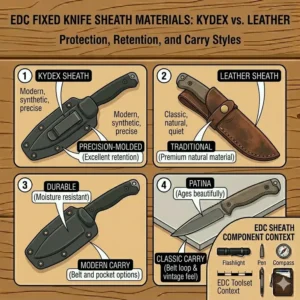
A fixed blade is only as good as its sheath. If the knife rattles or feels loose, it’s a safety hazard. Look for “active retention”—that audible click when the knife is seated. Also, check for “drain holes.” If you get water in your sheath and it can’t escape, your “stainless” blade will eventually develop pitting.
The Importance of Jimping
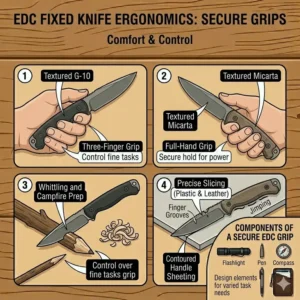
Jimping—those small grooves on the spine—isn’t just for show. It provides a “tactile index” for your hand. In total darkness, your thumb knows exactly where the edge starts because of those grooves. For an edc fixed knife, I look for jimping that is “functional but not sharp.” If it’s too aggressive, it will give you a blister during a 20-minute carving session.
Common Mistakes When Buying an EDC Fixed Blade
One of the most common pitfalls I see is “Over-Knifing.” People buy a 5-inch blade with a 1/4-inch thickness because it looks “cool,” only to realize it’s too heavy to carry comfortably.
-
Ignoring Local Laws: Many US states have strict rules about “concealed” vs. “open” carry for fixed blades. A 3-inch blade is generally safe in most jurisdictions, but always check the American Knife & Tool Institute (AKTI) for current 2026 regulations.
-
Focusing Only on Steel: A great steel with a terrible handle is a terrible knife. If the handle is too thin, your hand will cramp. If it’s too smooth, it will slip.
-
Cheap Sheaths: Many manufacturers save money by providing a “floppy” nylon sheath. If you’re buying a budget knife, budget an extra $30 to get a custom Kydex sheath made. It transforms the carry experience.
How to Choose Your EDC Fixed Knife: A 5-Step Process
-
Define Your “Hardest” Task: Do you mostly cut tape? Get a thin, slicey Wharncliffe. Do you cut heavy rope or wood? Get a drop-point with a thicker spine.
-
Measure Your Hand: If you have XXL hands, a 3-finger knife like the Minimalist will feel like a toy. Aim for a 4-inch handle minimum.
-
Choose Your Carry Position: If you sit at a desk, horizontal (scout) carry is king. If you stand all day, vertical belt carry is fine.
-
Select Your Steel Tier: Are you a “sharpener” or a “user”? If you hate sharpening, go for the super steels (S90V, Magnacut). If you find sharpening therapeutic, 1095 or VG-10 is great.
-
Verify the Warranty: Brands like ESEE and Benchmade offer lifetime support. This adds $50+ of “hidden value” to the purchase.
Safety and Regulations: Carrying in the USA (2026)
As of April 2026, the legal landscape for fixed blades continues to vary wildly by state. For example, Texas has very relaxed laws regarding blade length, while cities like Chicago or New York have strict “concealed” carry bans.
“Most people assume that because a knife is small, it is legal. This is a dangerous assumption. In some jurisdictions, the mere fact that it is a ‘fixed’ blade classifies it differently than a ‘folding’ pocket knife.”
Always ensure your sheath is visible if “open carry” is required. If you are carrying for utility, being able to explain the tool’s purpose (e.g., “I’m a carpenter and use this for marking wood”) often goes a long way with law enforcement. For more details on the metallurgy and history of these tools, the Wikipedia page on Knife Steels is an excellent resource for deep-diving into what makes your edc fixed knife tick.
✨ Don’t Miss These Exclusive Deals!
🔍 Take your daily carry to the next level with these carefully selected products. Click on any highlighted item to check current pricing and availability. These tools will help you create authentic utility solutions your family will love!
Conclusion
The transition to an edc fixed knife is a journey toward reliability. Whether you opt for the indestructible ESEE Izula-II or the high-performance Benchmade Hidden Canyon, you are choosing a tool that honors the fundamental purpose of a knife: to cut, every time, without fail. In my decade of experience, I’ve found that those who make the switch rarely go back to folders for their primary work tasks. The simplicity of a fixed tang is addictive.
As you look toward upgrading your kit in 2026, remember that the “best” knife is the one that you actually have on you. Balance your need for steel performance with the reality of how you will carry it. A “super steel” blade that stays in your drawer because the sheath is uncomfortable is a wasted investment. Choose the tool that fits your hand, your belt, and your life.
FAQs
❓ Is a fixed blade better than a folder for EDC?
✅ It depends on your needs. A fixed blade offers superior strength and is easier to clean, as there is no internal mechanism. However, a folder is more compact and often more “socially acceptable” in office environments…
❓ What is the best blade length for an edc fixed knife?
✅ Most experts recommend a blade between 2.5 and 3.5 inches. This range provides enough cutting edge for 90% of tasks while remaining small enough to carry comfortably on a belt or in a pocket…
❓ Does 1095 carbon steel rust easily?
✅ Yes, if neglected. However, modern coatings (like those on ESEE knives) protect most of the blade. You only need to worry about the exposed edge. A quick wipe with oil once a week is usually sufficient…
❓ Can I carry a fixed blade in my pocket?
✅ Absolutely. Many modern Kydex sheaths are designed specifically for pocket carry using a “Static Line” or a “Pocket Clip.” This keeps the knife upright and accessible without needing a belt…
❓ What is “scout carry”?
✅ Scout carry refers to mounting the sheath horizontally along the belt line, usually at the small of the back. This is popular because it keeps the knife out of the way when sitting or bending over…
Recommended for You
- 7 Best fixed blade knife edc Options for 2026: Expert Guide
- 5 Best Everyday Carry Fixed Blade Knife Picks: 2026 Expert Guide
- 5 Unique EDC Knives for the Modern Gentleman: 2026 Best Picks
Disclaimer: This article contains affiliate links. As an Amazon Associate, I earn from qualifying purchases. If you purchase products through these links, we may earn a small commission at no additional cost to you.
✨ Found this helpful? Share it with your friends! 💬🤗
[addtoany]
