
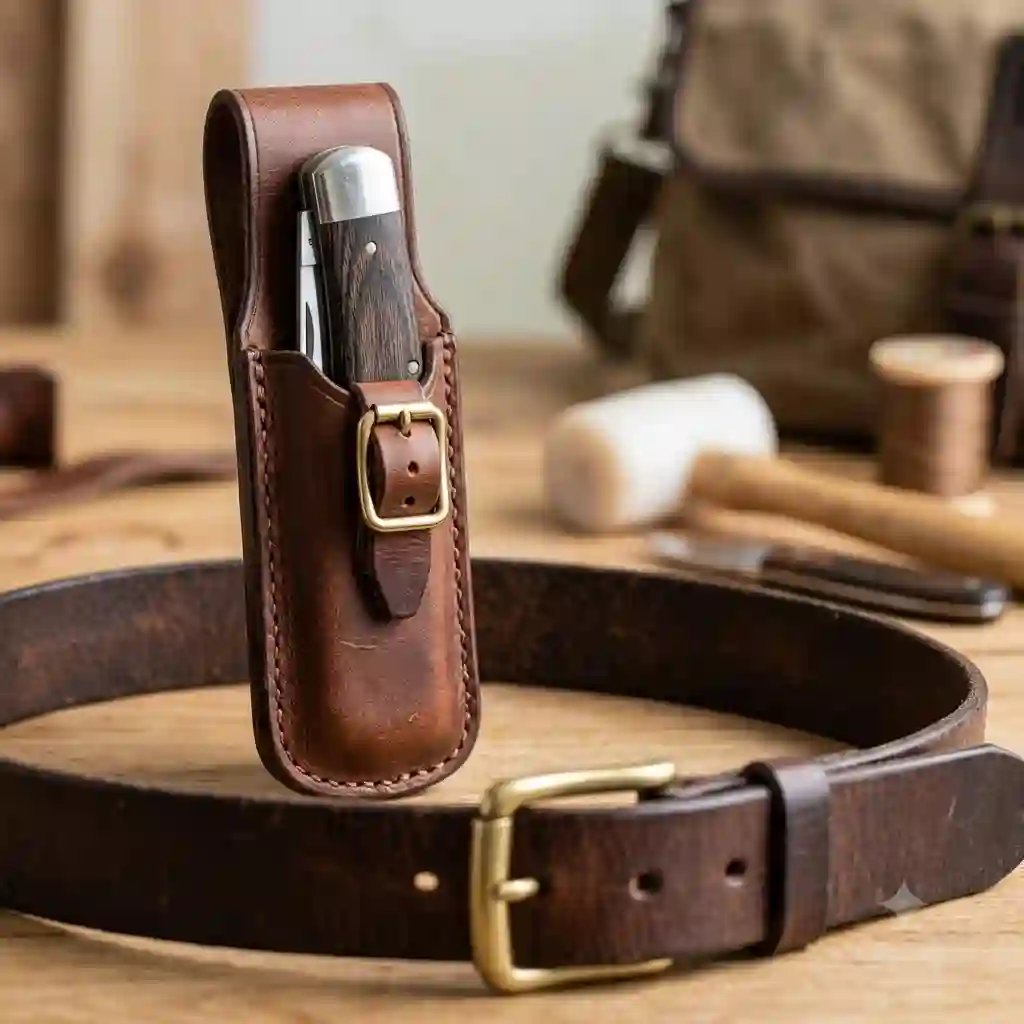
I’ve spent over a decade field-testing everyday carry (EDC) gear across construction sites, backcountry trails, and urban commutes. If there is one catastrophic failure point that consistently ruins a carefully curated setup, it’s a flimsy carry system. You can spend $150 on a premium multitool or custom blade, but if you secure it with a cheap, mass-produced nylon pouch that sags and frays within a week, you’re compromising both accessibility and security.
What most buyers overlook is the biomechanical impact of carry gear. A poorly designed pouch creates localized pressure on your hips and throws off the balance of your belt line. In my field tests, I’ve found that upgrading your carry method doesn’t just protect your tool; it fundamentally transforms how efficiently you operate throughout the day.
What is a belt sheath?
A belt sheath is a specialized, rigid or semi-rigid holster designed to secure knives, multitools, or flashlights to a wearer’s waistline. Typically crafted from leather, Kydex, or heavy-duty nylon, it provides quick, one-handed access while protecting the tool from environmental damage and preventing accidental loss during high-movement activities.
Whether you are navigating strict workplace safety compliance or simply want a reliable way to organize your pockets, finding the right carry solution requires looking past the manufacturer’s spec sheet. Let’s dive into the gear that actually survives the daily grind.
Quick Comparison: Top Carry Systems Tested
| Product Model | Primary Material | Retention Type | Best For | Price Range |
| Tale of Knives Standard Push Up | Full-Grain Leather | Friction Fit | Premium EDC Organization | $70 – $95 |
| Leatherman Ainsworth | Vegetable-Tanned Leather | Snap Closure | Heavy-Duty Tradesmen | $50 – $70 |
| Clip & Carry Multitool | Kydex | Adjustable Tension | Tactical / High-Moisture | $30 – $45 |
| Hide & Drink Rustic Case | Suede/Leather Blend | Friction Fit | Budget-Conscious Buyers | Under $25 |
| Nite Ize Clip Pock-Its XL | Ballistic Nylon | Hook-and-Loop | Multi-Tool Utility | Under $20 |
Looking at the comparison above, the Tale of Knives delivers the absolute best long-term value for dedicated EDC enthusiasts who want custom molding, but if high-moisture environments are your priority, the Kydex construction of the Clip & Carry justifies prioritizing polymers over leather. Budget buyers should note that while the Nite Ize sacrifices aesthetic aging, it offers unbeatable compartment versatility for the price point.
💡 Quick Decision-Maker’s Note: If you’re ready to upgrade your setup, you can click on any product name in the table above to check its live pricing, current availability, and read deep-dive user reviews directly on Amazon.
[addtoany]
Top 5 Belt Sheaths: Expert Field Analysis
1. Tale of Knives Standard Multitool Push Up
When you first unbox this rig, the stiffness of the 1095-grade full-grain leather is immediately apparent. The spec sheet boasts “American-made leather,” but in practical terms, this means the leather fibers are tightly packed and haven’t been sanded down or artificially smoothed. This translates to an incredibly rigid initial friction fit that literally locks your tool in place. The integrated “push-up” hole at the bottom is a masterful touch; instead of digging your fingernails into the top of your tool, you simply press up with your index finger for lightning-fast deployment.
In my everyday use, I’ve found this rig to be the undisputed king for the modern professional. It sits exceptionally tight to the body, completely eliminating the annoying “flop” you get with standard dangler pouches. However, you absolutely must pair this with a rigid EDC belt (at least 1.5 inches wide). If you try to run this on a flimsy department-store dress belt, the sheer weight of the leather and your tool will cause uncomfortable sagging by noon.
The community feedback heavily praises the patina development, noting that after six months, the leather molds perfectly to the exact dimensions of your specific tool. At the $70 to $95 range, it’s an investment, but considering you’d run through three cheap alternatives in the time it takes to break this one in, the long-term ROI is phenomenal.
-
Best For: EDC purists and professionals who want silent deployment and aesthetic aging.
-
✅ Pros: Unmatched durability, beautiful patina, silent friction retention.
-
❌ Cons: Stiff break-in period, requires a heavy-duty belt.
2. Leatherman Ainsworth Leather Sheath
Most OEM (Original Equipment Manufacturer) pouches are afterthoughts, but the Ainsworth is a massive departure from the norm. Built from premium vegetable-tanned leather, it relies on a custom snap closure rather than friction. The vegetable tanning process—which you can read about in depth via traditional leathercraft university studies—leaves the leather highly responsive to natural oils and conditioning. This means that instead of cracking under UV exposure, the material actually gains structural integrity and flexibility over time when properly maintained.
From a practical standpoint, this is the tradesman’s dream. The heavy-duty snap closure provides an audible, tactile confirmation that your gear is locked down. When you’re climbing scaffolding or crawling under a truck, friction fit alone doesn’t always inspire confidence; you want that mechanical lock. What surprised me most during use was how well the brass hardware held up to repeated saltwater exposure without seizing or oxidizing.
Reviews consistently highlight the peace of mind the snap brings, though some note it adds a microsecond to deployment speed compared to open-top models. Sitting in the $50 to $70 range, it hits the sweet spot for premium quality without custom-maker wait times.
-
Best For: Construction workers, mechanics, and anyone doing highly active physical labor.
-
✅ Pros: Positive mechanical retention, excellent weather resistance, thick stitching.
-
❌ Cons: Snap adds bulk, slightly slower access speed.
3. Clip & Carry Kydex Multitool Sheath
Moving away from traditional materials, this rig brings tactical engineering to the civilian market. Formed from .08-inch Kydex, it uses adjustable Chicago screws to dial in the exact retention pressure you desire. This specification is crucial: unlike leather, which loosens over time, you can micro-adjust this Kydex rig using a simple Phillips head screwdriver. If you’re going for a run, tighten it down; if you’re lounging at a campsite, back it off for smoother deployment.
I strictly reserve this setup for high-moisture environments—kayaking, deep woods hiking, or working out in the rain. Leather absorbs sweat and can rust your high-carbon steel tools if not cared for, but Kydex is completely hydrophobic. The heavy-duty nylon belt clip is aggressive; it bites into your belt securely but can occasionally snag on car seat upholstery if you aren’t paying attention when sitting down.
Actual user feedback raves about the precise “click” you feel when re-holstering, though a few users find the rigid edges less comfortable against bare skin than leather. In the $30 to $45 range, it’s a hyper-functional, maintenance-free powerhouse.
-
Best For: Kayakers, hikers, tactical users, and those living in humid climates.
-
✅ Pros: Impervious to moisture, adjustable retention, audible lock-in.
-
❌ Cons: Can scratch tool finishes over time, rigid edges lack comfort.
4. Hide & Drink Rustic Leather Multitool Case
If you need a belt sheath but are constrained by a strict budget, this rustic option punches far above its weight class. Made from a blend of full-grain leather and heavy-duty suede, it’s stitched with fire-resistant thread. The softer nature of this leather means there is virtually zero break-in time. Right out of the packaging, it comfortably accepts a wide variety of tools, making it incredibly versatile if you frequently rotate what you carry.
However, you must temper your expectations regarding long-term structural retention. Because the leather is softer and more pliable, it will eventually stretch. In my experience, it’s perfect for weekend warriors or casual DIYers, but if you draw and holster your tool 40 times a day on a job site, it will lose its grip after about eight months. The single-loop design on the back also allows for a bit more sliding along the waistline than I typically prefer.
Community sentiment is overwhelmingly positive regarding the aesthetic and initial value, often praising the unique, raw look. Hovering neatly under $25, it’s the perfect entry-level option or backup rig.
-
Best For: Weekend hobbyists, casual carriers, and budget-conscious buyers.
-
✅ Pros: Instant comfort, accommodates multiple tool sizes, great rustic look.
-
❌ Cons: Loses shape over heavy use, slides slightly on thinner belts.
5. Nite Ize Clip Pock-Its XL
When utility trumps aesthetics entirely, this ballistic nylon organizer is the undisputed champion. The core specification here is the multi-compartment design utilizing heavy-duty elastic and a weather-resistant hook-and-loop (Velcro) flap. This translates to an incredible carrying capacity: you can simultaneously carry a multitool, a tactical flashlight, a tactical pen, and spare batteries without any metal-on-metal clanking.
In field testing, this is my go-to “throw and go” solution for camping and vehicle maintenance. The rugged plastic J-clip on the back is a standout feature because it allows you to attach and remove the rig without unthreading your belt. However, the Velcro closure is loud. If you need stealth (say, while hunting), the aggressive ripping sound of opening this pouch will give away your position instantly.
Reviewers consistently praise its cavernous capacity, though many point out that it is quite bulky under an untucked shirt. Priced under $20, it’s practically a steal for the sheer amount of organizational power it provides.
-
Best For: Campers, technicians, and those who need to carry multiple items simultaneously.
-
✅ Pros: Massive storage capacity, easy-on clip, extremely durable nylon.
-
❌ Cons: Very bulky, hook-and-loop closure is noisy.
🔍 Ready to Upgrade Your EDC Setup?
Whether you’re trying to streamline your pocket clutter or need rugged reliability that won’t fail on a job site, finding the right carry system changes everything. Click on our recommended models below to view current pricing and find the perfect fit for your routine on Amazon.
The First 30 Days: Breaking In Your New Carry
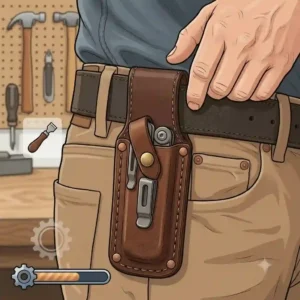
Amazon product descriptions never tell you what happens the moment you take your new gear out of the box. A premium leather belt sheath arrives stiff—sometimes so stiff you’ll think you bought the wrong size. This is a feature, not a bug.
The Setup and Break-in Ritual:
For friction-fit leather rigs, never force a dry tool into a dry sheath if it feels dangerously tight. Instead, wrap your multitool or knife tightly in one layer of wax paper or a thin plastic grocery bag. Push the wrapped tool into the sheath and leave it sitting at room temperature for 48 hours. The slight added thickness of the plastic forces the leather fibers to stretch precisely a fraction of a millimeter wider than the tool itself. When you remove the plastic, you’ll have a buttery smooth, custom-molded fit that retains tension.
The First Month Maintenance:
Avoid the temptation to slather a new leather rig in cheap boot oil. Over-conditioning breaks down the structural integrity of the welted seams, turning a rigid piece of gear into a floppy, useless sock. For the first 30 days, do nothing but wear it. Let the natural heat of your body and the micro-abrasions of daily movement shape the material. If you opted for a Kydex model, your day-one task is to apply a single drop of medium-strength blue thread locker (like Loctite) to the retention screws. The vibration of walking will slowly back those screws out, and you don’t want to lose a piece of hardware in tall grass.
Edge Cases: When Perfect Gear Fails (Problem & Solution Guide)
Even a top-tier product can become a liability if deployed in the wrong context. Let’s address the anti-recommendations and the most common failure points I see in the field.
Problem 1: The “Belt Sag” Syndrome
-
The Issue: You bought a heavy-duty leather rig, loaded it with a 10-ounce multitool, and now your pants sag on one side, causing lower back pain by the end of the shift.
-
The Solution: The sheath isn’t the problem; your foundation is. Standard fashion belts lack vertical rigidity. You must upgrade to an EDC-specific belt reinforced with a polymer core or dual-layer webbing. If you refuse to change your belt, switch from a heavy leather rig to a lightweight Kydex or Nylon model to shave off static weight.
Problem 2: The “Sweat Out” Rust
-
The Issue: Carrying a carbon steel tool in a leather pouch during peak summer heat or heavy physical labor results in surface rust on your expensive gear. Leather absorbs and holds body sweat against the metal.
-
The Solution: If you are a heavy sweater or work in a humid climate, leather is a bad fit for you. Switch immediately to a Kydex system like the Clip & Carry. If you absolutely insist on leather, you must coat your tool weekly with a dry-film rust inhibitor (like EDCi or FrogLube) and apply a beeswax-based waterproofer to the interior of the leather.
Problem 3: The “Seatbelt Snag”
-
The Issue: Getting in and out of a truck repeatedly causes the bottom of the pouch to snag on the seatbelt or upholstery, eventually tearing the belt loops.
-
The Solution: Stop using vertical drops. Look for a rig with a “cant angle” (usually 45 degrees) or a horizontal carry orientation. This drastically reduces the vertical profile of your gear, allowing it to slide smoothly past obstructions when sitting down.
How to Choose a Belt Sheath: The Insider’s Framework
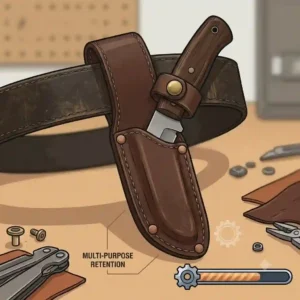
When evaluating options, you need a decision matrix that goes beyond aesthetics. According to communities like EverydayCarry.com, the specific mechanics of your carry style dictate your gear choices. Here is the framework I use when consulting clients:
-
Assess Your Retention Needs First: Do you work at heights or ride a motorcycle? If yes, you require positive mechanical retention (a snap, flap, or hard Kydex click). Friction-fit leather is beautiful, but a hard jolt can dislodge a heavy tool, creating a dangerous drop hazard.
-
Evaluate Your Belt Real Estate: How much space do you actually have? If you already carry a phone, a radio, or a firearm, a massive multi-tool organizer is going to cause hip fatigue. Opt for a slim, open-top design that minimizes footprint.
-
Determine Your Deployment Speed: If you need your tool in a fraction of a second with one hand (e.g., emergency responders cutting seatbelts), avoid hook-and-loop flaps. Open-top push-up designs or precisely tuned Kydex are mandatory here.
-
Check the Belt Loop Tolerance: Always check the maximum belt width supported by the rig. Trying to cram a 1.75-inch rigger’s belt through a 1.5-inch leather loop will warp the material and ruin the stitching over time.
Leather vs Kydex vs Nylon: The Real-World Verdict
The spec sheet won’t tell you this, but material science dictates 90% of your user experience. Don’t just pick what looks cool; pick what aligns with your biomechanics and environment.
Full-Grain Leather:
This is the gold standard for office environments, casual carry, and aesthetic appreciation. It breathes, molds to your body, and creates a silent draw. However, it requires a “Year One” maintenance cycle. After six months of use, the natural oils deplete. You must saddle-soap it to remove dirt, then re-condition it. Verdict: Best for the traditionalist who doesn’t mind mild maintenance.
Kydex (Thermoformed Plastic):
Kydex is violently efficient. It doesn’t care about rain, sweat, or mud. You can literally wash it in the sink with dish soap. The rigid nature means it never collapses, allowing for incredibly easy one-handed re-holstering. The downside? It lacks “give.” If you lean against a hard surface, a Kydex rig will aggressively dig into your hip. Verdict: Best for tactical users, first responders, and outdoor survivalists.
Ballistic Nylon:
Originally developed for flak jackets, high-denier nylon is cheap, lightweight, and tear-resistant. It flexes easily with the body. However, nylon pouches usually rely on Velcro or plastic buckles, which degrade over time. Furthermore, over months of heavy use, the internal lining frays, and the structural integrity breaks down, leading to the dreaded “flop.” Verdict: Best for budget carry, tool storage, and non-daily use.
Long-Term Cost & Maintenance: The Year One Roadmap
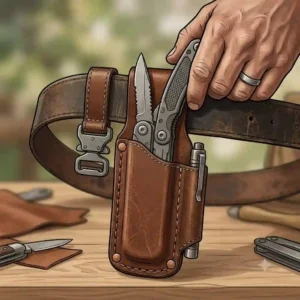
What is the true total cost of ownership for a belt sheath? The purchase price is just the entry fee. Let’s look at the “Efficiency Gap” over twelve months.
If you buy a $15 generic nylon pouch, the initial cost is low. However, by month four, the Velcro stops sticking. By month six, a hole wears through the bottom from the friction of your tool’s pliers. You buy another one. Over two years, you’ve spent $60 and dealt with constant frustration.
Conversely, investing $75 in a premium full-grain leather rig requires a different mindset.
-
Month 1-3: Break-in period. The tool fits tightly.
-
Month 6: The leather has formed a custom patina. You spend $10 on a tin of high-quality leather balm. You apply a light coat.
-
Month 12: The rig looks better than the day you bought it, the stitching (if welted properly) is fully intact, and it functions flawlessly.
The hidden cost of cheap gear is the cognitive load of constantly worrying if your $180 multitool is going to fall into the dirt. Invest in your carry system as if it were an insurance policy for your primary tools.
Common Mistakes When Buying a Carry System
Even seasoned veterans make critical errors when switching up their EDC loadout. Here are the pitfalls to avoid:
-
Ignoring the Cant Angle: Buying a straight-drop vertical rig for a massive 5-inch tool. When you sit down, the bottom of the tool hits your thigh, pushing the entire rig up into your ribs. Always look for a 45-degree cant if you spend a lot of time driving or sitting at a desk.
-
Mismatched Weight Distribution: Putting a tiny, 2-ounce Swiss Army Knife into a massive, heavy-duty leather rig. The carry system should never weigh more than the tool it holds.
-
Assuming “Genuine Leather” is Good: This is a marketing trick. “Genuine leather” is actually the lowest usable grade of leather, essentially glued-together scraps. It will peel and tear within months. Always look for “Full-Grain” or “Top-Grain” on the spec sheet.
epted. However, bulky, tactical nylon pouches may violate strict corporate dress codes. Always check your specific HR guidelines regarding visible tools…
Final Thoughts on Securing Your Gear
Your everyday carry is only as reliable as the system holding it to your body. Upgrading to a purpose-built belt sheath removes the friction from your daily tasks, protects your expensive tools, and eliminates the dreaded pocket bulge that ruins your mobility.
Remember, there is no single perfect option—only the perfect option for your specific environment. If you are working construction, lean toward the mechanical retention of a snap-closure leather rig. If you’re managing property in the sweltering heat, lock down a Kydex system. Respect the break-in period, maintain your materials, and your gear will take care of you when you need it most.
FAQs
❓ What is the best material for a belt sheath?
✅ Full-grain leather offers the best balance of comfort, durability, and silent operation for everyday use. However, Kydex is superior for high-moisture environments, and ballistic nylon is best for carrying multiple items on a strict budget…
❓ How do I stop my belt sheath from sliding around?
✅ Ensure your belt width matches the loop width perfectly. A 1.5-inch belt in a 2-inch loop will always slide. Alternatively, look for models with heavy-duty metal clips that aggressively bite into the belt fabric to lock it in place…
❓ Can a belt sheath scratch my knife or multitool?
✅ Leather and nylon will not scratch metal finishes. However, Kydex can cause micro-abrasions over time as dust and grit get trapped inside the hard plastic shell. Wiping down the interior of a Kydex rig regularly prevents this…
❓ How tight should a friction-fit sheath be?
✅ It should be tight enough that you can turn the rig upside down and shake it without the tool falling out. If it requires two hands and immense force to extract the tool, it needs to be broken in further…
❓ Does wearing a belt sheath violate workplace dress codes?
✅ Generally, slim, dark leather models blend in seamlessly with professional attire and are acc
Recommended for You
- Gerber Leather Sheath: 7 Best Rugged Cases for Your Gear in 2026
- Leather Sheath Guide: 5 Best Field-Tested Options for 2026
- Top 5 Best Multitool Sheath Picks: 2026 Ultimate Survival Guide
Disclaimer: This article contains affiliate links. As an Amazon Associate, I earn from qualifying purchases. If you purchase products through these links, we may earn a small commission at no additional cost to you.
✨ Found this guide helpful? Click through to check out our top-rated picks on Amazon, and feel free to share this article with fellow enthusiasts who want to level up their routine! 💬🤗
[addtoany]
