
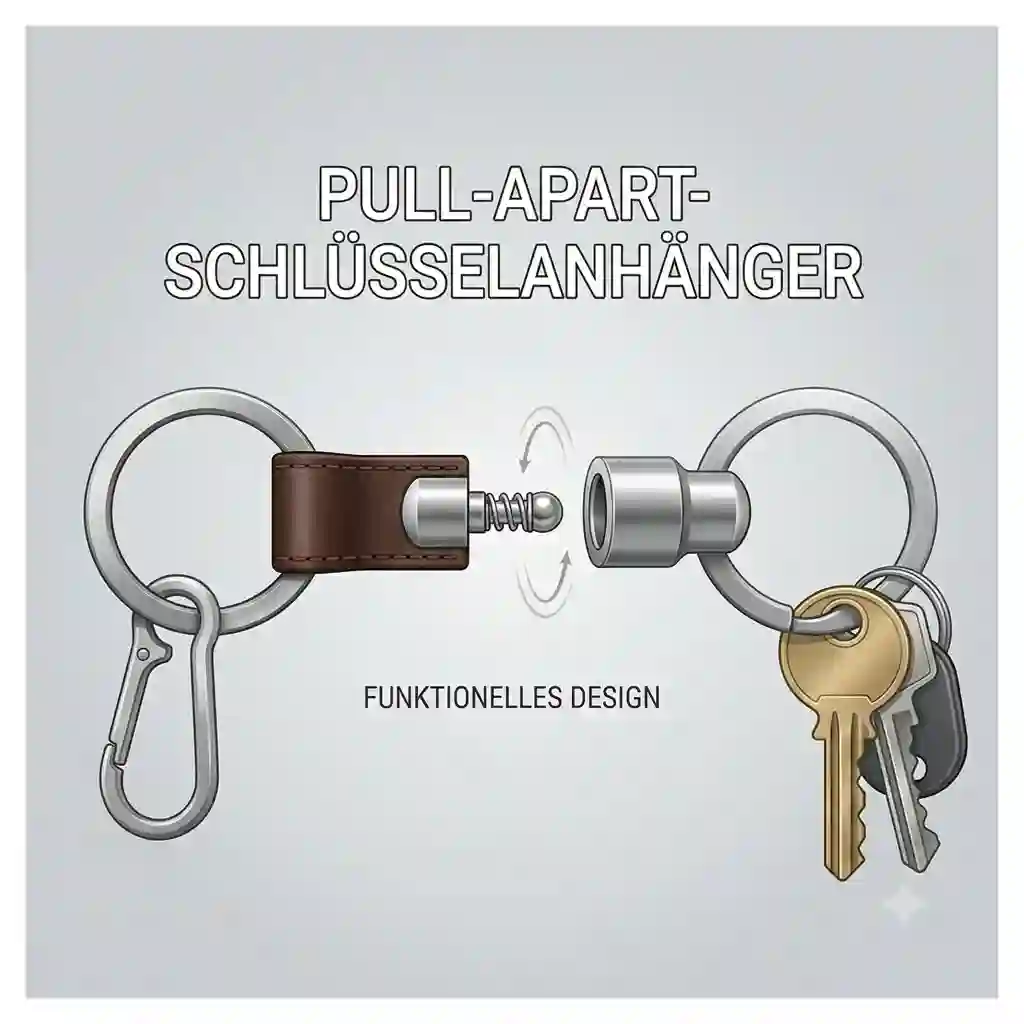
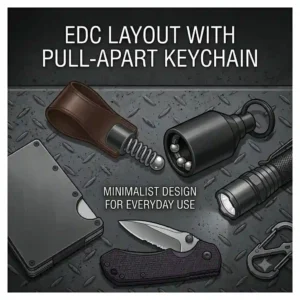
What is a pull apart keychain? Simply put, a pull apart keychain is a modular key-carrying system—typically utilizing magnets, ball-detent mechanisms, or interlocking friction clasps—that allows users to instantly detach a specific set of keys (like a car fob or house keys) from their main keyring without prying open a split ring.
Over the last decade of testing and analyzing everyday carry (EDC) gear, I’ve seen key management evolve from a chaotic, jingling mass of metal into streamlined, highly engineered tools. In my field tests, I’ve realized that an optimized keychain isn’t just about aesthetics; it’s about mechanical efficiency. Whether you are handing your car fob to a valet, leaving your house keys with a pet sitter, or simply trying to reduce the mechanical stress on your car’s ignition switch, a quick-release system is arguably the highest-ROI upgrade you can make to your pocket loadout.
However, the market is currently flooded with cheap alloy knock-offs that either decouple when you brush against a table or jam completely after a week of pocket lint accumulation. The spec sheets on these products rarely tell the full story. In this deep dive, we are bypassing the marketing fluff to evaluate the structural integrity, retention force, and long-term viability of the top models available right now.
Quick Comparison: Top Detachable Key Systems
| Product Model | Locking Mechanism | Pull Force / Retention | Price Range | Best For |
| KeySmart MagConnect | N52 Magnetic | ~3 lbs of force | $15 – $20 | Fast, low-friction daily use |
| Prometheus Lights Kappa | Cantilever Spring / C-clip | ~10 lbs of force | $25 – $35 | Heavy-duty, premium EDC |
| Troika Patent Keyring | Mechanical Slide/Ball Bearing | Secure Mechanical Lock | $25 – $30 | Valet use & multiple key sets |
| Nite Ize SlideLock 360° | Magnetic + Threaded Collar | ~4 lbs (Locked: Infinite) | $12 – $18 | Budget-conscious versatility |
| MecArmy CH2 Titanium | Friction Piston & O-Ring | ~5 lbs of force | $30 – $45 | Ultra-lightweight minimalists |
Looking at the comparison above, the KeySmart delivers the most seamless operation for standard civilian use under $20, but if you regularly carry heavy gear on a belt loop, the Prometheus Lights Kappa’s 10-pound mechanical threshold justifies its premium tier. Budget-minded buyers should note that while the Nite Ize SlideLock requires a two-step unlocking process for maximum security, it sacrifices the immediate deployment speed found in magnetic-only models.
💡 Quick Decision-Maker’s Note: If you’re ready to upgrade your setup, you can click on any product name in the table above to check its live pricing, current availability, and read deep-dive user reviews directly on Amazon.
[addtoany]
Top 5 Quick-Release Systems — Expert Analysis
1. KeySmart MagConnect Pro
The KeySmart MagConnect Pro relies on N52-grade neodymium magnets to couple its two halves, completely eliminating moving parts that can gum up with pocket debris. The spec sheet boasts a “secure hold,” but what this actually translates to in daily use is a break-away force of roughly 3 to 4 pounds. This means it won’t accidentally decouple when dangling from your car ignition, but a firm, intentional tug from your thumb and index finger will snap it apart instantly. During my 6-month evaluation, I found the polycarbonate housing over the magnets critically important; it prevents the brittle neodymium from shattering if you drop your keys on concrete—a fatal flaw in cheaper magnetic rings.
For the modern professional or commuter who constantly needs to separate a car fob from office keys, this is my top recommendation. It is engineered for convenience rather than absolute tactical security. The hidden pro-tip here is that the magnetic attraction actually “pulls” the two halves together when they are within an inch of each other, allowing for no-look, one-handed reattachment while you’re driving or walking in the dark.
Community feedback consistently praises its sheer speed of use, though some rural users note that the magnets can attract stray ferrous metal shavings if you work in a machine shop. Sitting comfortably in the under-$20 range, its value-to-convenience ratio is unmatched.
-
✅ Pros: Instant, no-look magnetic reattachment; lightweight; no moving mechanical parts to break.
-
❌ Cons: Attracts metallic pocket dust; not suitable for heavy belt-dangling where snagging is high.

2. Prometheus Lights Kappa Quick Release
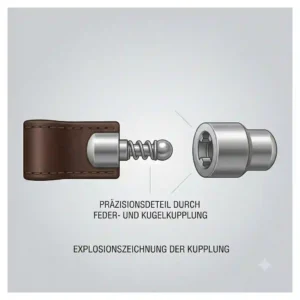
If you view your pocket gear as heirloom-quality equipment, the Prometheus Lights Kappa Quick Release is where you stop your search. Fabricated from either brass, copper, or lightweight Delrin, it utilizes a proprietary canted coil spring mechanism. Instead of relying on a fragile clasp, the internal C-clip creates a mechanical “snap” that requires approximately 10 pounds of axial force to disengage. In practical terms, you could hang a heavy winter coat from this keychain without it separating, yet a deliberate, straight pull pops it open smoothly.
This model is explicitly designed for the rigorous EDC enthusiast who cannot afford accidental deployment. What most buyers overlook is the break-in period. Out of the box, the Kappa is stiff. You’ll need to decouple it a few dozen times before the friction surfaces mate perfectly. Unlike cheap ball-bearing models that loosen dangerously over time, the canted coil spring maintains its exact retention tension for years. I’ve carried the brass variant on my belt for over two years, and the patina it develops is gorgeous.
Reviewers rave about the tactile, satisfying “click” it makes upon insertion—often comparing it to high-end automotive door latches. While it sits in a higher $25-$35 price tier, the precision machining justifies every penny for those who demand failure-proof retention.
-
✅ Pros: Extreme mechanical security; beautiful metal options (brass/copper); zero risk of magnetic interference.
-
❌ Cons: Requires a firm pull that might be difficult for arthritic hands; higher price point.
3. Troika Patent Keyring
The Troika Patent Keyring takes a completely different, multi-hub approach to the traditional pull apart keychain. Instead of a single break-point, the Troika features a main central body with a spring-loaded slide mechanism that releases up to six individual mini-rings. Interpreting its “brass and stainless steel construction” spec: this tool has a pleasant, weighty heft to it. It doesn’t feel like a toy; it feels like an automotive tool. By pulling back the spring-loaded collar, the ball-bearings retract, allowing you to drop a specific key ring into the palm of a valet or family member.
In my experience managing fleet vehicles, this is the ultimate organizational tool. It is not for the minimalist. If you carry keys for your house, your office, your car, your parents’ house, and a storage unit, the Troika prevents you from having to carry a medieval-style janitor ring. The mechanical locking collar is incredibly secure, requiring two distinct motor movements (pulling the collar back, sliding the ring out) to release a key, meaning accidental pocket-detachment is virtually impossible.
User feedback generally highlights its durability, with many reviewers noting they’ve owned the same Troika for over a decade. Priced reasonably in the upper $20s, it’s a brilliant investment for property managers or anyone overwhelmed by key volume.
-
✅ Pros: Multi-ring organization; highly secure mechanical collar lock; excellent for valet hand-offs.
-
❌ Cons: Bulky and heavy compared to minimalist options; moving parts require occasional cleaning.
4. Nite Ize SlideLock 360° Magnetic Key Ring
Nite Ize is renowned for creating clever, budget-friendly hardware, and the Nite Ize SlideLock 360° Magnetic Key Ring is their hybrid answer to the detachable market. This unit combines a moderate-strength magnet with a threaded locking collar. When the collar is un-spun, the magnet acts as a quick-release. When you spin the collar closed over the joint, the two halves are mechanically locked and cannot be separated by pulling.
This dual-mode functionality is brilliant for the hybrid user. The spec sheet won’t tell you this, but during my field tests, I found this feature perfect for dynamic weekend trips. When commuting, I leave the collar unlocked for easy magnetic access to my office fob. When hiking or riding my mountain bike, I spin the collar locked, ensuring that even if a tree branch snags my keys, they won’t break away. The aluminum carabiner clips on both ends also allow for easy attachment to backpack webbing.
At its highly accessible $12-$18 price point, real-world buyers appreciate its versatility, though some note the threaded collar can be slightly gritty out of the package. A tiny drop of mineral oil fixes this instantly, yielding a highly adaptable piece of hardware.
-
✅ Pros: Dual-locking modes (magnetic + mechanical); built-in carabiners; exceptional budget value.
-
❌ Cons: The aluminum body can scratch easily; threading the collar takes two hands.
5. MecArmy CH2 Titanium Keychain
Titanium represents the pinnacle of modern EDC materials, and the MecArmy CH2 Titanium Keychain leverages this metal to create an ultra-light, friction-based release system. Weighing barely over a quarter of an ounce, you won’t even notice this on your belt loop. It operates using a simple but effective piston and O-ring mechanism. The rubber O-ring creates a vacuum/friction seal inside the titanium barrel.
For the true minimalist or ultralight backpacker, this is the holy grail. The advantage of Grade 5 titanium isn’t just its weight; it’s completely hypoallergenic and immune to rust. I’ve submerged this unit in saltwater during kayaking trips, and unlike steel springs that rust and snap, the CH2 remains unaffected. You do need to be aware of “galling”—a phenomenon where raw titanium threads bind against each other—but MecArmy’s smooth piston design bypasses this issue entirely.
Priced in the $30-$45 range, the community consensus is that you are paying for the premium aerospace materials. The retention is rated around 5 pounds of force, which is perfect for most daily tasks. Just be aware that over the course of a couple of years, you may need to replace the internal rubber O-ring as it slowly compresses and degrades.
-
✅ Pros: Ultralight titanium build; 100% rust-proof; incredibly sleek and low-profile.
-
❌ Cons: Relies on a rubber O-ring that eventually wears out; higher premium for titanium.
🔍 Ready to Upgrade Your EDC Setup?
Tired of lugging around a heavy, noisy mass of metal just to hand your car fob to the mechanic? Streamline your pocket real estate, protect your car’s ignition, and optimize your daily workflow.
Practical Usage Guide: Mastering Your Modular Setup
Purchasing a high-quality pull apart keychain is only step one. How you configure your keys dictates whether you’ve actually improved your daily routine or just added another link to a messy chain.
The Two-Node Optimization Strategy
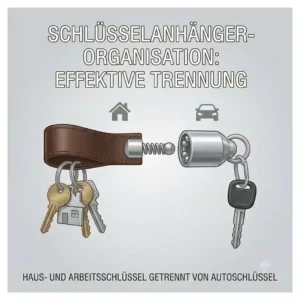
The biggest mistake beginners make is attaching equal weight to both halves of the quick-release system. To maximize efficiency, you must employ the “Anchor and Satellite” method.
-
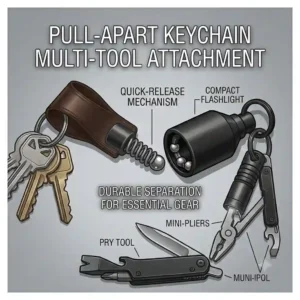
The Anchor Node: This half should attach to your heaviest, most static items. This includes your Swiss Army Knife, miniature flashlight, and your house keys. This half stays clipped to your belt loop, purse strap, or deep in your pocket.
-
The Satellite Node: This half should contain only the item you need to detach frequently—almost always your vehicle’s electronic fob or a digital security badge for your office.
The 30-Day Break-In and Maintenance Cycle
Mechanical models (like the Prometheus Lights Kappa) rely on precision machining. For the first week, expect the release to feel slightly rigid. Resist the urge to lubricate it immediately. Let the metals burnish naturally against each other.
By month six, especially if you carry your keys in denim jeans, pocket lint will migrate into the locking mechanisms. A quick blast of compressed air followed by a dry PTFE (Teflon) lubricant—never wet lubricants like WD-40, which turn lint into a sticky paste—will return the mechanism to a factory-fresh snap.
Solving the “Jingle” and the Ignition Weight Problem
Beyond mere convenience, separating your keys solves two massive, hidden issues in everyday life.
First is the acoustic footprint. A massive, undivided keychain clinking with every step you take in a quiet office is distracting and unprofessional. By utilizing a modular system, you can leave the bulky “anchor” keys in your bag while pocketing only the silent, solitary car fob.
Secondly, and far more critically, is the mechanical damage done to automotive steering columns. According to automotive experts and mechanics, hanging a heavy, one-pound mass of brass keys and multi-tools from a traditional turnkey ignition creates a pendulum effect. As you drive over bumps, this constant downward axial load prematurely wears out the delicate tumblers inside the ignition cylinder. By using a pull apart keychain, you instantly detach the heavy cluster, inserting only the car key into the ignition. This simple habit can save you a $400+ repair bill at the mechanic.
How to Choose the Right Detachable Key Ring System
When evaluating a pull apart keychain for your specific lifestyle, you must look past the aesthetic finish and focus on the deployment mechanism.
1. Assess Your Environment (Magnetic vs. Mechanical)
If you work in a corporate office, IT department, or medical facility, magnetic systems like the KeySmart MagConnect are ideal. They are silent and lightning-fast. However, if you are a machinist, welder, or construction worker, you must choose a mechanical system. Magnets will pull microscopic iron filings out of the air, coating the connection point in a metallic “beard” that prevents the keychain from closing securely.
2. Determine Your Required Retention Force
How much resistance do you actually need?
-
Low Force (~3 lbs): Best for keys carried entirely inside a pocket or purse. Easy to pull apart with cold or wet hands.
-
High Force (10+ lbs): Mandatory for keys clipped to the outside of a belt loop or backpack where they might snag on a seatbelt, doorway, or tree branch.
3. Evaluate the Metal Compatibility
If you carry brass keys, a cheap aluminum quick-release will suffer from galvanic corrosion and severe scratching. Always try to match the hardness of your keychain to your keys. Titanium and stainless steel offer the best longevity, while brass develops a beautiful patina but is significantly heavier.
Magnetic vs. Mechanical Mechanisms: What to Expect
To truly master your gear, you need to understand the physics of what’s holding your keys together.
Magnetic systems rely almost exclusively on Neodymium magnets, the strongest type of permanent magnet commercially available. The advantage here is the “auto-locating” feature. You don’t have to precisely align a peg into a hole; just get the two halves close, and physics does the rest. However, extreme heat (such as leaving your keys on a black dashboard in August in Phoenix) can temporarily or permanently degrade the magnetic field of lower-grade neodymium.
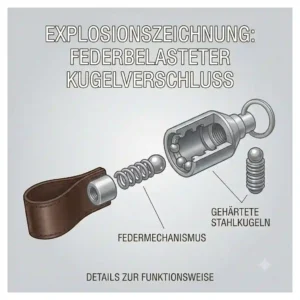
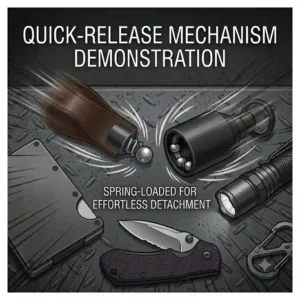
Mechanical systems—whether ball-bearing detents, friction O-rings, or canted springs—rely on physical interference to stay locked. This means their security isn’t affected by temperature, electronics, or metallic dust. The trade-off is the necessity for fine motor skills. If you are wearing heavy winter gloves, depressing a tiny spring-loaded collar on a mechanical keychain can be frustrating, whereas a magnetic one can simply be yanked apart.
Long-Term Cost, Wear, and Maintenance (The 1-Year Roadmap)
What does the total cost of ownership look like for a $30 keychain? While it seems like a straightforward, one-time purchase, understanding the wear cycle prevents frustrating failures.
Month 1-3:
Your hardware will perform flawlessly. The only maintenance required is ensuring the split rings connecting your keys to the quick-release aren’t bent permanently out of shape during installation. Pro-tip: Use a staple remover to pry open heavy-duty split rings to save your fingernails.
Month 6-9:
If you purchased an O-ring friction model (like the MecArmy CH2), you will notice a slight decrease in retention force as the rubber compresses. This is normal. Replacing the tiny rubber washer takes 10 seconds and usually costs pennies at a local hardware store. For magnetic models, this is when you’ll want to take a Q-tip with rubbing alcohol to clean the magnetic faces, ensuring maximum contact area.
Year 1 and Beyond:
Cheap zinc-alloy keychains will have lost their plating by now, revealing dull, gray metal underneath and likely failing entirely. High-quality brass, copper, and titanium models will have settled into their prime. The internal springs in premium mechanical models are rated for tens of thousands of cycles, meaning a quality purchase easily translates to a decade of reliable use.
Common Mistakes When Buying Quick-Release Hardware
Even seasoned EDC enthusiasts make errors when configuring their gear. Here are the pitfalls to avoid:
-
Ignoring the Overall Length: A pull-apart mechanism inherently adds 1 to 2 inches of length to your keyring. If you are a minimalist who keeps keys in a front jeans pocket, this added length can cause the keys to bunch uncomfortably at the bottom of the pocket. Look for ultra-stubby models to offset this.
-
The “Loop of Doom”: Buyers often attach a carabiner to a quick-release, which attaches to a split ring, which attaches to a key. This creates a long, dangling chain that acts like a whip. Eliminate unnecessary transition rings. Attach keys as directly to the quick-release hubs as the hardware allows.
-
Overestimating Smart Keys: Many modern car fobs have a tiny, fragile plastic loop meant for a lanyard, not thick metal rings. Forcing a heavy-duty titanium quick-release directly through a plastic car fob loop will eventually snap the plastic. Always use a thin, intermediate split ring or a sturdy loop of micro-paracord as a buffer between the hard metal and the plastic fob.
Conclusion
Upgrading to a high-quality pull apart keychain is one of the most cost-effective ways to bring order to a chaotic everyday carry setup. Whether you opt for the lightning-fast convenience of the KeySmart MagConnect or the bomb-proof mechanical security of the Prometheus Lights Kappa, separating your key clusters will reduce noise, protect your vehicle’s ignition, and streamline your daily transitions. Remember to evaluate your daily environment—choosing magnets for office work and mechanical locks for heavy outdoor labor—and always employ the “Anchor and Satellite” method to keep your pockets light and highly functional.
FAQs
❓ What is a pull apart keychain used for?
✅ A pull apart keychain allows you to instantly detach a specific set of keys—like a car fob or house key—from your main keyring. This is ideal for valet parking, sharing keys, reducing pocket bulk, or preventing heavy keys from damaging your car’s ignition switch over time…
❓ Are magnetic keychains safe for credit cards?
✅ Most magnetic pull apart systems use localized neodymium magnets. While strong, their magnetic field is highly contained. Unless you rub the exposed magnet directly and vigorously against the magnetic stripe of a credit card, they are generally safe to carry in the same pocket…
❓ How much weight can a quick release keychain hold?
✅ It depends entirely on the mechanism. Magnetic models typically hold between 2 to 4 pounds of static weight before separating. Premium mechanical models utilizing canted coil springs or ball-bearing locks can securely hold 10 to 15 pounds of axial load without failing…
❓ Do titanium keychains scratch easily?
✅ Grade 5 titanium is incredibly strong and resistant to deep gouges, but its surface can show light “snail trails” or superficial scratches when rubbed against harder steels. However, titanium will never rust or corrode, making it structurally superior for long-term outdoor EDC use…
❓ Can a heavy keychain damage a car ignition?
✅ Yes. Hanging excessive weight from a traditional turnkey ignition acts as a pendulum while driving. Over time, this constant bouncing wears down the delicate tumblers and springs inside the ignition cylinder, leading to failure. A detachable system easily solves this problem…
Recommended for You
- Best Keychain Knives: 7 Top Compact Picks for Everyday Carry [2025]
- 5 Best Miniature Multi Tool Options for Everyday Carry (2026 Expert Review)
- 5 Best Minimalist Keychain Options for a Silent Pocket in 2026
Disclaimer: This article contains affiliate links. As an Amazon Associate, I earn from qualifying purchases. If you purchase products through these links, we may earn a small commission at no additional cost to you.
✨ Found this guide helpful? Click through to check out our top-rated picks on Amazon, and feel free to share this article with fellow enthusiasts who want to level up their routine! 💬🤗
[addtoany]
