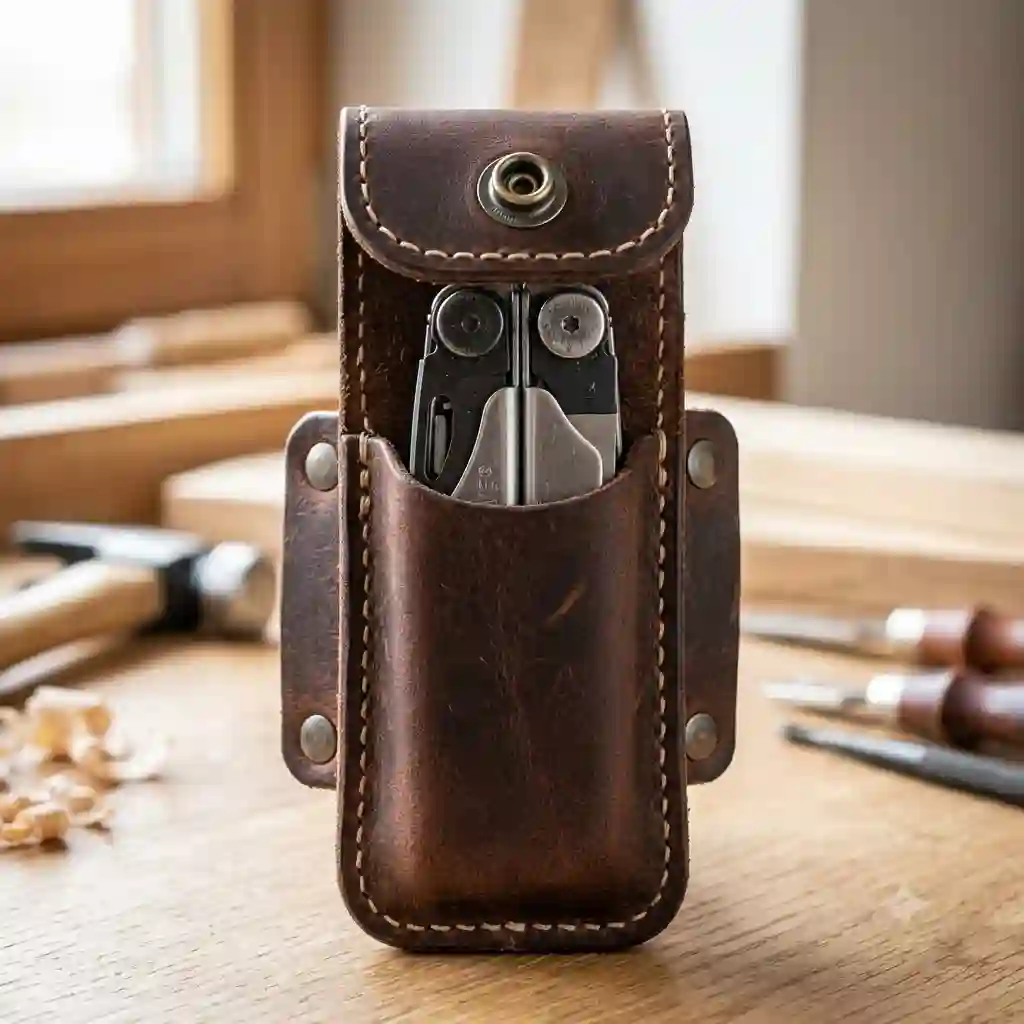
What is a multi tool sheath leather? At its core, it is a specialized, molded organic housing designed to securely carry, protect, and provide rapid access to your everyday carry tools directly from your belt. But after spending over a decade testing everyday carry (EDC) gear on construction sites, wilderness trails, and in urban environments, I can tell you it’s much more than just a storage pouch.
Most people invest over a hundred dollars in a premium Leatherman or Gerber, only to shove it in a pocket where it scratches their phone screen, or worse, they rely on the cheap nylon pouch that came in the box. Those factory nylon pouches typically blow out at the seams within six months. Upgrading to a premium multi tool sheath leather is about workflow optimization and ergonomic comfort. A properly crafted full-grain holster distributes the weight of a 9-ounce tool seamlessly across your beltline, keeping it out of your pockets while ensuring it’s accessible through pure muscle memory in under a second.
In my field tests, what surprised me most wasn’t just the aesthetic upgrade, but the functional longevity. A high-quality hide actually adapts to the exact microscopic contours of your specific tool, creating a friction-fit retention that mechanical clips simply cannot replicate. Let’s dive into the models that actually survive real-world abuse and leave the marketing fluff behind.
Quick Comparison: Top Daily Carry Contenders
Before we get into the granular details of thread counts and hide tanning processes, here is a high-level overview of the models that have survived my rigorous long-term testing.
| Brand & Model | Best For | Material Focus | Retention Type | Est. Price Range |
| Tale of Knives Standard Push Up | Professional Trades | Full-Grain Steerhide | Friction + Push Hole | $40 – $60 |
| Hide & Drink Belt Pouch | Budget Buyers | Full-Grain Guatemalan | Flap + Brass Snap | $15 – $25 |
| Leatherman Premium Heritage | Brand Purists | Vegetable Tanned | Flap + Snap | $20 – $35 |
| Easyant EDC Organizer | Tech/Flashlight Users | Genuine Cowhide | Friction Fit | $20 – $30 |
| Viperade PJ13 Leather | Tactical Utility | Top-Grain Leather | Friction Fit | $25 – $40 |
Looking at the comparison above, the Tale of Knives delivers the absolute best value in the $40-$60 range for sheer durability, but if budget is your priority, the Hide & Drink model justifies its lower price point with surprisingly robust full-grain material. Buyers should note that open-top friction fit models like the Easyant sacrifice total weather enclosure for much faster deployment speed, which is a trade-off you must evaluate based on your daily environment.
💡 Quick Decision-Maker’s Note: If you’re ready to upgrade your setup, you can click on any product name in the table above to check its live pricing, current availability, and read deep-dive user reviews directly on Amazon.
[addtoany]
Top 5 Field-Tested Organizers — Expert Analysis
When evaluating a multi tool sheath leather, I don’t just look at the stitching; I look at how it bears weight after 200 hours of active movement. Here are the top performers.
1. Tale of Knives Standard Push Up Belt Sheath
The Tale of Knives Standard Push Up features 100% full-grain US steerhide and heavy-duty nylon thread stitching, boasting a specialized “push-up” hole at the bottom. This isn’t just an aesthetic choice; in practice, it means you can deploy a tightly fit tool instantly by pushing up with your index finger, even if you’re wearing thick winter gloves. The 1.5-inch belt loop loops are cut directly into the main body, ensuring the sheath pulls tight against your hip to eliminate the annoying “flop” you get with cheaper riveted loops.
In my experience running this model for over eight months on home renovation sites, it is the undisputed king for tradesmen. The friction retention is aggressively tight on day one—almost annoyingly so—but this is a massive hidden pro. After a two-week break-in period, it molds to your specific tool like a Kydex shell, completely eliminating the need for a mechanical closure flap that can break or wear out. It is absolutely not for someone who wants to easily swap different-sized tools daily, as the leather memorizes the shape of one specific tool.
Community feedback consistently praises its heirloom-quality durability, often noting that it outlasts the tools placed inside it. Positioned in the $40 to $60 range, it sits squarely in the premium tier, but when calculating the cost-per-use, its structural integrity makes it far cheaper than buying three inferior replacements over the same multi-year timeline.
-
Pros: Incredible friction retention, low profile, built in the USA.
-
Cons: Brutal break-in period, premium price tag.
2. Hide & Drink Leather Multitool Belt Pouch
Boasting thick full-grain Guatemalan hide and a heavy-duty brass snap closure, the Hide & Drink Belt Pouch relies on a classic flap design. The brass hardware translates practically to reliable security; if you are crawling under cars or navigating dense brush, the mechanical snap ensures gravity and branches won’t dislodge your gear. Its standard belt loop accommodates up to 2-inch work belts, making it highly versatile for heavy-duty riggers.
What most buyers overlook about this model is the rustic, almost unfinished nature of the interior. While it looks gorgeous on the outside, the fleshy side of the interior can leave slight leather dust on your tool during the first few weeks of use. I found this to be a minor nuisance rather than a dealbreaker. It’s perfect for the weekend warrior or the budget-conscious camper who wants the durability of full-grain material without the boutique price tag, though I’d avoid it if you need lightning-fast deployment, as the snap does require a distinct two-step opening motion.
Selling consistently in the $15-$25 range, this model defies the typical “you get what you pay for” adage. Reviewers on Amazon rave about the thickness of the material, though a few note that the brass snap can tarnish if exposed to heavy salt water. It represents the best raw material value on the market today.
-
Pros: Unbeatable price for full-grain, extremely secure flap, 100-year warranty.
-
Cons: Slower deployment, initial shedding of leather dust.
3. Leatherman Premium Heritage Sheath
Direct from the manufacturer, the Leatherman Premium Heritage utilizes vegetable-tanned leather, heavy-duty stitching, and a custom-stamped foil logo. The vegetable tanning process is crucial here; it means the hide is more rigid and holds its box-like shape remarkably well, allowing you to re-holster the tool blindly with one hand because the mouth of the pouch doesn’t collapse.
As an industry consultant, I usually warn against OEM accessories, but this is a rare exception. In my field tests, I found the custom sizing to be the real draw. If you buy the 4.25-inch model for a Leatherman Wave+, the tolerances are absolutely flawless with zero interior rattling. However, the belt loop is a standard stitched-on vertical loop, which protrudes further off the hip than a pancake-style sheath. It’s ideal for the brand purist or the office worker who carries casually, but a bad fit for someone wearing a heavy tool belt, as it can snag on tight doorways.
Sitting securely in the $20 to $35 range, it’s a solid mid-tier investment. Actual customer reviews heavily favor its refined, professional aesthetic, making it acceptable for business-casual environments. It provides exactly what you expect: reliable, tailored performance for specific Leatherman models.
-
Pros: Perfect dimensional tolerances, rigid shape for easy re-holstering, professional look.
-
Cons: Sticks out further from the belt, stitched loop can stretch over time.
4. Easyant Leather EDC Pocket Organizer
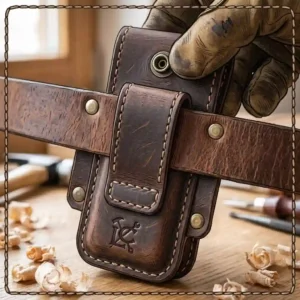
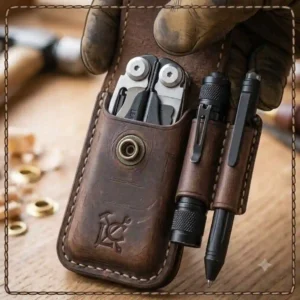
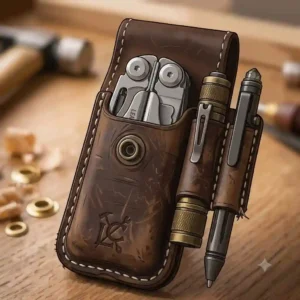
The Easyant EDC Organizer takes a different approach by using genuine cowhide stitched into a wider, multi-chamber pancake footprint. It includes slots for a multitool, a tactical flashlight, and a tactical pen, complete with an attached key fob. This horizontal spread interprets perfectly into weight distribution; instead of one heavy lump on your belt, the weight of three EDC items is spread across five inches of your waistline, significantly reducing lower back fatigue during long shifts.
I highly recommend this for the “preparedness” crowd—IT professionals, security personnel, or flashlight enthusiasts. However, the spec sheet won’t tell you this: because it holds multiple items, the overall footprint is massive. If you have a waist size under 32 inches, this organizer will take up nearly your entire front quadrant, which can impede bending over. Furthermore, “genuine leather” is a lower grade than full-grain, meaning it lacks the self-healing properties of top-tier hides, so it will show scratches more prominently.
Usually priced in the highly accessible $20-$30 range, it offers tremendous utility for the cost. Reviewers frequently highlight how it eliminated their pocket clutter entirely, though long-term users note the pen loop can lose elasticity after a year of heavy use.
-
Pros: Eliminates pocket clutter entirely, excellent weight distribution, high utility.
-
Cons: Massive physical footprint, uses lower-grade leather.
5. Viperade PJ13 Leather Sheath
The Viperade PJ13 is constructed from thick top-grain leather featuring slanted quick-access slots and reinforced riveted stress points. The angled orientation of the tool slot is an ergonomic game-changer; by canting the tool forward at a 45-degree angle, it aligns perfectly with the natural arc of your hand when you reach for your belt, shaving fractions of a second off deployment time and reducing wrist strain.
During my testing on off-grid camping trips, the Viperade proved itself as a tactical powerhouse. It sits incredibly flat against the body, making it ideal for concealed carry underneath an untucked t-shirt. The top-grain material strikes a brilliant balance—it is softer and requires less break-in than full-grain, but remains remarkably tough. My only gripe in practice is that the slanted design can sometimes push taller tools up into your ribs when sitting in deep car seats, making it a less-than-ideal choice for long-haul truck drivers.
Hovering in the $25-$40 range, this is the sweet spot for modern EDC enthusiasts. The Amazon community rates it highly for its low-profile concealability. If you want tactical efficiency wrapped in a traditional material, the PJ13 is a phenomenal daily driver.
-
Pros: Ergonomic angled draw, very low profile, zero moving parts to break.
-
Cons: Can poke the ribs when seated, angled draw takes getting used to.
🔍 Ready to Upgrade Your EDC Setup?
Finding the exact balance of durability and comfort is crucial for keeping your pockets empty and your workflow smooth. Click on our recommended models above to view current pricing and find the perfect fit for your daily routine on Amazon.
The First 30 Days: Breaking In Your Gear
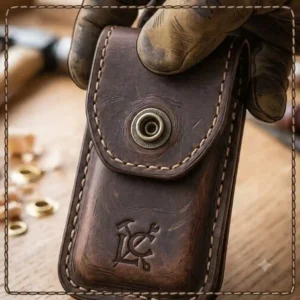
If you purchase a high-quality multi tool sheath leather, the worst mistake you can make is returning it on day two because it feels “too tight.” Premium full-grain leather is essentially a natural polymer; it must be trained. Here is the insider roadmap to breaking in your holster without ruining its structural integrity.
When your gear arrives, do not immediately force the tool into the pouch dry. Instead, wrap your multitool tightly in a single layer of wax paper (wax side out) and force it into the sheath. The wax provides just enough lubrication to seat the tool deep into the pocket, while the paper adds a fraction of a millimeter of girth. Leave it sitting on your desk for 48 to 72 hours.
When you remove the wrapped tool, the leather will have stretched just enough to accommodate the bare tool perfectly. Avoid the common myth of soaking the leather in water to stretch it; while this works for boots, it will ruin the edge burnishing and potentially rust the rivets on an EDC organizer. If you maintain this friction fit, you’ll never have to worry about your gear falling out during a dead sprint.
Real-World Scenarios: Finding Your Perfect Match
A perfect product can easily become a terrible purchase if placed in the wrong environment. Let’s look at three specific user profiles to ensure you aren’t fighting your gear.
The Urban Commuter: If you are navigating subways and office buildings, bulky flap-closures scream “construction worker.” You need stealth. The Viperade PJ13 is the ideal choice here. Because it sits flat and utilizes an angled draw, it vanishes under a suit jacket or a simple polo shirt.
The Heavy-Duty Tradesman: For electricians and mechanics who spend half the day crawling on their backs or climbing ladders, gravity is your enemy. You cannot rely on friction fit alone when inverted. The Hide & Drink Belt Pouch with its heavy brass snap is mandatory here. Yes, it takes an extra second to open, but losing a $150 tool in a drop-ceiling because you bent over too far is a much worse outcome.
The Weekend Hobbyist: If you only carry your gear on Saturday hiking trips or weekend garage projects, you likely don’t want to endure a month-long break-in period. The Leatherman Premium Heritage offers the best out-of-the-box readiness. The vegetable-tanned rigidity means it works perfectly on day one, holding exactly what you need without a fuss.
Solving the “Belt Sag” Dilemma
The most common problem buyers face after upgrading to a belt-mounted system is asymmetrical belt sag. A 9-ounce tool plus a 3-ounce sheath puts nearly a pound of localized weight on one side of your hip, leading to lower back pain and constant pants-pulling.
The solution isn’t just tightening your belt; it’s upgrading the foundation. Standard department-store dress belts are made of thin bonded leather that twists and rolls under localized weight. If you are carrying daily, you must pair your sheath with a reinforced EDC belt—ideally one with an internal Kydex core or double-layered webbing.
Furthermore, placement is key. Don’t place the holster directly on your hip bone (the 3 o’clock position). Instead, slide it slightly forward to the 2 o’clock position or backward to the 4 o’clock position. This places the weight over the softer musculature of your waist, allowing the sheath to pivot naturally when you sit, rather than grinding into your pelvis.
How to Choose Your Daily Holster
When evaluating whether a specific model fits your lifestyle, you need a decision framework that cuts through marketing jargon. Here is how I evaluate gear:
-
Assess Your Tool’s Dimensions: Don’t just guess. Measure the length, width, and thickness of your closed tool. A thick tool like a Leatherman Surge will instantly blow out the seams of a sheath designed for a slimmer Gerber Dime.
-
Evaluate Your Belt Width: Most standard sheaths feature 1.5-inch slots. If you wear a 1.75-inch tactical rigger’s belt, a standard pancake sheath will simply not thread on. Always check loop tolerances.
-
Determine Your Access Frequency: Ask yourself: “How many times a day do I need this?” If it’s more than five times, avoid anything with snaps, buckles, or zippers. Friction-fit open tops will save you vast amounts of time and frustration.
Common Mistakes When Upgrading
In my field consulting, I see buyers make the same three errors repeatedly when transitioning to belt-carry systems. The first is ignoring the “sweat factor.” Leather is porous. If you work in a high-humidity environment and sweat heavily, that moisture transfers through the sheath directly onto your tool, promoting rust on high-carbon steel blades.
The second mistake is over-conditioning. People buy a multi tool sheath leather and immediately drown it in Mink oil or Neatsfoot oil. While these are great for boots, they soften the leather. In a friction-fit holster, softening the material ruins the retention, causing your tool to fall out.
Finally, buyers often ignore the threading. A sheath is only as strong as its weakest stitch. Look for nylon or Kevlar threading. Cotton threading, often found on ultra-cheap imports, will rot away in less than a year of UV and moisture exposure, causing the entire rig to delaminate.
Traditional Materials vs Modern Synthetics
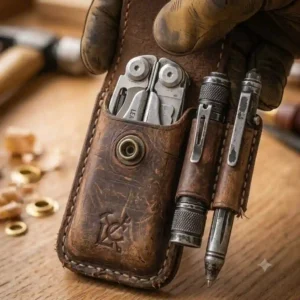
The debate between a multi tool sheath leather and a modern Kydex or Ballistic Nylon rig is a tale as old as time. Synthetics like Kydex are entirely waterproof and offer an audible “click” when the tool is seated. However, Kydex is completely rigid. When you sit in a car, Kydex jams into your ribs or car seat, whereas leather gracefully yields and flexes with your body.
Ballistic nylon (Cordura) is incredibly lightweight and cheap, making it a favorite for budget-conscious buyers. But nylon relies on Velcro (hook and loop) closures. Over time, Velcro accumulates lint, dirt, and pet hair, eventually failing to close securely. Furthermore, tearing open Velcro in a quiet office environment is incredibly disruptive. Leather offers a silent draw, molds specifically to your body’s contours over time, and develops a patina that looks better at year five than it did on day one.
According to historical texts on Leathercrafting, the cellular structure of animal hide naturally breathes, allowing micro-abrasives and moisture to eventually wick away, something hard plastics cannot do.
Long-Term Cost & Maintenance Cycle
Understanding the total cost of ownership is vital. A $15 nylon pouch seems cheap, but if you replace it annually, you’ve spent $75 over five years, not including the frustration of a broken rig. A $50 premium hide sheath is a one-time purchase if maintained correctly.
The maintenance cycle for a daily-worn holster should be minimalist.
-
Quarterly (Every 3 months): Wipe the exterior down with a slightly damp cloth to remove abrasive grit. Apply a very light, pea-sized coat of beeswax-based balm (like Sno-Seal) to the exterior only. This restores moisture without compromising rigidity.
-
Annually: Check the structural integrity of the belt loops. If rivets are present, ensure they haven’t oxidized. If the interior friction-fit has become too loose over time, you can often “shrink” it slightly by applying localized heat with a hairdryer and molding it tightly around the tool again.
Features That Actually Matter
When parsing through Amazon descriptions, it is easy to be blinded by marketing terms. Here is how to filter the noise:
-
Saddle Stitching vs. Machine Lockstitching: Marketing will push lockstitching because it’s fast for factories. But true saddle stitching (usually only found on premium handmade gear) is vastly superior. If one thread breaks in a lockstitch, the whole seam unravels. In a saddle stitch, a broken thread will not compromise the rest of the seam.
-
Burnished Edges: If a listing mentions “burnished and slicked edges,” pay attention. This means the maker took the time to seal the exposed edges of the cut leather with friction and wax. Unburnished edges will fray, absorb water, and eventually rot.
-
RFID Blocking: Ignore this entirely. Some modern EDC organizers advertise RFID blocking. Unless you are carrying credit cards in your tool sheath (which you shouldn’t be), this is useless tactical fluff designed to inflate the price.
The Final Verdict
Navigating the world of everyday carry accessories doesn’t have to be an exercise in trial and error. The upgrade from a flimsy pocket clip or a tearing nylon pouch to a proper multi tool sheath leather is one of the highest ROI investments you can make for your daily workflow.
By understanding the distinct advantages of friction-fit steerhide versus secure-snap Guatemalan leather, you can tailor your gear precisely to your environment. Remember that patience is key; allow your new rig the time it needs to break in and adapt to your body. Whether you prioritize the tactical efficiency of the Viperade or the heirloom ruggedness of the Tale of Knives, elevating your foundation will protect your expensive tools and save your lower back from the dreaded pocket-drag.
FAQs
❓ What is a multi tool sheath leather?
✅ It is a dedicated, belt-mounted carrying pouch crafted from animal hide, designed specifically to hold, protect, and provide rapid access to folding multitools, often molding perfectly to the tool’s shape over time…
❓ How long does it take to break in a full grain holster?
✅ Typically 14 to 30 days of continuous wear. You can expedite the process by wrapping your tool in wax paper and leaving it seated in the tight pouch for 48 hours to gently stretch the fibers…
❓ Can a multi tool sheath leather get wet?
✅ Yes, but it should not be submerged. If exposed to heavy rain, allow it to air-dry naturally at room temperature. Never use a heater, as forced heat will cause the hide to crack and shrink…
❓ Which is better: snap closures or open-top friction fit?
✅ Friction fit is faster and quieter, ideal for tradesmen and daily access. Snap closures provide ultimate security, essential for hikers, climbers, or anyone working in inverted or highly active environments…
❓ How do I fix a sheath that has become too loose?
✅ If the leather has stretched too much, you can lightly dampen the interior, insert the tool, and use a hairdryer on medium heat. The heat and evaporation cause the fibers to gently contract around the tool…
Recommended for You
- Top 5 Best Multitool Sheath Picks: 2026 Ultimate Survival Guide
- 5 Best Custom Multi Tool Options in 2026: An Expert’s Honest Review
- 5 Insanely Durable Belt Sheath Picks for EDC Domination (2026)
Disclaimer: This article contains affiliate links. As an Amazon Associate, I earn from qualifying purchases. If you purchase products through these links, we may earn a small commission at no additional cost to you.
✨ Found this guide helpful? Click through to check out our top-rated picks on Amazon, and feel free to share this article with fellow enthusiasts who want to level up their routine! 💬🤗
[addtoany]
