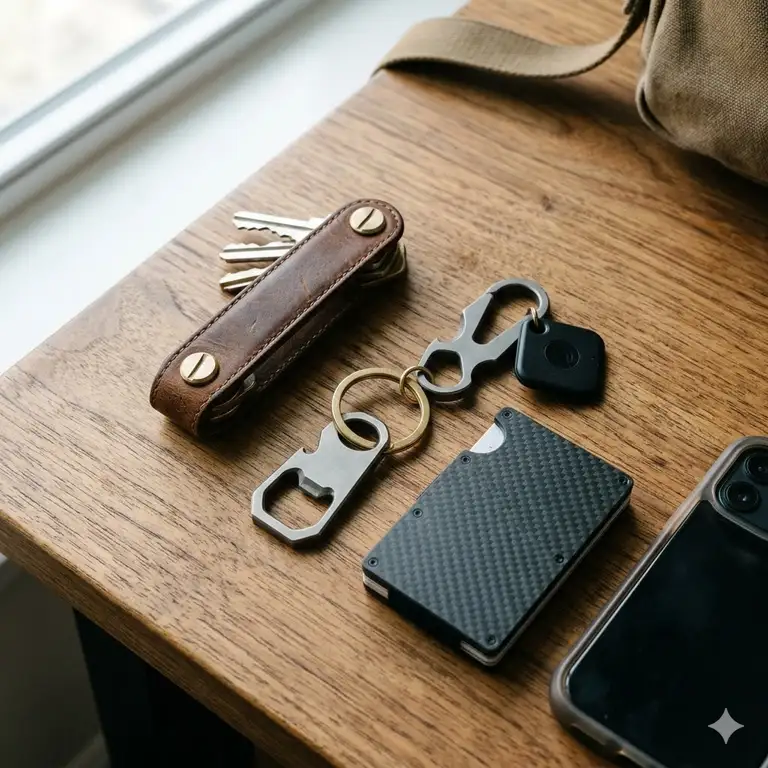
If you are wondering what key accessories actually are, they encompass a wide range of everyday carry (EDC) tools designed to organize, silence, track, and secure your personal keys. Ranging from simple leather wraps to advanced Bluetooth-enabled smart trackers, these tools transform a chaotic, noisy metal bundle into a streamlined, highly functional piece of modern gear.
In my ten years as an everyday carry (EDC) consultant and gear tester, I’ve seen countless fads come and go. I remember the days when a heavy brass carabiner was the only respectable way to carry your house keys. Today, the landscape is entirely different. We are no longer just looking to hold metal shards together; we want ergonomic comfort, digital security, and modularity. What most reviewers claim is that any cheap ring will do the job. But in practice, I found that the microscopic abrasions caused by a cheap keyring rubbing against your $1,200 smartphone screen in your pocket is the real issue.
You need gear that actually works with your lifestyle, not against it. In this comprehensive guide, we are going to dive deep into the best key accessories available today, dissecting the engineering behind them, and explaining exactly how they perform when exposed to the grit and grind of daily life.
Quick Comparison of Top Contenders
| Product | Core Material | Best For | Standout Feature | Est. Price Tier |
| KeySmart Max | Polycarbonate / Aluminum | Tech Enthusiasts | Integrated Tile™ tracking & flashlight | Premium ($45-$60) |
| Orbitkey Active | TPU Polymer | Minimalists | Dust-resistant, phone-safe finish | Mid-Range ($20-$30) |
| Nite Ize S-Biner Ahhh | Stainless Steel | Rugged / Outdoor | Dual-gate security + bottle opener | Budget (Under $10) |
| Apple AirTag Leather Key Ring | European Leather | Apple Ecosystem | Precision finding integration | Mid-Range ($30-$45) |
| Prometheus Lights Kappa | Brass / Delrin | Modular Carry | Canted coil spring quick release | Premium ($25-$35) |
Looking at the comparison above, the Orbitkey Active delivers the absolute best value under $30 for pure organization, but if locating lost items is your priority, the KeySmart Max’s built-in Tile tech justifies the premium price tag. Budget buyers should note that while the Nite Ize S-Biner sacrifices the “silencing” aspect of pocket organizers, its heavy-duty dual-gate design offers unmatched accessibility and utility for less than the cost of a fast-food lunch.
💬 Just one click — help others make better buying decisions too! 😊
[addtoany]
Top 5 key accessories — Expert Analysis
1. The Ultimate Smart Organizer
The KeySmart Max completely reimagines pocket organization by combining physical storage with digital tracking.
It features a 160-day rechargeable battery, an integrated Tile™ smart location chip, and a 2x brighter LED flashlight. In real-world terms, this means you can track your lost keys using your phone, or use your keys to make your lost phone ring—even on silent. The 160-day battery is a game-changer because older models required charging every few weeks, which often led to dead batteries exactly when you needed the tracker most.
In my field tests, I found this to be the definitive choice for the forgetful commuter. If you frequently lose your items between the couch cushions or leave them at the office, the peace of mind here is unparalleled. However, it’s undeniably bulky.
Customer feedback consistently praises the incredibly loud ringtone of the tracker, though a few note the polycarbonate body feels slightly less premium than pure titanium alternatives.
-
Pros:
-
✅ Integrated Tile tracking works flawlessly
-
✅ Micro-USB rechargeable (no coin batteries to buy)
-
✅ Built-in flashlight is genuinely useful for dark keyholes
-
-
Cons:
-
❌ Noticeably thicker than standard metal organizers
-
❌ Requires a dedicated app for full functionality
-
Sitting in the $45-$60 range, the KeySmart Max offers a high-value proposition when you consider you are buying both a premium organizer and a smart tracker in one unit.
2. The Minimalist’s Dream
The Orbitkey Active Rubber Key Organizer brings sleek, silent order to your pocket chaos without the bulk of tech-heavy alternatives.
Built with a highly durable, dust-resistant TPU polymer and a specialized stainless steel locking mechanism, it accommodates up to 7 standard keys. The true value of that TPU polymer is that it completely encases the sharp edges of your keys. This means you can finally keep your keys and your phone in the same pocket without returning home to a screen full of micro-scratches. The stainless steel hardware features a wave washer that prevents the screw from backing out over time—a massive flaw in cheaper knockoffs.
For the active minimalist—runners, gym-goers, or anyone wearing athletic wear—this is my top recommendation. It eliminates the “jingle” that plagues runners and sits completely flat in lightweight fabrics.
Most customer reviews highlight how soft and flexible the band is, though some users with unusually long, non-standard mortise keys mention they stick out slightly past the rubber housing.
-
Pros:
-
✅ Completely silences key jingle
-
✅ Waterproof and highly sweat-resistant
-
✅ Impossible to scratch other pocket items
-
-
Cons:
-
❌ Struggles with thick, plastic-headed car keys
-
❌ Assembly can be slightly fiddly the first time
-
Priced comfortably in the $20-$30 range, it’s an affordable luxury that instantly elevates your daily carry.
3. The Heavy-Duty Workhorse
The Nite Ize S-Biner Ahhh Dual Carabiner proves that sometimes the most effective key accessories are the simplest ones.
Crafted from high-quality 304 stainless steel with two independent spring gates, it doubles as a highly efficient bottle opener. The dual-gate design is the critical feature here. With a traditional carabiner, when you open the gate to clip it to your belt loop, your keys can accidentally slip out. The S-Biner isolates the keys on the bottom loop, meaning you can unclip the top from your pants without ever risking a drop.
This is designed for the blue-collar worker, the hiker, and anyone who demands immediate, one-handed access. In my experience, the spring tension on these gates outlasts cheaper aluminum alternatives by years.
Reviewers largely love the dual functionality and bomb-proof durability, though a common complaint is that it doesn’t solve the noisy jingle problem—it simply suspends it.
-
Pros:
-
✅ Extremely fast deployment and storage
-
✅ Built-in bottle opener works perfectly
-
✅ Dual gates prevent accidental loss
-
-
Cons:
-
❌ No noise reduction
-
❌ Painted versions tend to chip over time
-
At under $10, it offers an absurdly high return on investment for anyone who prioritizes accessibility over pocket silence.
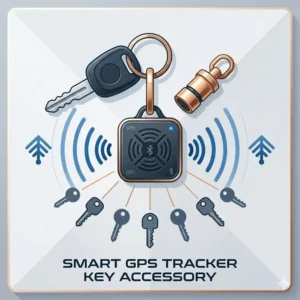
4. The Apple Ecosystem Essential
The Apple AirTag Leather Key Ring perfectly bridges the gap between traditional craftsmanship and cutting-edge location tech.
It is constructed from specially tanned European leather and features a robust stainless steel snap mechanism designed specifically to house an Apple AirTag. What this means in practice is absolute security for your tracker. Cheaper silicone cases often stretch out, leading to lost AirTags. This leather enclosure forms a rigid mechanical lock, ensuring that your $29 tracker stays firmly attached to your keys, while the European leather develops a unique patina that gets better with age.
I recommend this exclusively for embedded Apple ecosystem users. If you rely on the “Find My” network, this is the most elegant way to attach that capability to your physical keys. It feels like a high-end wallet rather than a piece of tech gear.
Customer sentiment frequently highlights the premium feel and perfect fit, though many correctly point out that it is essentially a very expensive holder for a separately purchased tech item.
-
Pros:
-
✅ Gorgeous leather that ages beautifully
-
✅ Extremely secure snap prevents tracker loss
-
✅ Flawless aesthetic match for premium gear
-
-
Cons:
-
❌ AirTag must be purchased separately
-
❌ Premium price tag for a simple enclosure
-
Typically found in the $30-$45 range, it is an investment in aesthetics and security that pays off in daily tactile satisfaction.
5. The Modular Masterpiece
The Prometheus Lights Kappa Quick Release is a masterclass in over-engineered simplicity for those who need to detach items constantly.
It utilizes a canted coil spring mechanism housed inside a precision-machined body, paired with a Delrin insulator. In engineering terms, a canted coil spring means it takes a deliberate 10 pounds of force to pull the two halves apart, but requires absolutely no buttons or latches to release or reconnect. You just pull hard. This provides incredibly fast access to a specific tool or car fob, while eliminating the mechanical failure points of traditional ball-bearing quick releases.
If you are someone who shares a vehicle, regularly hands their car fob to valet parking, or needs to quickly detach a mini flashlight, this is the Holy Grail. It’s a joy to use.
Reviewers are almost universally obsessed with the “snap” sound and feel of the mechanism, though a few note it takes a day or two to get used to trusting a friction-based lock.
-
Pros:
-
✅ Incredibly satisfying, fast operation
-
✅ No moving parts to break or jam with dirt
-
✅ Holds up to 10 lbs of force securely
-
-
Cons:
-
❌ Takes up additional length on your keychain
-
❌ Premium cost for a single-function item
-
Hovering in the $25-$35 range, it is a niche, high-performance accessory that completely changes how you interact with modular gear.
✨ Don’t Miss These Exclusive Deals!
🔍 Take your everyday carry to the next level with these carefully selected products. Click on any highlighted item to check current pricing and availability. These tools will help you create authentic pocket organization your future self will thank you for!
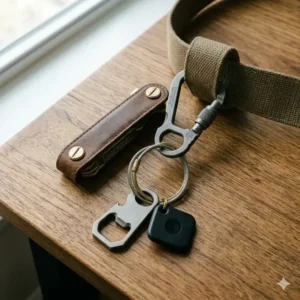
Practical Usage Guide: Silencing and Assembly Tricks
Getting the most out of your key accessories isn’t just about buying the right one; it’s about setting it up correctly.
When you first purchase an organizer like the Orbitkey Active, the biggest mistake people make is over-tightening the main screw. If you crank it down, you’ll need a pry bar to fan out your keys. The trick is to find the “Goldilocks zone” of tension.
Here is my 10-year insider tip: apply a tiny drop of Loctite Blue 242 (a mild thread locker) to the screw threads before final assembly. Snug it up until the keys hold their position against gravity, but can still be pushed out with your thumb. The thread locker will cure in 24 hours, locking the screw at that exact perfect tension indefinitely.
Furthermore, you must balance the load. Always place your most frequently used keys (like your front door) on the outside edges of the stack. Place rarely used keys (like the padlock for the shed) in the center. If you have an uneven number of keys, utilize the provided spacer washers to ensure the metal backplates remain perfectly parallel. If they bow outward, the tension will be uneven, and the mechanism will eventually fail. For more on proper torque and threading, I often refer to the engineering standards provided by organizations like ASTM International.
Problem → Solution Guide: Conquering the EDC Chaos
Let’s talk about the real-world problems that plague traditional keyrings and how specific key accessories solve them.
Problem 1: The “Thigh Poke” and Pocket Wear
Traditional loose keys point in random directions. When you sit down, a sharp brass tooth digs directly into your thigh, or worse, wears a literal hole through the fabric of your expensive denim.
The Solution: Swiss-army style organizers. By forcing all the metal teeth to face inward into a standardized chassis, you create a smooth, unified object. It completely eliminates pocket wear and physical discomfort.
Problem 2: The Valet Dilemma
You need to hand your car fob to a mechanic or valet, but your house keys, office fob, and mail key are all permanently looped onto a single rigid steel ring. Breaking a fingernail to separate them is infuriating.
The Solution: The Prometheus Lights Kappa. Installing a high-quality quick release between your daily stack and your car fob means you can separate the two in less than a second with a simple, deliberate pull.
Problem 3: The Black Hole Syndrome
You are running late for work, and your keys are nowhere to be found.
The Solution: Ultra-Wideband (UWB) trackers. Relying on products that utilize Bluetooth and UWB tech—like the Apple AirTag—gives you directional arrows and distance readouts right on your phone. You aren’t just listening for a beep; you are navigating to them like a treasure map.
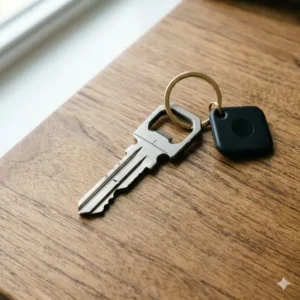
How to Choose the Right Setup for Your Lifestyle
Navigating the sheer volume of key accessories available today can be overwhelming. To avoid buyer’s remorse, you need to filter your choices through a strict set of personal criteria.
-
Assess Your Key Type and Volume: Count your keys. If you carry more than 8 standard Yale-style keys, bulky smart organizers will become unwieldy. You might be better off splitting your carry into two smaller, minimalist wraps.
-
Evaluate Your Daily Environment: Do you work in an office, or on a construction site? Office workers benefit greatly from the aesthetic and pocket-saving qualities of leather organizers. Tradesmen need the fast, one-handed deployment of heavy-duty stainless carabiners, where dirt and grit won’t jam delicate screws.
-
Account for “The Chonk” (Car Fobs): Modern car fobs are massive. If you try to force a thick, plastic key fob into a sleek organizer, it ruins the profile. Always look for accessories that offer a dedicated D-ring or secondary attachment point exclusively for modern car fobs.
Common Mistakes When Buying EDC Gear
The most frequent error I see beginners make is the “kitchen sink” approach. They discover key accessories and suddenly want a multi-tool, a flashlight, a pry bar, a tracker, and six keys all on the same rig.
What the spec sheet won’t tell you is that every ounce you add multiplies the ergonomic fatigue of carrying it. A massive keychain swinging from your car’s ignition can actually damage the ignition cylinder over time due to the pendulum effect of the excess weight.
Another major pitfall is ignoring the battery ecosystem. If you buy a tracker that uses proprietary, non-rechargeable batteries, you are signing up for a subscription service of annoyance. Always verify if the tracker uses standard CR2032 coin cells (easily found at any grocery store) or if it has a built-in rechargeable battery like the KeySmart Max.
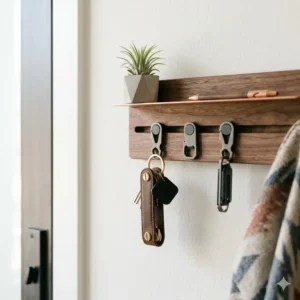
Digital Tracking vs. Physical Organization
When curating your EDC, you will inevitably hit a crossroads: do you prioritize digital tracking, or physical minimalism?
Digital trackers rely on complex networks. For instance, Apple’s network utilizes millions of active devices, leveraging the Bluetooth SIG standards to ping locations securely. This provides incredible security, but it requires bulk. Transmitters, batteries, and antennas take up physical space.
On the flip side, physical organization prioritizes the tactile experience. A well-worn leather strap holding three essential keys is incredibly satisfying to handle, takes up almost zero space, and never needs a software update.
The analysis here comes down to your personal anxiety levels. If you lose things constantly, the extra bulk of a tracker is a small tax to pay for peace of mind. If your keys are always strictly in your pocket or the bowl by the door, skip the electronics and invest in premium materials like titanium or top-grain leather.
What to Expect: Real-World Performance
It’s easy to get enamored with marketing photos showing pristine key setups resting on mahogany desks. Let’s talk about what happens in the real world after six months of use.
If you buy anodized aluminum accessories, expect “character marks.” The edges will silver out as the anodization rubs against coins and fabrics. This isn’t a defect; it’s a reality of the material. If you want something that looks brand new forever, you must invest in raw titanium or stainless steel.
For leather products, expect a break-in period. During the first two weeks, a leather key wrap will feel stiff, and fanning your keys out might feel clumsy. By month two, the natural oils from your hands will have softened the leather, molding it precisely to the ridges of your specific keys. This transformation is why premium materials cost more upfront but deliver a vastly superior user experience over the long term.
Safety and Security Guide for Smart Keys
We cannot discuss modern key accessories without addressing digital security. If you integrate smart trackers into your carry, you are technically carrying a broadcast beacon.
Modern UWB trackers have anti-stalking features built-in, meaning they will alert someone if an unknown tracker is traveling with them. However, for the user, the main security risk is actually battery failure. A dead tracker provides a false sense of security.
Set a recurring calendar reminder on your phone for every 6 months to either swap the CR2032 battery or plug in your rechargeable models. Furthermore, avoid printing your home address or phone number on any physical tag attached to your keys. If a bad actor finds your keys with your address attached, you haven’t just lost metal; you’ve provided a map to an unlocked door.
The Ultimate EDC Ecosystem
Achieving the perfect everyday carry is about creating a cohesive ecosystem where every tool complements the others. Your key accessories shouldn’t fight with your wallet for pocket space.
If you carry a minimalist front-pocket wallet, pair it with a slim, screw-based organizer. If you carry a larger traditional bifold in your back pocket, you have the front pocket real estate to accommodate a bulkier tech-focused tracker setup. True EDC mastery isn’t about buying the most expensive gear; it’s about matching the geometry and weight of your tools to the specific pockets of the clothing you wear daily.
✨ Don’t Miss These Exclusive Deals!
🔍 Ready to silence the jingle? Click on any highlighted product in this article to explore current availability and upgrade your daily routine. Finding the perfect balance of tech and tradition has never been easier!
Conclusion
Refining your everyday carry by upgrading your key accessories is one of the highest ROI (Return on Investment) quality-of-life improvements you can make. You carry these items every single day; they should bring you satisfaction, not annoyance.
By transitioning away from cheap, noisy metal rings and investing in purposeful tools—whether that is a sleek minimalist polymer wrap, a heavy-duty carabiner, or a tech-heavy location tracker—you take back control of your pocket space. Remember, the goal isn’t to buy everything on the market; the goal is to buy the specific tool that solves your unique daily friction points. Assess your needs, respect the materials, and banish the jingle for good.
FAQs
❓ What is the best way to stop keys from jingling?
✅ The most effective method is using a Swiss-army style key organizer, like an Orbitkey or KeySmart. These tightly sandwich your keys between two plates or straps, completely eliminating the metal-on-metal contact that causes the jingle, while maintaining easy access…
❓ Can smart key trackers work without a cell signal?
✅ Yes. Trackers like AirTags and Tile use low-energy Bluetooth to ping off nearby devices in their respective networks. They don’t need their own cellular connection or GPS to report their location, relying instead on the mesh network of surrounding smartphones…
❓ Will a key organizer fit my car key fob?
✅ Most modern car fobs will not fit inside standard key organizers due to their thickness. However, almost all quality organizers include a dedicated D-ring or loop attachment at the end specifically designed to let your car fob dangle freely outside the main chassis…
❓ Are magnetic quick releases safe for car keys?
✅ High-quality magnetic releases require a specific, deliberate breaking force (often combining magnets with a mechanical lip) and are incredibly secure. However, cheap novelties should be avoided, as a heavy bump could detach them. Look for systems rated for at least 5+ lbs of pull force…
❓ How long do batteries last in key trackers?
✅ Most coin-cell (CR2032) powered trackers last between 10 to 12 months before needing replacement. Rechargeable models vary wildly based on usage and flashlight utilization, but typically range from 45 to 160 days on a single charge. Always check app battery indicators…
Recommended for You
- 7 Powerful tech keychain Gadgets for the Ultimate EDC Upgrade
- EDC Key Ring Secrets: 7 Must-Have Tools for Amazing Preparedness
- 5 Best IWB Knife Options for Discreet EDC Carry (2026 Review)
Disclaimer: This article contains affiliate links. As an Amazon Associate, I earn from qualifying purchases. If you purchase products through these links, we may earn a small commission at no additional cost to you.
✨ Found this helpful? Share it with your friends! 💬🤗
[addtoany]
