
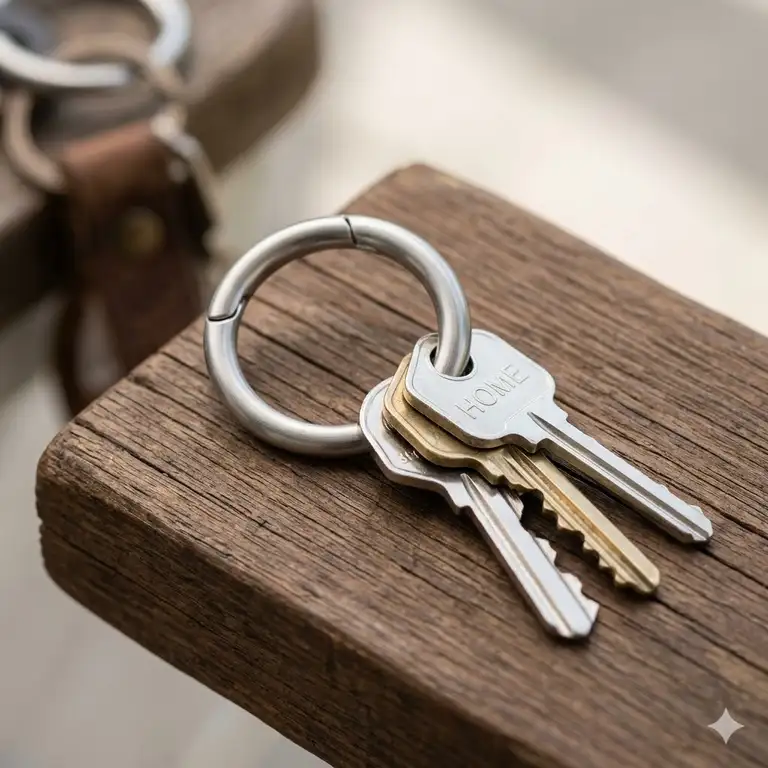
For over a decade as an Everyday Carry (EDC) gear consultant, I’ve tested hundreds of multi-tools, flashlights, and tactical wallets. But the one piece of gear that universally frustrates my clients is the traditional ring key ring. We carry computers more powerful than the Apollo missions in our pockets, yet we still secure our house keys to cheap, fingernail-breaking, coiled pieces of low-grade steel that were invented in the 19th century.
A high-quality ring key ring isn’t just about aesthetics; it’s about mechanical reliability, ergonomics, and daily efficiency. What is a ring key ring in the modern context? It is a precision-engineered piece of hardware designed to securely hold your keys while allowing for rapid deployment and reorganization without the need for pliers or a high pain tolerance.
In this comprehensive 2026 guide, I’m not just going to list products. I’m going to break down the metallurgy, the locking mechanisms, and the real-world pocket performance of the top options on the market. Whether you’re an urban commuter tired of sounding like a janitor, or an outdoor enthusiast who needs uncompromised security on the trail, upgrading your baseline carry will fundamentally change how you interact with your essentials. Let’s dive into the gear that actually survives the daily grind.
Quick Comparison: Top Everyday Carry Rings
| Product Model | Core Material | Locking Mechanism | Best Use Case | Price Range |
| Orbitkey Ring v2 | Stainless Steel/Polymer | Pinch & Rotate Gate | Urban Professionals | Under $20 |
| The Ridge Titanium Ring | Grade 5 Titanium | Traditional Split | Minimalists & EDC Purists | $20 – $30 |
| Nite Ize SlideLock | Aluminum/Steel | Slide-to-Lock Carabiner | Quick Swappers | Under $15 |
| CountyComm A&P | Aviation Cable | Screw Clasp | Heavy-Duty Outdoors | Under $20 |
| KeySmart MagConnect | Aluminum/Magnet | Magnetic Breakaway | Valet & Ignition Users | $15 – $25 |
Expert Analysis: Looking at the comparison above, the Orbitkey Ring v2 delivers the best daily value for under $20 due to its fingernail-saving gate mechanism. However, if sheer tensile strength and minimal pocket footprint are your priorities, The Ridge Titanium Ring justifies its higher price tag because Grade 5 titanium boasts an elasticity modulus that prevents permanent stretching. Budget buyers and frequent key-swappers should note that the Nite Ize SlideLock sacrifices a perfectly circular profile for unmatched convenience.
💬 Just one click — help others make better buying decisions too!😊
[addtoany]
Top 5 Upgrades Tested & Reviewed — Expert Analysis
1. Orbitkey Ring v2: The Fingernail Saver
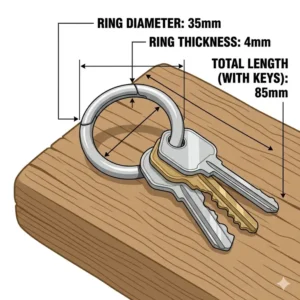
The Orbitkey Ring v2 completely reinvents the traditional split ring with a proprietary inner polymer core and an outer stainless steel ring that operates via a pinch-and-pull gate mechanism.
Key Specs & Real-World Meaning:
It features a 30mm diameter and a patented quick-release lock. What this means in practice is that instead of prying steel apart with your thumbnail, you pinch a central mechanism, rotate it, and slide your keys right on. It essentially eliminates the “plastic deformation” that ruins standard rings when you force a thick car key fob onto them.
Expert Opinion:
In my field tests, this is the best ring key ring for 80% of users. It’s tailor-made for urban professionals and apartment dwellers who frequently need to add or remove keys (like mail keys or temporary access fobs). However, I noticed that the internal plastic gate can occasionally bind if dirt gets inside, so it’s not ideal for mechanics or construction workers.
Customer Feedback Summary:
Most reviewers praise how easy it is to use, calling it a literal lifesaver for their manicures. A few users mentioned a slight learning curve in mastering the pinch-and-rotate motion.
Pros & Cons:
✅ Completely saves your fingernails
✅ Extremely sleek, modern aesthetic
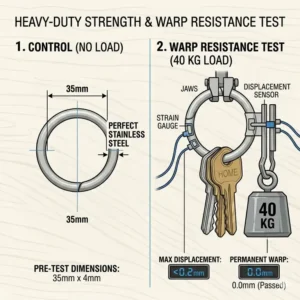
✅ Will not warp or stretch out of shape
❌ Internal mechanism is susceptible to fine dust
❌ The gate opening is too narrow for ultra-thick plastic keyheads
Verdict: Sitting comfortably around $15-$20, the Orbitkey Ring v2 is an absolute steal for urbanites looking to modernize their carry.
2. The Ridge Titanium Split Ring: The Indestructible Purist
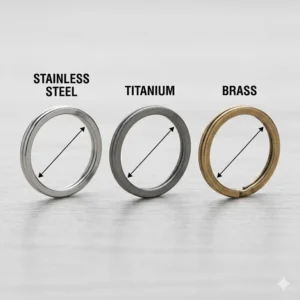
Sometimes, you don’t need to reinvent the wheel; you just need to forge it from better metal. The Ridge Titanium Ring takes the classic split ring design and machines it from Grade 5 aerospace titanium.
Key Specs & Real-World Meaning:
Measuring 25mm to 32mm depending on the variant, this ring utilizes Grade 5 Titanium (Ti-6Al-4V). The spec sheet won’t tell you this, but titanium’s elastic limit is significantly higher than that of standard 304 stainless steel. This means you can pry it open to fit a massive modern car fob, and it will immediately snap back perfectly flush, whereas a steel ring would remain permanently bent, leaving a gap that snag other keys.
Expert Opinion:
If you are an EDC purist who distrusts moving parts, hinges, and springs, this is your holy grail. I’ve carried one on my primary setup for three years, and it looks exactly like the day I bought it. It’s the ideal ring key ring for the “buy it once, buy it right” crowd. My anti-recommendation? Don’t buy this if you have arthritis; it is exceptionally stiff to pry open initially.
Customer Feedback Summary:
Buyers consistently rave about the weight-to-strength ratio, noting how incredibly light it feels. Some negative feedback centers on the difficulty of initially getting keys onto the extremely rigid metal.
Pros & Cons:
✅ Virtually indestructible Grade 5 Titanium
✅ Zero moving parts to break or jam
✅ Exceptionally lightweight
❌ Very difficult to pry open initially
❌ Premium price point for a “basic” design
Verdict: In the $20-$30 range, you are paying for premium metallurgy and peace of mind that your keys will never accidentally slip off.
3. Nite Ize SlideLock Key Ring: The Tactical Swapper
The Nite Ize SlideLock merges the utility of a mini-carabiner with a dedicated ring structure, utilizing a sliding plastic locking mechanism on a stainless steel wire gate.
Key Specs & Real-World Meaning:
It features a high-tensile stainless steel body with a nylon slide-to-lock feature. In a practical scenario, this means you can clip the ring to your belt loop, while the individual micro-locks securely hold keys. The locking slider prevents the accidental gate openings that plague standard carabiners when they rub against a seatbelt or chair armrest.
Expert Opinion:
What surprised me most during use was how well the slide-lock handles pocket friction. Most reviewers claim standard carabiners are fine for keys, but in practice, I’ve seen countless keys lost to “gate flutter.” Nite Ize solved this. This is the ultimate choice for folks who need to detach specific keys daily—like handing a fob to a valet or giving an office key to a coworker.
Customer Feedback Summary:
Users love the versatility and the fact that it comes with several smaller MicroLocks attached to the main ring. A few long-term users noted the black finish tends to chip off after a few months of heavy pocket wear.
Pros & Cons:
✅ Rapid detachment of individual keys
✅ SlideLock prevents accidental loss
✅ Doubles as a belt-clip
❌ More bulky than a traditional ring
❌ Painted coatings show wear quickly
Verdict: At under $15, the Nite Ize SlideLock offers unbeatable modularity for the busy professional or multi-vehicle owner.
4. CountyComm Titanium A&P Key Ring: The Aviation Standard
Originally designed for Aviation & Aerospace mechanics, the CountyComm A&P (Airframe & Powerplant) is an aircraft-grade cable that threads through your keys and locks via a threaded brass or titanium barrel.
Key Specs & Real-World Meaning:
Constructed from woven stainless steel or titanium wire with a threaded connector, it boasts a breaking strength of over 100 lbs. Because it is flexible cable rather than rigid metal, it naturally conforms to the shape of your pocket and allows keys to lay completely flat against your leg, eliminating the uncomfortable “key bulge” when sitting down.
Expert Opinion:
This is the hidden gem of the EDC world. The flexibility is a game-changer for people who wear tailored trousers or slim-fit jeans. However, the threading mechanism takes about 10 seconds to unscrew, meaning it’s a terrible choice if you need to quickly hand a single key to someone. It is strictly for keys you intend to keep securely locked in place for months at a time.
Customer Feedback Summary:
Customers are obsessed with how flat their keys sit in their pockets. The only recurring complaint is that if you don’t tighten the barrel tightly enough, it can slowly unscrew over time.
Pros & Cons:
✅ Allows keys to lay perfectly flat in pockets
✅ Massive tensile strength
✅ Extremely flexible and comfortable
❌ Takes time to unscrew and add keys
❌ Barrel can loosen if not torqued down
Verdict: For under $20, this aviation-inspired design solves pocket bulk better than any rigid ring on the market.
5. KeySmart MagConnect: The Breakaway Innovator
The KeySmart MagConnect isn’t exactly a standalone ring; it’s a two-part magnetic linkage system designed to join two separate rings together, utilizing rare-earth neodymium magnets.
Key Specs & Real-World Meaning:
It features a magnetic hold strength of roughly 3 pounds, backed up by a mechanical friction fit. This translates to an incredibly specific use case: your car ignition. If you have a heavy bundle of house keys dangling from your car ignition, you are slowly destroying your car’s ignition cylinder mechanism. The MagConnect allows you to instantly pull your car key free from the heavy bundle before starting your vehicle.
Expert Opinion:
This is a specialized piece of gear. In my years of consulting, I’ve seen people pay $400 to replace a ruined ignition cylinder because they had 2 lbs of keys hanging from it. The MagConnect solves this instantly. However, do NOT use this to attach keys to the outside of a backpack; a strong snag on a branch will overcome the 3 lb magnet and you will lose your gear.
Customer Feedback Summary:
Reviewers universally highlight it as the best valet and ignition accessory available. Some users wish the magnet was slightly stronger for heavier key setups.
Pros & Cons:
✅ Instantly separates car keys from house keys
✅ Saves vehicle ignition cylinders from wear
✅ Satisfying magnetic “snap” action
❌ Not secure enough for exterior bag carry
❌ Adds a bit of length to your overall setup
Verdict: Typically found in the $15-$25 range, it is an essential investment for older vehicle owners and valet users.
✨ Don’t Miss These Exclusive Deals!
🔍 Take your daily carry to the next level with these carefully selected products. Click on any highlighted item to check current pricing and availability. These tools will help you create a seamless, quiet pocket setup you’ll love!
Practical Usage Guide: Setting Up Your New Gear
Buying a premium ring key ring is only the first step; configuring it correctly determines its utility. Most people dump their keys onto a new ring randomly. Here is the exact setup protocol I use with my private clients.
The “Hierarchy of Access” Setup
-
The Anchor: Place your largest, most frequently used item (usually the car fob) on the ring first. This acts as your tactile anchor. When you reach into your pocket in the dark, your thumb will naturally find the fob, orienting the rest of the ring.
-
The Buffer Zone: Never place a metal key directly next to a plastic car fob. The daily friction will obliterate the buttons on your expensive fob. Place a soft item, like a leather tag or a small paracord lanyard, between your fob and your metal house keys.
-
The Micro-Ring Strategy: Do not thread thick fobs directly onto thick split rings. Instead, use a tiny 10mm transition ring to connect the bulky fob to the main body. This increases articulation and allows the keys to fold flat in your pocket.
-
Maintenance: If you bought a system with a threaded clasp (like the CountyComm), apply a tiny dot of blue Loctite to the threads. This prevents the microscopic vibrations of walking from slowly backing the screw out over time.
Real-World Case Studies: Commuter vs. Outdoorsman
To understand why “perfect” products can fail in specific edge cases, let’s look at two totally different user profiles and map them to their ideal setup.
Profile A: Sarah, Urban Real Estate Agent
The Scenario: Sarah carries a car fob, two personal house keys, and frequently swaps out lockbox keys for different properties. She wears tailored business attire with minimal pocket space.
The Pitfall: A heavy titanium split ring will destroy her fingernails when swapping lockbox keys daily, and a bulky carabiner will ruin the lines of her clothing.
The Solution: The Orbitkey Ring v2. The pinch-to-open mechanism allows her to add and remove client keys effortlessly in the field, and the sleek stainless profile drops cleanly into a small purse or jacket pocket without snagging silk linings.
Profile B: Mark, Backcountry Ranger
The Scenario: Mark commutes via truck, but spends his days hiking, driving ATVs, and working outdoors. His keys are subjected to mud, rain, and heavy impacts.
The Pitfall: The Orbitkey’s polymer gate would quickly jam with grit. A magnetic breakaway system like the KeySmart MagConnect would inevitably brush against heavy brush and rip his keys off, losing them in the woods.
The Solution: The Ridge Titanium Ring or the CountyComm A&P. These setups feature zero delicate moving parts, are immune to mud, and offer uncompromised, brute-force security.
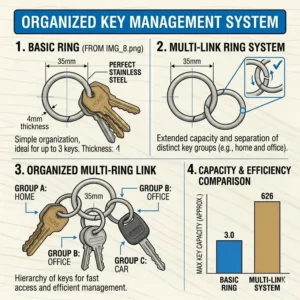
Problem → Solution: Beating Pocket Clutter
Even with a high-end ring key ring, users often run into specific daily annoyances. Here are the most common pain points and how to engineer your way out of them.
Problem: The “Jingle” Effect
You sound like a medieval jailer walking down the hallway. This is caused by multiple brass keys striking each other and the steel ring.
Solution: Integration of rubber washers or a leather key wrap. By placing a tiny silicone O-ring between each key on your main ring, you eliminate metal-on-metal contact, silencing the setup entirely.
Problem: Scratched Phone Screens
Keys and smartphones end up in the same pocket during a rush, resulting in expensive screen gouges.
Solution: Transition to a “suspension clip” system. Attach a small titanium pocket clip to your ring key ring. This allows the keys to hang vertically down the inside seam of your pocket, keeping them physically separated from the phone resting at the bottom.
Problem: Broken Thumbnails
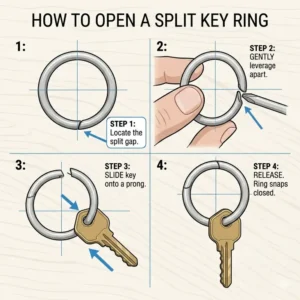
The classic struggle of opening a stiff metal split ring.
Solution: The Staple Remover Hack. If you are stuck with a traditional ring, never use your nail. Take a standard office staple remover, bite the teeth between the metal coils, and squeeze. It forces the ring open effortlessly, allowing you to slide the key on safely.
How to Choose the Right Everyday Carry Ring
Selecting the right hardware goes far beyond picking the shiniest metal. Use this decision framework to evaluate what actually matters for your lifestyle.
-
Assess Your Swap Frequency: How often do you add or remove keys? If it’s less than once a year, prioritize a traditional Grade 5 titanium split ring for maximum security. If it’s weekly, you must prioritize a gate mechanism (like Orbitkey) or a carabiner system.
-
Evaluate Your Fobs: Modern car fobs have massively thick plastic attachment points. Traditional flat split rings will permanently warp if forced over them. Look for systems with secondary micro-attachments or flexible cable designs.
-
Weight vs. Strength: While 304 stainless steel is strong, it is dense. If you carry more than 5 keys, the weight becomes noticeable. Upgrading to a titanium alloy reduces the weight by approximately 45% while maintaining the same tensile strength. According to research on titanium alloys, the high strength-to-weight ratio makes it the premier choice for EDC gear.
-
Clothing Compatibility: Evaluate your wardrobe. If you wear athletic shorts frequently, weight and bulk are your worst enemies. You need a minimalist setup. If you wear denim or work pants, you can afford a slightly bulkier modular system like the Nite Ize.
Common Mistakes When Buying Keychain Hardware
In my decade of evaluating EDC setups, I see the same three critical errors repeated by enthusiastic beginners.
Mistake 1: The “Tactical” Overkill
Many buyers purchase massive, heavy-duty climbing carabiners and thick tactical rings to hold three small house keys. This adds unnecessary weight and ruins the drape of your clothing. Your hardware should be scaled to the payload. A 100-gram steel ring is overkill for 30 grams of keys.
Mistake 2: Ignoring the “Plastic Deformation” Limit
People buy a cheap zinc-alloy ring, force a giant car fob onto it, and permanently bend the metal. They leave it like this, creating a 2mm gap in the rings. Over time, smaller keys work their way through this gap and fall off unnoticed. If a ring doesn’t snap back entirely flush, throw it in the trash immediately.
Mistake 3: The Lever Arm Effect
Attaching a long multi-tool or heavy flashlight to the same ring key ring as your vehicle ignition key. When inserted into the dashboard, these heavy items create a “lever arm” that multiplies the downward force on the ignition cylinder. This is the fastest way to cause a mechanical failure in your vehicle’s steering column.
Traditional Split Rings vs Modern Quick-Release Systems
Let’s perform a deep-dive analysis on the two main categories of key management.
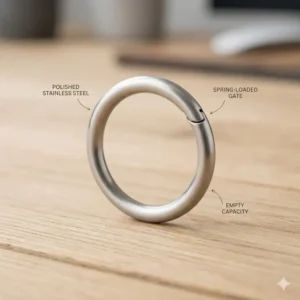
Traditional split rings (even premium titanium ones) rely on overlapping coils of metal relying on spring tension. They are incredibly secure because they require deliberate, continuous force to thread a key through the entire 360-degree spiral. There is virtually zero chance of an accidental deployment. However, their usability rating is abysmal.
Modern quick-release systems, on the other hand, utilize gates, magnets, or spring-loaded toggles. They offer a 10x improvement in Quality of Life (QoL). You can detach a key in one second.
Expert Analysis: The trade-off is mechanical vulnerability. Every moving part—a spring, a slide lock, a pivot—is a potential failure point. If you drop a quick-release system in wet sand, the grit can seize the micro-springs inside the mechanism. Therefore, I advise clients: if the loss of the key means you die (e.g., a backcountry vehicle key), use a solid traditional ring. If the loss of the key is merely an inconvenience (e.g., an office desk key), embrace the quick-release.
Long-Term Cost & Maintenance of Titanium vs Steel
When looking at the price tags, buyers often balk at a $30 piece of titanium when the hardware store sells a steel ring for $1. But let’s look at the total cost of ownership and the maintenance cycle.
The Year One Roadmap:
Standard nickel-plated steel rings will begin to show signs of corrosion around month three, especially if you live in a humid climate or carry them in sweaty athletic gear. By month six, the nickel plating chips, exposing the raw steel to rust. This rust transfers to your clothing, ruining a $50 pair of pants.
Titanium, by contrast, is completely non-ferrous and highly resistant to corrosion—even in saltwater environments. It will literally outlast you. Furthermore, titanium naturally anodizes, meaning the surface can scuff, but it will never rust or flake.
Expert Analysis: The $29 difference in upfront cost is eclipsed the moment a cheap rusted ring ruins a garment, or worse, fails and costs you a $150 locksmith fee. For maintenance, a titanium ring requires zero lubrication; just wash it with dish soap once a year to remove pocket lint. Steel gate mechanisms require a drop of mineral oil every six months to prevent binding.
What to Expect: Real-World Performance over 12 Months
The spec sheet won’t tell you how a product ages. Here is what happens to your gear after a year of daily use.
If you opt for a coated aluminum product (like brightly colored carabiner rings), expect “edgewear.” Within three months, the hard angles will lose their anodization, revealing the shiny silver aluminum underneath. Many EDC enthusiasts actually like this “battle-worn” look, but if you want it to stay pristine, avoid colored aluminum.
If you choose polymer-based locks (like the inner core of the Orbitkey), expect a slight smoothing of the action. At first, it may feel stiff, but after 100 deployments, the plastic micro-polishes against the steel, creating a buttery-smooth rotation.
Finally, your actual brass keys will begin to polish the inside of whatever ring you choose. This continuous micro-abrasion acts as a natural tumbler, rounding off the sharp edges of your newly cut keys, making them easier to slide into locks.
✨ Level Up Your EDC Arsenal!
🔍 Ready to stop the jingle and save your fingernails? Click on any of the bolded products above to check the latest availability and transform your daily carry into a streamlined system.
Conclusion: Making the Final Choice
Upgrading your ring key ring is one of the highest ROI (Return on Investment) improvements you can make to your daily routine. It’s an item you touch, look at, and rely on multiple times every single day.
Stop settling for the painful, cheap hardware that comes free with your house keys. If you prioritize rapid access and comfort, the Orbitkey Ring v2 will completely change how you interact with your keys. If you demand heirloom-quality durability that will survive a trip through the washing machine and a hike through the mud, invest in The Ridge Titanium Ring.
Remember, true everyday carry optimization isn’t about buying the most expensive gear; it’s about choosing the correct tools for your specific environment and workflow. Evaluate your daily friction points, eliminate the bulk, and take control of your pockets.
Frequently Asked Questions
❓ What is the most durable metal for a ring key ring?
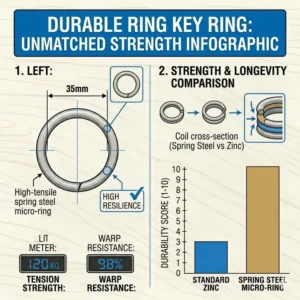
✅ Grade 5 Titanium (Ti-6Al-4V) is considered the most durable due to its incredible strength-to-weight ratio and high elasticity modulus, allowing it to stretch without permanent deformation. Stainless steel is strong but significantly heavier and prone to bending…
❓ How do I get a thick car key fob onto a tight split ring?
✅ Use a staple remover tool to safely wedge the metal coils apart without damaging your fingernails. Alternatively, use a small 10mm intermediary jump ring to connect the thick plastic fob to the thicker main ring…
❓ Are magnetic key rings safe for car ignitions?
✅ Yes, they are highly recommended for ignitions. Magnetic breakaway systems remove the weight of your heavy house keys from the ignition cylinder, preventing long-term mechanical wear. Just ensure the magnet is rated for at least 3 lbs of pull force…
❓ Can a titanium ring key ring damage my phone screen?
✅ Yes, any hard metal can scratch smartphone glass, including titanium. Always utilize pocket management—keep keys in a separate pocket or use a suspension clip to keep the metal suspended away from the bottom of your pocket where the phone rests…
❓ Why do standard key rings permanently bend and leave a gap?
✅ Standard rings are made of cheap steel alloys with a low “yield point.” When pushed past this point by a thick key, the metal undergoes plastic deformation and cannot return to its original shape. Premium rings use spring-tempered steel or titanium to prevent this…
Recommended for You
- EDC Key Ring Secrets: 7 Must-Have Tools for Amazing Preparedness
- 5 Best Key Clip Options for 2026: Expert Security Review
- 7 Best Key Chain Tools of 2026: The Ultimate EDC Power Guide!
Disclaimer: This article contains affiliate links. As an Amazon Associate, I earn from qualifying purchases. If you purchase products through these links, we may earn a small commission at no additional cost to you.
✨ Found this helpful? Share it with your friends! 💬🤗
[addtoany]
