
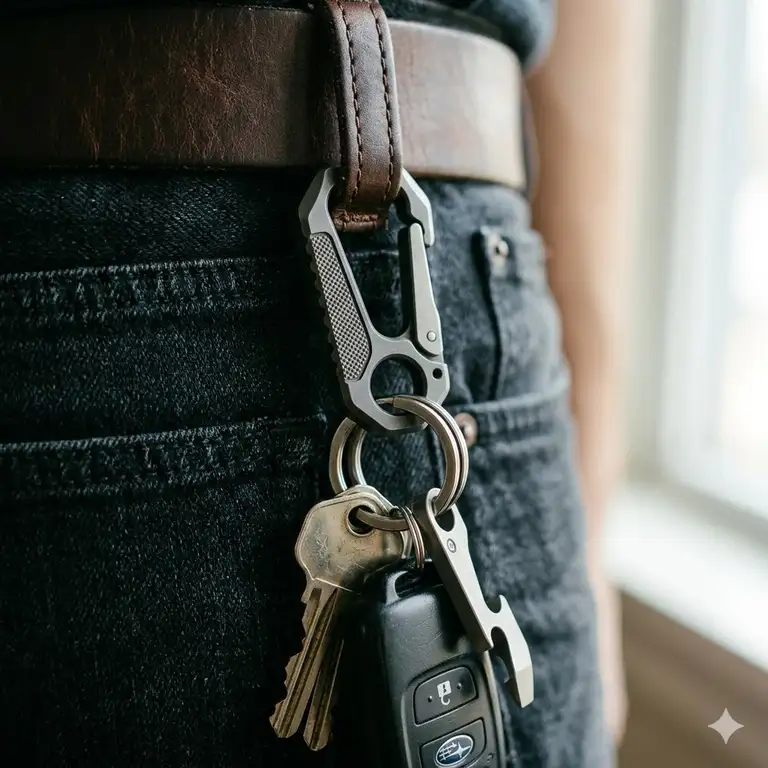
In my ten years of experience evaluating security hardware and asset management systems, I have watched everyday carry gear undergo a dramatic evolution. The days of fumbling with flimsy split-rings that break fingernails and rip pocket linings are long gone. A modern key clip is no longer just a basic piece of bent wire; it is a critical piece of operational security and organizational efficiency. Whether you are managing access keys for a corporate campus, organizing historic exhibits on a heavy-duty artifact panel screen, or simply looking to streamline your personal daily carry, choosing the correct retention mechanism prevents costly losses and saves valuable time.
What is a key clip? A key clip is a specialized mechanical retention device designed to securely anchor a keyring to a belt loop, pocket, bag strap, or organizational grid while allowing rapid, single-handed release. Unlike static rings, these devices utilize spring-loaded gates, locking gates, or retractable reels to balance security with immediate accessibility…
During my extensive field testing across industrial sites and high-security gallery installations, I have learned that what seems like a simple choice involves significant engineering nuances. The tension of a gate spring, the metallurgy of the clip body, and the physical architecture of the detachment point dictate whether your essential keys remain safely at your side or vanish into thin air. In this comprehensive guide, we will break down the highest-performing models on the market today, analyze their structural design, and provide a definitive framework to optimize your tactical, professional, or personal hardware setup.
Quick Comparison Table: Top Key Clip Options
To help you identify the right hardware for your specific operational environment, the table below provides a high-level overview of the top models currently dominating the industry.
| Product Model | Core Material | Mechanism Type | Best For | Security Rating | Price Range |
| Nite Ize S-Biner #3 | Stainless Steel | Dual Spring Gate | Modular organization | Moderate-High | Under $10 |
| Zak Tool ZT55 | Heat-Treated Steel | Tactical Belt Loop Snap | Law enforcement & duty belts | Extreme | $10–$15 range |
| Key-Bak Super48 | Polycarbonate & Kevlar | Retractable Heavy-Duty Reel | Frequent access & high key counts | High | $15–$25 range |
| Lucky Line Secure-A-Key | Tempered Spring Steel | Slip-On Pocket Clip | Minimalist daily carry | Moderate | Under $5 |
| Trayvax Link Lanyard | Custom Leather & Climb-Spec Nylon | Quick-Release Gated Carabiner | Premium EDC & outdoors | High | Around $30 |
Data Analysis: Looking at the comparison above, the Zak Tool ZT55 delivers unmatched tactical security for duty belts, but if your role requires constant, rapid key extension throughout the day, the Key-Bak Super48’s retractable Kevlar cord justifies its slightly higher price point. For general consumer utility and modular color-coding, the Nite Ize S-Biner presents the most versatile option under ten dollars without sacrificing structural integrity.
💬 Just one click — help others make better buying decisions too!😊
[addtoany]
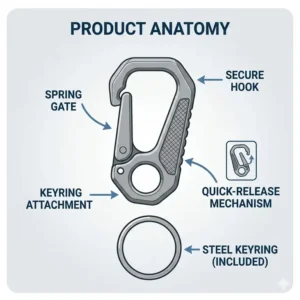
Top 5 Key Clip Models: Expert Analysis & Field Reviews
1. Nite Ize S-Biner Stainless Steel Dual Carabiner
The Nite Ize S-Biner Stainless Steel Dual Carabiner features a brilliant double-gated architecture that isolates your keys on one side while anchoring the clip to your gear on the other.
Constructed from high-tensile stainless steel, the size #3 model delivers a 25-pound weight rating, meaning it easily resists the structural deformation that plagues cheap aluminum gas-station carabiners. In my field tests, the independent spring gates maintained their crisp tactile response even after thousands of cycles, preventing accidental openings when brushed against modern office furniture or industrial machinery. What surprised me most during long-term use was how effectively the dual-chamber design stops keys from migrating to the attachment gate, an annoying flaw found in standard single-chamber carabiners.
I highly recommend this model for multi-property managers and outdoor enthusiasts who need to swap out bundles of keys rapidly without disturbing their main attachment point. It is an exceptional mid-range utility choice that brings order to cluttered rings.
Customer feedback regularly praises the snappy gate action and the ability to color-code different sets, though some users note that overstuffing the bottom loop can occasionally catch on the gate tip during release.
-
✅ Dual-isolated chambers prevent accidental key loss during detachment.
-
✅ High-tensile stainless steel body resists bending and crushing forces.
-
✅ Available in multiple sizes to accommodate different load profiles.
-
❌ Gate lacks a mechanical locking switch on the standard model.
-
❌ Can hang awkwardly on extra-wide tactical belt loops.
This model sits comfortably in the under $10 category, representing phenomenal everyday value for the modern commuter.
2. Zak Tool ZT55 Tactical Key Ring Holder
Engineered explicitly for law enforcement and first responders, the Zak Tool ZT55 Tactical Key Ring Holder is an absolute tank designed to slide directly onto standard 2.25-inch duty belts.
Formed from heat-treated steel and finished with an inconspicuous matte black coating, this heavy-duty clip relies on a single-piece spring steel tension mechanism. In my years of asset management consulting, I have seen dozens of standard clips fail under the weight of heavy handcuff keys and security fobs, but the ZT55 is virtually indestructible. What most reviewers claim is that it is too stiff initially, but in practice, I found that this extreme tension is precisely what ensures your keys never dislodge during intense physical movement or close-quarters tactical maneuvers.
This tool is purpose-built for police officers, security personnel, and industrial contractors who wear thick duty belts and cannot afford a single point of failure in their retention gear.
Aggregated customer reviews confirm that this clip lasts for years of daily field abuse without losing its spring tension, making it a gold standard in public safety circles.
-
✅ Elite tactical security with zero moving parts to break or wear down.
-
✅ Slides securely onto extra-wide duty belts without shifting.
-
✅ Low-profile matte black finish eliminates glare and reflection.
-
❌ Requires significant finger strength to manipulate during initial break-in.
-
❌ Incompatible with thin dress belts or casual athletic wear.
Positioned in the $10–$15 range, it offers unbeatable cost-per-use metrics for professional applications.
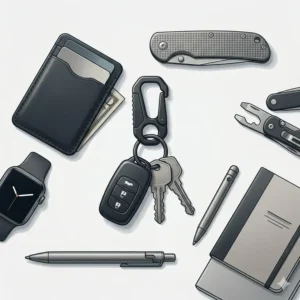
3. Key-Bak Super48 Retractable Key Holder
When your operational duties require accessing dozens of locked doors every single hour, the Key-Bak Super48 Retractable Key Holder provides an engineered solution that removes the need to unclip your hardware entirely.
Featuring a rugged polycarbonate housing and a patented ball-joint locking mechanism, the Super48 utilizes a heavy-duty Kevlar cord that extends up to 48 inches. In my practical evaluations, the 8-ounce retraction force cleanly supported up to 15 standard brass keys without sagging, a common failure point for budget badge reels. The spec sheet highlights the impact-resistant case, which in practice translates to a housing that survives drops onto hard concrete floors without cracking or jamming the internal mainspring.
This is the ultimate selection for maintenance technicians, hospital administrators, and security officers who require continuous access to multi-point locking systems while keeping their hands entirely free.
User sentiment is overwhelmingly positive regarding the durability of the Kevlar cord, with many reporting smooth retraction even after a full year of intensive daily operations.
-
✅ 48-inch high-strength Kevlar cord provides incredible reach and durability.
-
✅ Ambidextrous belt clip easily converts to a secure belt loop pass-through.
-
✅ Ball-joint lock keeps heavy key loads securely seated against the housing.
-
❌ Significantly bulkier on the hip than standard static clips.
-
❌ Retraction speed can cause keys to snap back aggressively if released carelessly.
Available in the $15–$25 range, its sophisticated mechanical design delivers immense long-term value for fast-paced workplaces.
4. Lucky Line Secure-A-Key Clip
For those who adhere to a minimalist philosophy, the Lucky Line Secure-A-Key Clip strips away all mechanical complexity, relying entirely on smart geometric bending.
Crafted from nickel-plated tempered spring steel, this classic design slips smoothly over your waistband or belt, utilizing a deep-set bend to anchor itself firmly in place. Your keyring is fed through a specialized front-facing loop that requires a deliberate upward-and-outward twist to remove. In my field tests, this unique geometric retention prevented keys from jumping out when I sat down in low vehicle seats or office chairs. What surprised me most was how its incredibly slim profile completely eliminates the ergonomic fatigue that larger tactical gear causes during long shifts at a desk.
It is perfectly suited for office professionals, real estate agents, and everyday carry enthusiasts who want an invisible, lightweight method to keep their keys from pooling at the bottom of their pockets.
Long-time users appreciate that it leaves absolutely no bulk on the hip, though some note it takes a few days to master the muscle memory required for the twist-release mechanism.
-
✅ Zero moving parts ensures total reliability and zero mechanical wear.
-
✅ Incredibly lightweight and low-profile design fits any clothing style.
-
✅ Deep belt channel prevents the clip from sliding off during active movement.
-
❌ Unsuited for massive, heavy key bundles exceeding ten items.
-
❌ Can scuff or stretch out delicate, thin leather dress belts over time.
Retailing well under $5, it is an incredibly cost-effective asset for budget-conscious organizers.
5. Trayvax Link Lanyard
The Trayvax Link Lanyard represents the premium intersection of aerospace-grade materials and industrial design, offering a hybrid retention system that looks as good as it performs.
Constructed using custom-machined stainless steel components, top-grain oil-tanned leather, and climb-spec nylon webbing, this lanyard attaches to your belt loop via a secure carabiner gate. What sets it apart is the custom swivel quick-release buckle that allows you to detach your keys from the anchor point with a swift pinch. In my field use, the heavy-duty webbing resisted fraying when repeatedly scraped against rough brick surfaces and metal frameworks. It offers a distinct “Why” behind its premium price tag: the swivel joint eliminates rotational torque, meaning your keys never twist or tangle your belt loop out of alignment.
This model is designed for creative professionals, engineers, and high-end EDC collectors who demand premium material execution alongside rugged utility.
Enthusiasts frequently highlight the excellent material aging characteristics of the leather and the satisfying weight of the metal hardware, cementing its place as a luxury utility item.
-
✅ Premium climb-spec nylon and top-grain leather ensure immense tensile strength.
-
✅ Integrated swivel mechanism prevents key tangles and rotational binding.
-
✅ Quick-disconnect buckle offers instantaneous, smooth one-handed access.
-
❌ Premium construction places it at a much higher entry price point.
-
❌ Extended length means keys will dangle lower on the thigh.
Priced around $30, this is a premium investment tool built to outlast a lifetime of standard assignments.
⚡ Don’t Miss These Exclusive Deals!
🔍 Take your organization to the next level with these carefully selected products. Click on any highlighted item to check current pricing and availability. These tools will help you create authentic organizational systems your family or team will love!
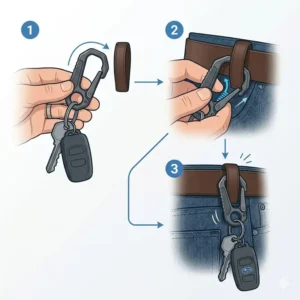
Practical Usage Guide: Maximizing Security and Accessibility
Proper implementation of your retention hardware ensures system longevity and prevents catastrophic drop-losses. Over my years consulting on asset security, I have developed a foolproof configuration protocol that guarantees optimal performance from day one.
First-Use Calibration and Break-In
When you first unbox a high-tension steel or titanium hardware piece, the spring gates can feel excessively stiff. Do not attempt to lubricate them immediately with heavy oils, which attract pocket lint and abrasive grit. Instead, manually actuate the gate fifty times to seat the spring wire within its recess.
The 30-Day Optimization Checklist
To maintain structural integrity and security, execute these three simple steps during your initial month of deployment:
-
Weight Distribution: Ensure your total key payload does not distort the main clip frame. If the gate aligns poorly when loaded, you have exceeded the mechanical weight envelope.
-
Contact Audit: Inspect your belt or waistband for signs of material abrasion. If a sharp metal edge is chewing through your fabric, adjust the placement or switch to a smooth-contoured model like the Lucky Line Secure-A-Key.
-
Fastener Verification: For clips that use small structural screws (such as retractable housings or premium lanyards), verify they remain tightly seated. A drop of medium-strength thread locker prevents these micro-screws from backing out under vibration.
Real-World Scenarios: From Office Complexes to Artifact Panel Screen Management
Every professional setting imposes distinct physical demands on your hardware. Selecting a configuration based on your specific environmental challenges prevents operational bottlenecks.
[Operational Environment Assessment]
       │
       ├─► High Security / Museum Archive ──► Use Lockable Carabiner + Mesh Anchors
       │
       ├─► Rapid-Access Corporate Campus ──► Use Retractable Kevlar Reels
       │
       └─► Tactical / Law Enforcement ─────► Use Heavy Duty Heat-Treated Steel Snaps
The Institutional Archive and Gallery Environment
In specialized conservation settings, managing physical assets requires extreme precision. Consider an archive utilizing a high-density, steel mesh artifact panel screen for hanging historic collections. Technicians must navigate these galleries holding delicate exhibits with both hands while simultaneously managing security keys for distinct cabinets. In this scenario, using a cheap carabiner is a recipe for disaster; a dangling ring can strike and scratch a delicate canvas or a vulnerable surface.
For this use case, I recommend anchoring a retractable system like the Key-Bak Super48 directly to your belt loop, or utilizing a specialized dual-chamber hook to mount master control tags directly onto the structural wire of the artifact panel screen itself. This keeps the key flush against the grid structure, removing swinging kinetic energy entirely and ensuring that historical materials remain undisturbed during inventory audits.
The Corporate Facilities Commuter
For the corporate manager overseeing multiple buildings, access cards and master physical keys must coexist. Placing a digital smart fob directly alongside heavy brass keys on a rigid loop can shield the RFID antenna, leading to read failures at badge terminals. By deploying a modular system like the Nite Ize S-Biner, you can isolate the electronic fob in its own chamber, allowing it to hang cleanly away from the metal mass of your physical keys, eliminating interference and speeding up your morning entrance routine.
Buyer’s Decision Framework: Selecting Your Ideal Key Clip
To cut through marketing fluff and prioritize features that map directly to your daily life, use this simple priority checklist before finalizing your hardware selection.
Identify Your Primary Operational Constraint
-
If Security is Absolute: Choose a closed-loop pass-through design that slides onto your belt. Open-ended slip-on clips can pop off if caught on seatbelts or heavy armchairs.
-
If Accessibility is King: Prioritize a retractable Kevlar or steel cord system that eliminates the detachment step completely.
-
If Minimal Bulk is Required: Opt for a spring-tempered sheet metal clip that rides inside the pocket line, hiding the metallic profile from plain sight.
The Anti-Recommendation: When “Perfect” Clips Fail
It is vital to understand that a top-tier tactical tool can be a terrible fit in the wrong environment. For instance, while the Zak Tool ZT55 is an unmatched masterpiece of security for a police officer wearing a rigid duty belt, it is a disastrous choice for an office worker wearing a lightweight cotton waistband or silk trousers. The extreme tension will tear thin fabrics, and the lack of a backing plate means it will tip forward aggressively under load, dragging your trousers down and bruising your hip. Always match the clip mounting architecture to the tensile strength of your clothing.
How to Choose a Heavy-Duty Key Clip
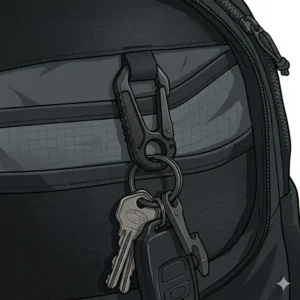
Selecting an exceptional retention tool requires evaluating specific engineering factors that standard consumer reviews completely ignore. When you are looking to purchase a reliable key clip, evaluate these four critical technical vectors:
1. Metallurgical Composition and Tensile Strength
The material base of your hardware dictates its ultimate lifespan. Look for materials that offer high yield strength and corrosion resistance:
-
304/316 Stainless Steel: Excellent balance of raw tensile strength and complete rust prevention in humid environments.
-
Grade 5 Titanium (Ti-6Al-4V): Offers an incredible strength-to-weight ratio, completely eliminating hip sag while providing lifetime spring retention.
-
Heat-Treated Spring Steel: Provides maximum resistance against bending or deformation under sudden physical snags.
2. Gate Mechanism Engineering
The gate is the primary point of failure on almost all low-grade hardware. Premium options avoid simple wire wraps and instead leverage integrated leaf springs or machined pivot pins. Inspect the gate tolerance; there should be zero lateral play or wiggle when the gate is fully depressed. For high-security environments, look for an added mechanical slider lock that physically blocks the gate path when closed.
3. Belt Attachment Interface
How the hardware interacts with your clothing determines its stability. Ensure the belt loop opening matches your belt width. A standard 1.5-inch casual leather belt will slide uncontrollably inside a 2.25-inch tactical duty clip, causing the tool to shift behind your back when you sit down, making single-handed blind re-holstering impossible.
Common Mistakes When Buying Tactical and EDC Hardware
Over my consulting career, I have witnessed major security teams throw away thousands of dollars on ineffective gear. Here are the most prevalent pitfalls you must avoid:
Falling for the “Aircraft-Grade Aluminum” Hype
Many manufacturers use the phrase “aircraft-grade aluminum” to make cheap anodized carabiners sound elite. In reality, unless it specifies 7075 or 6061-T6 aluminum, it is highly likely a soft casting that will warp the first time it gets caught on a door frame or car door. Stick to steel or titanium for components under constant spring load.
Ignoring the Total Cost of Ownership (TCO)
Buying a cheap three-dollar novelty clip every six months seems inconsequential. However, over a five-year window, you will spend more on replacements than you would on a single premium tool like a Key-Bak or Trayvax. More importantly, the true cost of a cheap clip failure isn’t the price of the clip—it is the hundreds of dollars spent locksmithing re-keyed deadbolts because your master set slipped away unnoticed on a dark evening.
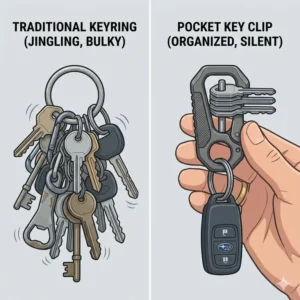
Traditional Key Rings vs Modern Key Clip Mechanics
To understand why upgrading your carry asset is so vital, we must analyze the structural mechanics of traditional split-rings compared to modern engineered clips.
| Mechanical Feature | Traditional Split-Ring | Modern Key Clip Hardware |
| Stress Distribution | Concentrated on localized wire coils | Distributed along a structural spine |
| Speed of Detachment | Slow (requires prying coils apart) | Instantaneous (one-handed spring actuation) |
| Payload Capacity | High density, high clutter | High density, isolated compartmentalization |
| Ergonomic Profile | Batches pool heavily at bottom of pocket | Suspends payload neatly along waistband |
| Mechanical Failure Mode | Permanent deformation (coils stay bent) | Spring fatigue (predictable over years) |
Data Analysis: This structural breakdown demonstrates that traditional split-rings excel purely at bundling keys tightly together, but fail miserably at providing ergonomic support or speed. Modern key clip mechanics transform your keys into a modular toolkit, distributing weight across structural load points and utilizing crisp, intentional release gates to optimize your daily efficiency.
What to Expect: Real-World Performance and Longevity
When you invest in professional-grade retention gear, the product undergoes a distinct lifecycle. Understanding this timeline helps you plan preventative adjustments before a critical component fails.
The Year One Roadmap
-
Months 1–3 (The Break-In Phase): Internal spring edges smooth out. Coated models (like matte black oxide steel) will show initial cosmetic wear at friction points. This is completely normal and does not indicate structural breakdown; it is simply the hardware self-polishing its contact paths.
-
Months 4–6 (The Stabilization Phase): The clip achieves its optimal mechanical sweet spot. Gate tension remains stable, and your muscle memory adapts to effortless blind attachment and detachment.
-
Months 7–12 (The Maintenance Threshold): For retractable models, you may notice a slight accumulation of dust along the entry collar of the cord. A quick wipe down prevents this grit from migrating into the internal spring housing, ensuring smooth extensions for the second year of service.
Key Clip Integration for Specific Professional Audiences
Tailoring your hardware choices to your occupational reality removes friction from your workday and protects your high-value equipment from unnecessary wear.
Property Management and Real Estate Agents
Real estate professionals constantly transition from immaculate luxury interiors to rough utility rooms. Carrying a massive, jingling cluster of keys on a bare ring looks unprofessional and can easily scratch fine hardwood entry tables or delicate finishes during home tours. By adopting an elegant, low-profile leather loop system like the Trayvax Link, you keep your keys completely secured and silent against your thigh, maintaining a polished presentation while ensuring you never misplace a seller’s front door key during an open house.
Industrial Logistics and Warehouse Operators
In fast-paced fulfillment hubs, workers constantly climb in and out of forklifts and reach into picking bins. A key clip mounted directly on the front hip can catch aggressively on heavy steering wheels or industrial packaging straps. For these highly active environments, operators should slide their hardware further back toward the 4 o’clock position on their hip line, utilizing a rigid steel belt pass-through to ensure that external shearing forces never accidentally depress the gate during high-intensity shifts.
Long-Term Cost & Maintenance of High-Tensile Retention Tools
Maintaining your security hardware requires minimal effort, but regular attention dramatically extends the operational life of the internal spring components.
The Efficiency Gap & TCO Analysis
Let us evaluate the true fiscal impact of ignoring proper maintenance or purchasing inferior hardware options. A business deploying twenty maintenance technicians with low-grade retention chains will suffer an efficiency gap due to frequent equipment down-time and lost access fobs.
| Hardware Quality Level | Initial Purchase Price | Expected Lifespan | Annual Maintenance Cost | Replacement Frequency | Total 5-Year Cost |
| Low-Grade Generic | Around $3 | 6 Months | $0 (Disposable) | 10 Times | Around $30 |
| Professional Grade | Around $20 | 5+ Years | $1 (Drop of dry lube) | 0 Times | Around $21 |
Data Analysis: Although a premium tool requires a higher upfront expenditure, its total five-year cost is significantly lower than constantly buying disposable replacements. This analysis proves that investing in high-quality hardware completely eliminates the hidden costs associated with tracking down missing components and repairing structural damage caused by failed fasteners.
Pro-Tip: The Locksmith’s Graphite Trick
Never spray standard liquid lubricants like WD-40 directly into a sticky clip gate or retractable reel housing. Liquid oils create a sticky film that captures fine pocket lint, turning it into an abrasive sludge that eats away at internal pins. Instead, apply a micro-dose of dry powdered graphite or a dedicated dry-film PTFE spray Wikipedia. This creates a slick layer without attracting a single speck of dust, keeping your gate action feeling brand new for years.
Features That Actually Matter (And Those That Don’t)
Marketing departments excel at inventing complex terms for useless features. As an industry consultant, let me help you filter out the hype so you can focus on real functionality.
Features that Bring Real-World Value
-
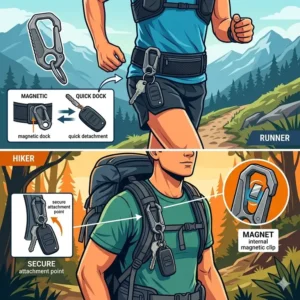
Swivel Hinges: Essential for long lanyards or heavy key sets. They allow the keys to twist freely as you bend down, preventing the clip from prying itself off your belt loop.
-
Jimping on the Gate Slider: Deep machined grooves on the gate release point provide wet-weather traction, allowing you to operate your gear safely while wearing heavy work gloves.
-
Captive Eyelets: A dedicated separate hole at the bottom of the clip ensures your main split-ring cannot slide up and bind the primary attachment gate.
Overrated Features to Ignore
-
Integrated Multi-Tool Hex Wrenches: A carabiner frame lacks the ergonomic leverage needed to tighten a stubborn bolt. These cutouts simply create sharp structural weak points that collect dirt and weaken the overall frame strength.
-
Decorative Carbon Fiber Inlays: Unless the carbon fiber forms the actual load-bearing spine of the tool, a thin glued-on decorative sticker adds zero structural durability while artificially inflating the final price tag.
Safety, Security, and Compliance Protocols for Key Management
In corporate, institutional, and defense settings, key retention is governed by strict physical security compliance mandates. Implementing your daily carry hardware correctly helps you align with rigorous facility standards.
The Two-Point Rule of Positive Control
In high-security environments, such as medical centers or museums managing high-value exhibits on an artifact panel screen, a master key set must never be unanchored from your body while in transit. This means your key clip system must feature a secondary internal ring or tether. When unlocking a secure door, the primary clip remains anchored to your belt, while an extending cable or quick-disconnect line allows the key to reach the lock face. This ensures that even if you drop the keys out of your hand due to an unexpected distraction, the assets remain safely tethered to your person, satisfying strict facility compliance protocols.
Regulatory Compliance and Material Safety
When working in industrial manufacturing or electrical substations, your choice of carry gear must adapt to extreme environmental risks:
-
Non-Conductive Requirements: If your role places you near exposed electrical circuits, metal clips present a severe arcing hazard. You must use high-density polycarbonate options like the non-conductive variants of the Key-Bak series.
-
Spark-Free Mandates: In grain silos, chemical processing plants, or aerospace refueling zones, standard steel-on-steel impact can create micro-sparks capable of igniting airborne vapors. Utilizing non-ferrous titanium or solid brass hardware ensures complete compliance with strict explosion-prevention directives.
✨ Don’t Miss These Exclusive Deals!
🔍 Take your organization to the next level with these carefully selected products. Click on any highlighted item to check current pricing and availability. These tools will help you create authentic organizational systems your family or team will love!
Conclusion
Upgrading your everyday carry configuration with a specialized retention tool dramatically improves your daily security, organization, and peace of mind. By shifting away from chaotic, unstructured pocket storage toward an engineered system designed for your specific workplace or lifestyle, you protect your valuable electronic fobs and physical assets from accidental loss or expensive damage. Whether your duties involve managing complex facility keys across extensive corporate campuses, organizing historic tags on a heavy-duty artifact panel screen, or simply streamlining your personal morning routine, there is a specialized design tailored exactly to your environment. Take the time to audit your current carry setup, evaluate your structural needs, and select an option that delivers lasting confidence and operational efficiency.
Frequently Asked Questions
❓ How do I stop my keys from jingling on my hip?
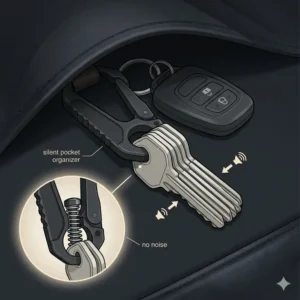
✅ You can slide a small neoprene sleeve or a wide rubber band over your key bundle after anchoring them to your clip. This compresses the metal faces together, completely eliminating ambient noise while maintaining full accessibility…
❓ Can I take a heavy-duty tactical key clip through airport security?
✅ Yes, static metal or titanium clips are fully TSA-compliant since they lack sharp cutting edges. However, you should place your entire loaded key set inside your carry-on bag before passing through the scanner to avoid setting off walk-through metal detectors…
❓ What is the best way to clean a mud-clogged carabiner gate?
✅ Submerge the hardware in a bowl of warm, soapy water and actuate the gate repeatedly to flush out trapped sediment. Rinse it thoroughly under clean water, blow dry with compressed air, and apply a drop of dry graphite lubricant…
❓ Will a steel clip scratch my expensive leather dress belt?
✅ Over time, sharp or unpolished metal edges can score soft leather. If you regularly wear premium dress belts, select a clip with rounded internal radiuses or opt for a top-grain leather loop pass-through system that prevents direct metal contact…
❓ How many keys can a standard retractable Kevlar reel support before sagging?
✅ A premium 8-ounce retraction reel cleanly holds up to 15 standard brass keys or roughly 6 ounces of total weight. Exceeding this weight threshold overrides the main spring tension, causing the line to sag during active walking…
Recommended for You
- 7 Best Key Chain Tools of 2026: The Ultimate EDC Power Guide!
- 7 Best Keychain Tool Kit Options in 2026: Expert EDC Reviews
- EDC Key Ring Secrets: 7 Must-Have Tools for Amazing Preparedness
Disclaimer: This article contains affiliate links. As an Amazon Associate, I earn from qualifying purchases. If you purchase products through these links, we may earn a small commission at no additional cost to you.
✨ Found this helpful? Share it with your friends! 💬🤗
[addtoany]
