
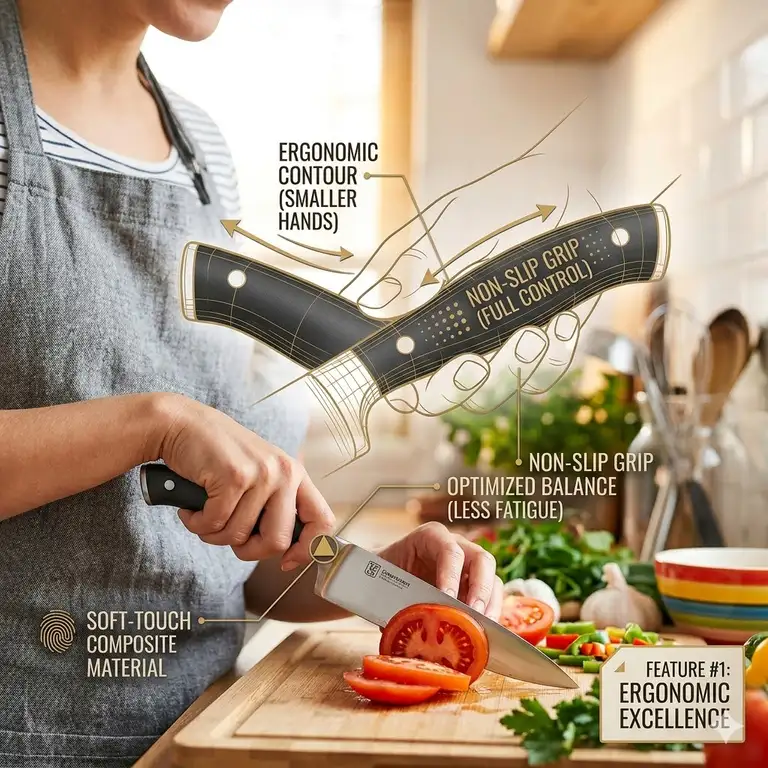
When we talk about the best knife for woman, we aren’t suggesting that gender dictates the ability to handle a blade. However, ergonomic reality often speaks louder than marketing fluff. For many female home cooks and professional chefs, traditional European knives—often designed for larger hand spans and greater forearm leverage—can feel cumbersome, leading to premature fatigue or, worse, a loss of control. In 2026, the culinary world has moved toward a more nuanced understanding of “fit,” focusing on how handle geometry, blade weight, and balance points interact with smaller hands and different grip styles.
Choosing the right tool is about more than just a sharp edge. A knife that is too heavy can strain the wrist during a long session of dicing onions, while a handle that is too thick prevents a secure “pinch grip,” which is the gold standard for safety and precision. The goal is to find a blade that feels like an extension of the arm. Whether you are a weekend gourmet or a daily meal-prepper, the right knife should provide a sense of confidence and effortless movement. This guide explores the top-tier options currently dominating the market, emphasizing tools that prioritize agility without sacrificing the heavy-duty performance required in a modern kitchen.
Quick Comparison: Top 5 Kitchen Blades for 2026
| Product Name | Blade Type | Weight | Best For | Price Range |
| Shun Classic 6-inch Chef’s Knife | Japanese VG-MAX | Ultra-Light | Precise dicing & small hands | $150 – $180 |
| Global G-2 Classic 8-inch | Stainless Steel | Very Light | Speed and modern aesthetics | $90 – $120 |
| Wüsthof Classic Ikon 7-inch Santoku | Forged German | Balanced | Heavy-duty prep & comfort | $160 – $200 |
| Victorinox Swiss Army Fibrox Pro | Stamped Steel | Lightweight | Budget-conscious beginners | $45 – $60 |
| MAC Professional Series 8″ Chef | High Carbon | Medium | All-around versatility | $140 – $175 |
Expert Analysis: The table above highlights a clear trend toward Japanese-style blades and hybrid German designs. While the Shun Classic offers the most precision for those with smaller hands, the Wüsthof Classic Ikon is the superior choice for users who still want that “German tank” feel but with a more contoured, feminine-friendly handle. The Global G-2 remains the outlier for its unique all-metal construction, which appeals to those who prioritize sanitation and a very forward-balanced weight.
💬 Just one click — help others make better buying decisions too!😊
[addtoany]
Top 5 Products: Expert Analysis
1. Shun Classic 6-inch Chef’s Knife (Model DM0723)
The Shun Classic 6-inch Chef’s Knife is often the “ah-ha” moment for many women who find standard 8-inch blades intimidating. Its shorter length provides a level of maneuverability that makes intricate tasks like mincing garlic or julienning shallots feel like child’s play.
-
Key Specifications: This knife features a VG-MAX cutting core clad in 34 layers of stainless Damascus steel per side, resulting in a 61 Rockwell hardness. In practical terms, this means the edge is incredibly thin and stays sharp significantly longer than standard stainless steel, allowing you to slice through tomato skins with zero resistance.
-
Expert Opinion: I frequently recommend this to home cooks who struggle with the “rocking” motion of larger knives. The D-shaped Pakkawood handle is specifically designed to tuck into the curve of your fingers, providing a mechanical advantage that reduces hand strain. It’s the ultimate “surgical” kitchen tool.
-
Customer Feedback: Users consistently rave about how “light as a feather” it feels compared to traditional knives, though some note that the hard steel can be prone to chipping if used on frozen foods.
✅ Pros:
-
Superior edge retention for precision work
-
D-shaped handle offers incredible grip stability
-
Beautiful aesthetic that stands out in any kitchen
❌ Cons:
-
Requires hand-washing and careful storage
-
High carbon core is more brittle than German steel
-
Value Verdict: Expect to spend around $165. This is a “buy it for life” investment for someone who values precision over brute force.
2. Global G-2 Classic 8-inch Chef’s Knife
If you prefer a full 8-inch blade but hate the weight of traditional forged knives, the Global G-2 Classic 8-inch Chef’s Knife is a revolutionary option. It is iconic for its one-piece stainless steel construction.
-
Key Specifications: Made from CROMOVA 18 stainless steel, it features a unique hollow handle filled with just enough sand to create a perfect weight balance. This design keeps the overall weight around 5.6 ounces—nearly 40% lighter than a standard German chef’s knife.
-
Expert Opinion: What most buyers overlook is the handle’s dimpled texture. Even when your hands are wet or covered in chicken fat, the grip remains remarkably secure. It’s perfect for fast-paced prep where you’re moving between different ingredients quickly.
-
Customer Feedback: Most love the “modern” feel and the ease of cleaning, while a few professional chefs mention the handle can feel a bit small for those with very large hands—which makes it a prime candidate for many women.
✅ Pros:
-
Incredibly easy to sanitize due to no-seam design
-
Extremely lightweight, reducing wrist fatigue
-
Steels stays sharp and is easy to maintain
❌ Cons:
-
Metallic handle can feel “cold” to some users
-
Lacks a traditional bolster for a finger rest
-
Value Verdict: Usually found in the $100-$120 range. It offers a professional-grade experience at a mid-tier price point.
3. Wüsthof Classic Ikon 7-inch Santoku (Model 4176)
The Wüsthof Classic Ikon 7-inch Santoku represents the pinnacle of German engineering adapted for modern ergonomics. It combines the durability of Wüsthof’s legendary steel with a handle that actually fits the human hand.
-
Key Specifications: This is a forged knife with a 58 HRC hardness and a “hollow edge” (dimples) that creates air pockets to prevent food from sticking. The double-bolster design acts as a counterweight to the blade, shifting the balance point toward the heel.
-
Expert Opinion: This is my “workhorse” recommendation. The Ikon handle is more curved and slimmer than the standard Wüsthof Classic, making it much more comfortable for smaller palms. The 7-inch length is the “sweet spot”—long enough for a cabbage, but short enough for total control.
-
Customer Feedback: Buyers appreciate the “solid” feel that doesn’t feel “heavy.” It is frequently cited as the best transition knife for those moving from cheap sets to high-end cutlery.
✅ Pros:
-
Double bolster provides impeccable balance
-
Extremely durable and resistant to stains/corrosion
-
Contoured handle is the most ergonomic in its class
❌ Cons:
-
Heavier than Japanese alternatives
-
Price is on the higher end of the spectrum
-
Value Verdict: Around $170-$190. It’s the safest “blind buy” because it handles almost any kitchen task with grace.
4. Victorinox Swiss Army Fibrox Pro 8-inch Chef’s Knife
Don’t let the modest price fool you; the Victorinox Swiss Army Fibrox Pro is a darling of professional kitchens and a fantastic entry point for anyone searching for the best knife for woman on a budget.
-
Key Specifications: This is a stamped blade made of high-carbon stainless steel. It features the patented Fibrox handle, which is a textured thermoplastic elastomer designed to be slip-resistant even when greasy.
-
Expert Opinion: The spec sheet won’t tell you this, but the thinness of this stamped blade actually makes it a better slicer than many expensive forged knives. Because it lacks a bolster, you can use the entire length of the blade and sharpen it easily from heel to tip. It’s the “sensible shoes” of the knife world.
-
Customer Feedback: Users love that they don’t have to “baby” this knife. It can handle the dishwasher (though I don’t recommend it) and stays sharp through a lot of abuse.
✅ Pros:
-
Unbeatable price-to-performance ratio
-
The safest grip in the industry (Fibrox)
-
Lightweight and easy to swing for long periods
❌ Cons:
-
Industrial, utilitarian appearance
-
Blade is somewhat flexible, which can feel odd at first
-
Value Verdict: Typically priced around $50. It’s the perfect choice for college students, beginners, or as a secondary “beater” knife.
5. MAC Knife Professional Series 8″ Chef’s Knife with Dimples (Model MBK-85)
The MAC Professional Series 8″ Chef’s Knife is often called the “chef’s favorite” because it bridges the gap between Japanese sharpness and Western utility.
-
Key Specifications: It features a thin 2.5mm blade with a sub-zero tempered steel core. The slight bolster and the addition of dimples (Granton edge) make it an elite performer for slicing through sticky vegetables like potatoes or squash.
-
Expert Opinion: In my experience, MAC knives have a “geometry of ease.” The blade is slightly tapered toward the tip, allowing for very fine work. For a woman who wants an 8-inch blade but finds German steel too chunky and pure Japanese steel too delicate, this is the perfect middle ground.
-
Customer Feedback: Owners often report that this becomes their most-used knife within a week, displacing much more expensive custom blades.
✅ Pros:
-
Thin blade reduces “wedging” in hard vegetables
-
Perfectly balanced right at the pinch-grip point
-
Extremely sharp out of the box
❌ Cons:
-
The handle is somewhat plain wood
-
Requires more frequent honing than the Shun
-
Value Verdict: Expect to pay around $150-$175. It is a high-performance tool that rewards good technique.
✨ Don’t Miss These Exclusive Deals!
🔍 Take your kitchen skills to the next level with these carefully selected products. Click on any highlighted item to check current pricing and availability. These tools will help you create authentic meals your family will love!
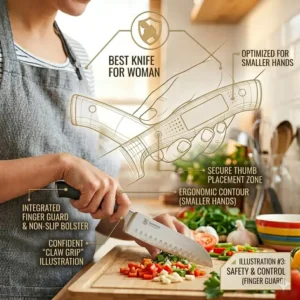
Transformation: A Practical Usage & Maintenance Guide
Owning the best knife for woman is only half the battle; the other half is ensuring that the tool remains a help rather than a hindrance. Many people buy a $200 knife and then destroy its edge within six months due to poor maintenance.
The First 30 Days: Mastering the Tool
When you first get your new knife, the most common mistake is over-compensating for a lack of sharpness. High-end blades like the Shun or MAC require very little downward pressure.
-
Tip 1: Practice your “Pinch Grip.” Grip the blade between your thumb and the side of your index finger just in front of the handle. This lowers your center of gravity and gives you 2x the control.
-
Tip 2: Always use a wood or plastic cutting board. Glass or marble boards are the natural enemies of steel; they will dull your edge in a single session.
-
Tip 3: Never “scrape” your chopped veggies off the board using the sharp edge of the knife. Flip the knife over and use the spine to push ingredients into your bowl.
Long-Term Optimization
To keep your knife performing like it’s brand new in 2026, you need a two-tiered sharpening strategy.
-
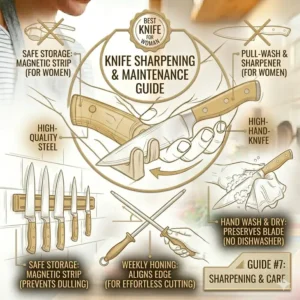
Honing (Weekly): Use a ceramic or steel rod to realign the microscopic teeth of the blade. This doesn’t remove metal; it just “straightens” the edge.
-
Sharpening (Yearly): Depending on use, have your knife professionally sharpened or use a high-quality whetstone. If you’re using the Global or Victorinox, a simple pull-through sharpener is acceptable, but for the Shun, stick to whetstones to preserve the 16-degree angle.
Transformation: The Buyer’s Decision Framework
Still not sure which blade to choose? Use this priority checklist to identify your needs before you click “buy.”
Step 1: Analyze Your Hand Size
Hold a standard ruler. If the distance from your wrist to the tip of your middle finger is less than 6.5 inches, you will likely find a 6-inch chef’s knife or a 7-inch Santoku much more comfortable than a standard 8-inch blade. The Shun Classic 6-inch is your gold standard here.
Step 2: Determine Your Cutting Style
-
The Rocker: If you like to keep the tip of the knife on the board and rock back and forth, choose a German-style blade with a “belly” (curve), like the Wüsthof Ikon.
-
The Pusher: If you prefer an up-and-down “chopping” motion, a flatter Japanese blade like the Shun or a Santoku will feel much more natural.
Step 3: Assess Your Maintenance Commitment
Be honest with yourself. If you are likely to leave your knife in the sink or forget to dry it immediately, avoid high-carbon Japanese steel. You are a “Stainless Warrior.” Go with the Victorinox or the Wüsthof. These can handle a bit of moisture without rusting or pitting.
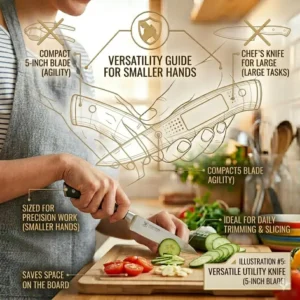
How to Choose the Best Knife for Woman: A 5-Step Guide
-
Prioritize the Bolster: Look for a “half-bolster” or a tapered bolster. Full bolsters (the thick metal part between handle and blade) often get in the way of a proper pinch grip and make sharpening the heel of the knife impossible.
-
Check the Balance Point: Balance the knife on your index finger at the point where the blade meets the handle. If it tips wildly toward the blade, it will feel “heavy” regardless of its actual weight. A neutral balance is best for beginners.
-
Evaluate Handle Geometry: Many women find that “waisted” handles (those that are thinner in the middle or toward the front) allow for a more secure wrap-around with the fingers.
-
Weight vs. Power: Don’t assume lighter is always better. A bit of weight in a Wüsthof helps the knife fall through harder vegetables like carrots, whereas a super-light Global requires you to provide all the downward force.
-
Blade Length Reality Check: In 2026, the 7-inch Santoku has become the most popular choice for women. It offers the surface area of a chef’s knife with the agility of a paring knife.
Common Mistakes When Buying a Kitchen Knife
One of the biggest pitfalls is buying a “block set.” You might think you’re getting a deal, but most sets contain 10-12 knives you will never use. Expert advice is always to spend that same $200-$300 on two high-quality knives: a great Chef’s knife (your primary) and a 3.5-inch paring knife.
Another mistake is falling for “marketing sets” targeted specifically at women through colors or floral patterns. Usually, these knives use inferior steel that won’t hold an edge. The best knife for woman isn’t pink; it’s a professional tool that happens to have superior ergonomics. Finally, don’t ignore the “spine” of the knife. If the spine has sharp, squared-off edges, it will chafe your hand during a pinch grip. High-end knives like the MAC or Wüsthof have slightly rounded spines for comfort.
Chef’s Knife vs. Santoku: Which is Better?
The debate between the traditional Chef’s knife and the Japanese Santoku is particularly relevant for female cooks. A Chef’s knife (like the Global G-2) has a curved edge designed for a rocking motion. This is great for herb mincing and general versatility. However, the curve means the “point” is higher, which can feel awkward for those with shorter arms.
The Santoku (like the Wüsthof Ikon Santoku) has a flatter edge and a “sheep’s foot” tip that points downward. This design promotes a vertical chopping motion, which many find more stable. Because the Santoku is typically shorter (5 to 7 inches), it keeps the hand closer to the food, providing a greater sense of control. If you find yourself mostly prepping vegetables and boneless meats, the Santoku is often the superior choice for ergonomics.
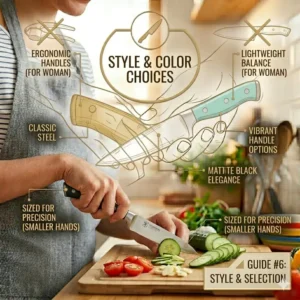
What to Expect: Real-World Performance
When you upgrade to a professional blade, the first thing you’ll notice isn’t just the sharpness—it’s the lack of friction. A high-quality blade is ground much thinner than a “grocery store” knife. This means the knife doesn’t just cut; it glides.
In real-world terms, this transforms your kitchen experience. Prep time for a stir-fry might drop from 20 minutes to 10. More importantly, the physical toll on your body is reduced. You won’t feel that dull ache in your shoulder or the tension in your forearm after preparing a Sunday roast. By 2026 standards, a knife is considered a success if the user “forgets” they are holding it. That level of “transparency” in a tool is what we aim for with these recommendations.
Long-Term Cost & Maintenance Analysis
While $150 might seem steep for a single kitchen tool, let’s look at the ROI (Return on Investment). A high-quality forged knife like the Wüsthof Classic Ikon is built to last 20 to 30 years with proper care.
-
The Math: $180 / 20 years = $9 per year.
-
The Alternative: Buying a $20 “supermarket” knife every 2 years because it becomes too dull to sharpen. Total cost over 20 years: $200.
Not only is the premium knife cheaper in the long run, but the “cost” of accidents is also lower. Dull knives require more force, which is when the blade is most likely to slip and cause an injury. A sharp, ergonomic knife is, ironically, the safest thing in your kitchen.
Features That Actually Matter (And Those That Don’t)
In the world of 2026 kitchen marketing, it’s easy to get lost in the hype. Here is the expert filter:
-
Matters: Steel Hardness (HRC). This tells you how long the edge will stay sharp. Look for 56-58 for durability, 60+ for extreme sharpness.
-
Matters: Handle Material. Synthetic materials like Pakkawood or Santoprene are better than natural wood because they won’t crack or harbor bacteria when exposed to water.
-
Doesn’t Matter: Damascus “Patterns.” While beautiful, the wavy lines on the side of a blade are largely aesthetic and do not improve the cutting ability of the core steel.
-
Doesn’t Matter: “As Seen on TV” Coatings. Non-stick coatings on knives usually flake off over time and can’t compare to the performance of a well-ground blade with dimples.
✨ Don’t Miss These Exclusive Deals!
🔍 Ready to upgrade? Click on any of the product names above to check the latest availability and price ranges. Your perfect kitchen companion is just a click away!
Conclusion
Finding the best knife for woman isn’t about finding a “lite” version of a professional tool; it’s about finding a professional tool that respects the ergonomics of the user. From the surgical precision of the Shun Classic to the rugged, balanced comfort of the Wüsthof Ikon, the options available in 2026 are better than ever. By prioritizing a handle that fits your grip and a weight that doesn’t strain your wrist, you transform cooking from a chore into a creative outlet. Remember, the best knife is the one you feel most confident using.
FAQs
❓ What is the best knife length for a woman?
✅ Most women find a 6-inch or 7-inch blade offers the best balance of capability and control. An 8-inch blade is versatile but can feel unwieldy if the user has a shorter reach or smaller workspace…
❓ Can I put high-end knives in the dishwasher?
✅ Absolutely not. The high heat can warp the handle, and the abrasive detergent will dull the edge. More importantly, the “clanking” against other dishes can chip the blade. Always hand-wash and dry immediately…
❓ What is a “Pinch Grip” and why does it matter?
✅ A pinch grip involves holding the blade itself between your thumb and forefinger. This provides maximum control and prevents the knife from rolling. It is the most important technique for kitchen safety and precision…
❓ How often should I sharpen my knife?
✅ You should “hone” your knife with a steel every few uses to keep the edge straight. “Sharpening” (removing metal to create a new edge) should only be done once or twice a year depending on usage…
❓ Is a heavier knife better for cutting tough vegetables?
✅ Yes, weight can be an advantage for “gravity-assisted” cutting of squashes or melons. However, for 90% of kitchen tasks, a lighter, more balanced knife is preferable to prevent wrist fatigue and strain…
Recommended for You
- 5 Best Knives for Ladies in 2026: Expert Safety & Utility Guide
- Gerber Truss vs Leatherman: 7 Best Multitools Compared (2026)
- 5 Best Light Weight Folding Knife Options for Your 2026 EDC
Disclaimer: This article contains affiliate links. As an Amazon Associate, I earn from qualifying purchases. If you purchase products through these links, we may earn a small commission at no additional cost to you.
✨ Found this helpful? Share it with your friends! 💬🤗
[addtoany]
