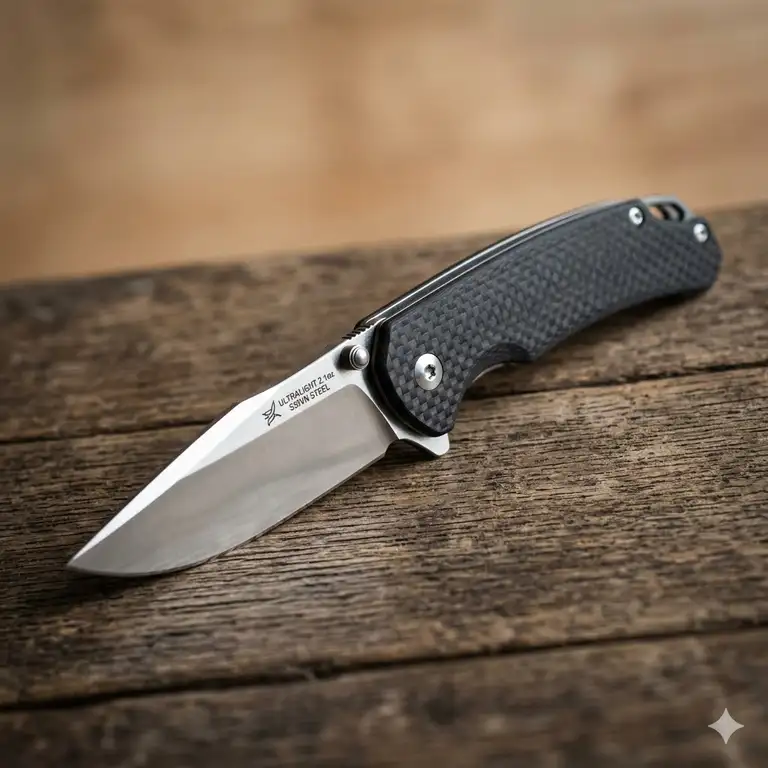
In the world of everyday carry (EDC), there is an old hiker’s adage that has become the golden rule for modern gear enthusiasts: “Ounces equal pounds, and pounds equal pain.” Whether you are trekking up a mountain pass or just trying to keep your khakis from sagging during a Tuesday morning meeting, the weight of your tools dictates your comfort. A light weight folding knife isn’t just a cutting tool; it is a marvel of modern metallurgy and polymer engineering designed to disappear into your pocket until the exact moment you need it.
What is a light weight folding knife?
A light weight folding knife is a pocket knife specifically engineered to weigh under 3 ounces (approximately 85 grams) without sacrificing structural integrity or cutting performance. These knives typically utilize high-strength handle materials like carbon fiber, FRN (Fiberglass Reinforced Nylon), or Grivory, paired with premium steels that allow for thinner blade stock while maintaining edge retention.
Back in the early 2000s, a “sturdy” knife meant a heavy hunk of stainless steel and G10 that felt like a brick in your pocket. Fast forward to 2026, and the industry has shifted toward “high-performance minimalism.” We are seeing manufacturers push the boundaries of what a folding tool can be, using aerospace-grade materials to create blades that are literally lighter than a deck of cards. In this guide, I’ll walk you through the top performers of the year, analyzing not just their specs, but how they actually feel when you’re trying to break down a cardboard box at the end of a long day.
Quick Comparison: Top Light Weight Folding Knife Models
| Product Model | Weight | Blade Steel | Handle Material | Best For |
| Benchmade Bugout | 1.85 oz | CPM-S30V | Grivory | Ultralight Hiking |
| Spyderco Para 3 LW | 2.40 oz | CTS-BD1N | FRCP | Ergonomic Utility |
| Civivi Elementum | 2.89 oz | Nitro-V | Carbon Fiber | Budget Elegance |
| Kershaw Leek | 2.40 oz | 14C28N | Stainless Steel | Sleek Office Carry |
| CRKT CEO | 2.10 oz | 8Cr13MoV | GRN | Discreet Professional |
Expert Data Analysis
Looking at the comparison above, the Benchmade Bugout remains the featherweight champion for those who prioritize the absolute lowest weight-to-blade-length ratio. However, if you are looking for a more ergonomic grip for heavy-duty tasks, the Spyderco Para 3 LW offers a more secure hand-feel despite being slightly heavier. For those on a budget, the Civivi Elementum provides the best balance of premium aesthetics and modern steel without crossing the $100 threshold.
💬 Just one click — help others make better buying decisions too!😊
[addtoany]
Top 5 Light Weight Folding Knife Options: Expert Analysis
1. The Featherweight Standard: Benchmade Bugout 535
The Benchmade Bugout is the knife that arguably started the modern ultralight EDC craze, and in 2026, it remains the benchmark by which all others are measured.
This knife features a 3.24-inch blade made from CPM-S30V steel, which provides excellent corrosion resistance and edge longevity. The handles are made of Grivory, a high-strength thermoplastic that allows the knife to weigh in at a staggering 1.85 ounces. In my experience, the Bugout is the only knife of its size that you can genuinely forget is in your pocket—I’ve accidentally put mine through the laundry twice because it simply lacks “pocket presence.”
What most buyers overlook is the AXIS lock mechanism. While it’s incredibly fun to “fidget” with, it also ensures your fingers are never in the path of the blade when closing. This makes it an exceptionally safe choice for beginners. However, the Grivory handles do have a slight “flex” if you squeeze them hard; if that bothers you, you might want to look at aftermarket titanium scales, though that will increase the weight.
-
Customer Feedback: Users consistently praise the “disappearing act” it performs in the pocket, though some veteran knife nuts mention the factory edge sometimes needs a quick touch-up out of the box.
-
Pros:
-
Incredibly thin profile for deep-carry.
-
Ambidextrous AXIS lock is industry-leading.
-
Premium S30V steel holds an edge for months.
-
-
Cons:
-
Handle flex can feel “plasticky” to some.
-
Price has increased significantly over the years.
-
-
Price Range: Around $160 – $185 (Check current price on Amazon).
-
Verdict: The ultimate choice for hikers and anyone who wearing gym shorts or lightweight slacks.
2. The Ergonomic King: Spyderco Para 3 Lightweight
If the Bugout is about being thin, the Spyderco Para 3 LW is about being comfortable. It’s the “truck” of the lightweight world.
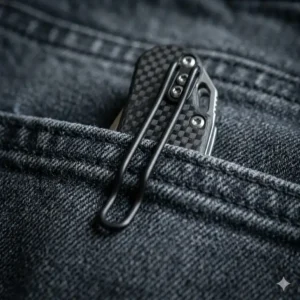
It utilizes a 2.92-inch blade made of CTS-BD1N steel, a nitrogen-enriched alloy that is surprisingly easy to sharpen to a mirror edge. The handle is Fiberglass Reinforced Co-Polymer (FRCP), featuring Spyderco’s signature bi-directional texturing. This texture is a lifesaver; even if your hands are wet or covered in fish scales, this knife isn’t going anywhere.
The standout feature here is the Compression Lock. It’s located on the spine of the handle, allowing for one-handed closing without your thumb crossing the blade’s path. From a practical perspective, this is a “hard-use” lightweight knife. While the Bugout is for slicing apples and opening mail, the Para 3 LW feels capable of heavy cardboard breakdown and even light bushcraft tasks. The wire clip is also the best in the industry—it’s discreet and doesn’t scream “I’m carrying a knife” to the public.
-
Customer Feedback: Fans love the ergonomics, often stating it fits the hand better than knives twice its price. Some note that the blade isn’t always perfectly centered due to the single-washer design.
-
Pros:
-
Unrivaled grip texture for safety.
-
Compression lock is strong and intuitive.
-
Wire pocket clip is very low-profile.
-
-
Cons:
-
Takes up more “width” in the pocket than the Bugout.
-
The FRCP handle can feel a bit hollow.
-
-
Price Range: $125 – $145 range (Check current price on Amazon).
-
Verdict: Best for blue-collar professionals who need a tool that works as hard as they do but weighs half as much.
3. The Modern Classic: Civivi Elementum (Carbon Fiber/S35VN)
Civivi has disrupted the market by offering “premium” materials at “budget” prices, and their lightweight Civivi Elementum variant is a masterclass in value.
Equipped with S35VN steel (in the premium variant) or Nitro-V (in the standard), this knife offers a 2.96-inch drop point blade. The carbon fiber overlays on the handle provide a sophisticated look that fits in just as well at a wedding as it does at a campsite. At 2.89 ounces, it sits right at the edge of our “lightweight” definition, but the flipping action is so smooth it feels like a much more expensive custom piece.
In my professional opinion, the Elementum is the “safe” gift. Its design is non-threatening and “gentlemanly.” The caged ceramic ball bearing pivot means the blade flies open with a simple press of the flipper tab. What the spec sheet won’t tell you is that the geometry of this blade makes it one of the best “slicers” on the list. If you find yourself cutting a lot of fibrous materials or prepping food on the go, the hollow grind on this blade is your best friend.
-
Customer Feedback: Reviews are overwhelmingly positive regarding the “bang for buck” factor. A few users mentioned the liner lock can be a bit stiff during the first week of use.
-
Pros:
-
Elegant aesthetics with real carbon fiber.
-
Incredibly smooth ball-bearing action.
-
Excellent blade geometry for clean slicing.
-
-
Cons:
-
The flipper tab can snag on pocket edges.
-
Not as “grippy” as the Spyderco.
-
-
Price Range: $65 – $95 range (Check current price on Amazon).
-
Verdict: The best choice for the “Gentleman” or “Lady” EDCer who wants a tool that looks like jewelry but performs like a scalpel.
4. The Executive’s Needle: CRKT CEO
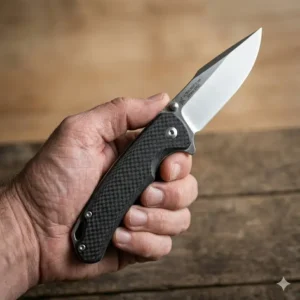
The CRKT CEO was designed with one goal: to look exactly like a pen when clipped into a shirt pocket.
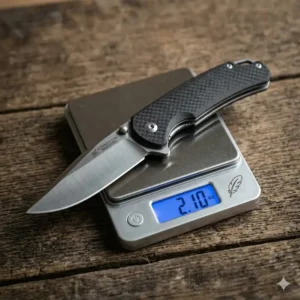
With a slim 3.1-inch blade made of 8Cr13MoV steel and a weight of only 2.1 ounces, this is the most discreet light weight folding knife on the market. The Glass Reinforced Nylon (GRN) handles are slim enough that the knife can be tucked into the pocket of a suit jacket without creating a bulge.
The expert insight here is about the deployment. Because it is so slim, the thumb stud requires a specific “push-up” motion rather than a “push-out” motion. It takes about ten minutes to master, but once you do, it’s lightning-fast. While 8Cr13MoV isn’t a “super steel,” it is very easy to maintain. For an office worker whose toughest task is opening an Amazon package or cutting a loose thread from a blazer, this steel is perfectly adequate. Just don’t expect to go skinning a deer with it.
-
Customer Feedback: Buyers love the “secret” nature of the knife. Some find the opening mechanism difficult to use if they have larger thumbs.
-
Pros:
-
Ultra-slim profile is virtually invisible.
-
Lightweight enough for dress shirts.
-
Very affordable entry point.
-
-
Cons:
-
Learning curve for the opening mechanism.
-
Steel requires more frequent sharpening.
-
-
Price Range: Around $45 – $55 (Check current price on Amazon).
-
Verdict: The perfect “Office EDC” for those in corporate environments where a traditional knife might raise eyebrows.
5. The Assisted Workhorse: Kershaw Leek
The Kershaw Leek is a design by the legendary Ken Onion, and it has remained popular for over two decades for a reason.
This knife features a 3-inch blade made of Sandvik 14C28N—a steel specifically designed for knives that offers a great balance of hardness and corrosion resistance. The handle is typically bead-blasted stainless steel, bringing the weight to about 2.4 ounces. What sets the Leek apart is the SpeedSafe assisted opening. A slight pull on the flipper and the blade snaps open with an authoritative “clack.”
What most people miss is the safety slider at the tip. Because it’s an assisted knife, it has a torsion bar that wants to push the blade open. The safety lock ensures it doesn’t deploy in your pocket accidentally. From a practical standpoint, the Leek’s needle-like tip is incredible for detail work—think precision cutting or removing a splinter. However, that thin tip is also fragile; if you try to pry a can lid with it, it will snap. Use it as a knife, not a screwdriver.
-
Customer Feedback: Users praise the fast action and the “Made in USA” quality. Some complain that the handle can be a bit slippery because it lacks texturing.
-
Pros:
-
Lightning-fast assisted opening.
-
Very thin “needle” point for precision.
-
High-quality Sandvik steel.
-
-
Cons:
-
The tip is prone to breakage if abused.
-
The handle lacks grip when wet.
-
-
Price Range: Mid-$60s to $85 range (Check current price on Amazon).
-
Verdict: Ideal for those who want a fast-deploying, precision tool for light-duty urban tasks.
The Weight-Watcher’s Guide: Maintaining Your Lightweight Blade
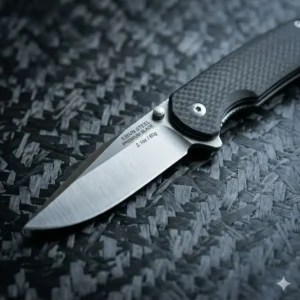
Owning a light weight folding knife comes with a specific set of responsibilities. Because these tools are engineered with tighter tolerances and lighter materials, they require a bit more “love” than your grandad’s heavy old buck knife.
Optimization Tips for 2026
-
Pivot Hygiene: Lightweight knives often use ceramic bearings or phosphor bronze washers to achieve that smooth “flick.” Dust and pocket lint are the enemies of these systems. Use a can of compressed air once a week to blow out the pivot area.
-
The “Dry” Lube Strategy: Since these knives often have FRN or Grivory handles, avoid heavy oils that can attract gunk. I recommend a dry film lubricant like Teflon-based sprays. It keeps the action smooth without creating a “sludge” inside the handle scales.
-
Centering Checks: Because lightweight handles (like those on the Para 3 LW) are sometimes less rigid than steel, check your blade centering once a month. If the blade is leaning to one side, a tiny 1/8th turn of the pivot screw can usually fix it.
Avoid the “Pry-Bar” Pitfall
The biggest mistake I see with new owners of a light weight folding knife is treating it like a multi-tool. These knives are optimized for cutting geometry. The liners are often skeletonized (full of holes to save weight), meaning the lateral strength is lower than a 6-ounce tactical knife. If you try to pry open a stuck window or a paint can, you aren’t just risking the blade—you’re risking a catastrophic failure of the handle scales.
Decision Framework: Which Light Weight Folding Knife Fits Your Life?
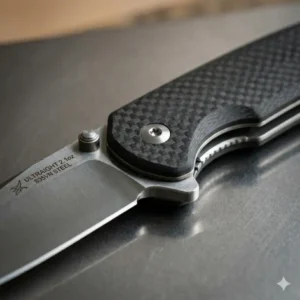
Choosing the right blade is about matching the tool to your specific “environment of use.” If you buy a knife that’s too heavy, you’ll leave it at home. If you buy one that’s too light for your job, you’ll break it.
Scenario A: The Ultralight Backpacker
If you are counting every gram for a thru-hike of the Appalachian Trail, the choice is clear: the Benchmade Bugout. At under 2 ounces, it provides a full-sized blade for food prep and emergency gear repair without the weight penalty of a traditional folder.
-
Priority: Weight above all.
-
Top Choice: Benchmade Bugout.
Scenario B: The Warehouse or Jobsite Worker
If you are cutting thick plastic banding, heavy cardboard, or rope all day, you need ergonomics and a “grip” that won’t fail when your hands get sweaty. The FRCP handle of the Spyderco is essentially sandpaper for your palm—it stays put.
-
Priority: Grip and Lock Strength.
-
Top Choice: Spyderco Para 3 LW.
Scenario C: The Corporate Professional
You need to open a letter or cut a loose thread, but you don’t want your HR manager to think you’re preparing for a tactical extraction. You need something that looks like a high-end stationery item.
-
Priority: Discretion and Style.
-
Top Choice: CRKT CEO.
How to Choose the Perfect Light Weight Folding Knife
Selecting the right tool isn’t just about looking at a “top 10” list; it’s about understanding the “why” behind the design. Here are the five criteria I use when evaluating any new blade that claims to be “lightweight.”
-
Blade-to-Weight Ratio: A truly great light weight folding knife should have a ratio of roughly 1 inch of blade for every 0.75 ounces of weight. If a knife has a 3-inch blade but weighs 5 ounces, it’s not a lightweight knife; it’s just a knife.
-
Handle Material Science: Look for words like Grivory, FRN, Carbon Fiber, or Titanium. Avoid “heavy” metals like solid brass or thick stainless steel scales unless they have been heavily skeletonized (milled out) on the inside.
-
Steel Composition: Since lightweight knives have thinner blades, the steel needs to be tougher. I look for CPM-S30V, S35VN, or Nitro-V. These “powder metallurgy” steels have a finer grain structure, making them less likely to chip when the blade is ground thin.
-
Locking Mechanism: In a lightweight build, the lock shouldn’t add unnecessary bulk. The AXIS lock and Compression lock are favorites because they utilize small, high-strength parts rather than heavy steel slabs.
-
Pocket Clip Design: A lightweight knife is meant to be carried. A deep-carry clip is essential because it allows the knife to sit low in the pocket, preventing it from flopping around—a common issue with light items.
Common Mistakes When Buying
The most frequent error is buying a knife that is “too small” because you think small equals light. You can have a 3.5-inch blade that weighs less than a 2-inch blade if the materials are right. Don’t sacrifice the utility of a full-sized handle just to save half an ounce. Your hand will thank you when you actually have to use the tool for more than ten seconds.
Materials Matter: Why 2026 is the Year of “Super-Polymers”
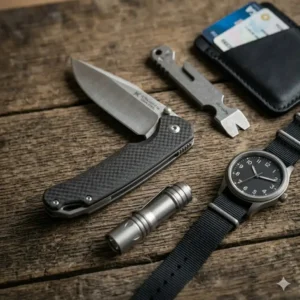
We’ve moved past the era where “plastic” was a dirty word in the knife community. The polymers used in a modern light weight folding knife are often more durable than the metals they replace. For example, Grivory (used in the Bugout) is a semi-crystalline thermoplastic that is reinforced with glass fibers. It has a higher melting point than some metals and won’t expand or contract in extreme cold or heat.
In 2026, we are also seeing the rise of “Magnacut” steel in the lightweight category. This steel is revolutionary because it offers high toughness and high corrosion resistance—something that was previously thought to be a metallurgical impossibility. When you pair a Magnacut blade with a carbon fiber handle, you essentially have a rust-proof, unbreakable scalpel that weighs as much as a couple of quarters.
Long-Term Cost & Maintenance: Is a Lightweight Knife a Good Investment?
When people see a price tag of “around $170” for a “plastic” knife like the Bugout, they often experience sticker shock. But let’s look at the ROI (Return on Investment).
A high-quality light weight folding knife with S30V or S35VN steel will hold its edge significantly longer than a $20 gas-station knife. If you use your knife daily, you might sharpen a cheap knife every week. With a premium lightweight folder, you might only need to “strop” it once a month and do a full sharpen once every six months.
Furthermore, companies like Benchmade and Spyderco offer “LifeSharp” services or excellent warranties. You aren’t just buying the physical object; you’re buying a lifetime of maintenance. In the long run, buying one $150 knife that lasts 20 years is far cheaper (and more sustainable) than buying a $20 “clunker” every year when the pivot gets loose or the steel gets dull.
Features That Actually Matter vs. Marketing Hype
-
Matter: Caged ball bearings (for smooth action), deep-carry clips, and jimping (the little notches on the spine for your thumb).
-
Hype: “Tactical” coatings that scratch off after one box, “Glass breakers” that just poke you in the leg, and “Speed holes” that don’t actually save enough weight to be noticeable.
✨ Don’t Miss These Exclusive Deals!
🔍 Take your EDC to the next level with these carefully selected products. Click on any highlighted item to check current pricing and availability. These tools will help you create a reliable kit your future self will thank you for!
Conclusion
The search for the perfect light weight folding knife is ultimately a journey toward personal efficiency. In 2026, we are spoiled for choice, with options ranging from the “disappearing” Benchmade Bugout to the budget-friendly but sophisticated Civivi Elementum.
My final advice? Don’t just buy the lightest knife on the list. Buy the one that matches your daily “pain points.” If your current knife feels like a lead weight in your pocket, the Bugout is your cure. If you find your hand slipping when you try to open heavy packages, the Spyderco Para 3 LW is your solution. Whatever you choose, remember that the best knife is the one you actually have on you when the need arises.
FAQs
❓ What is the best weight for an everyday carry knife?
✅ For most people, the “sweet spot” is between 2.0 and 3.0 ounces. This provides enough mass to feel substantial in the hand during a cut while remaining light enough to carry in any attire, from suit pants to athletic shorts…
❓ Can a light weight folding knife handle heavy tasks?
✅ Yes, provided it has a high-quality lock like a Compression or AXIS lock. While you shouldn’t use them for prying, they can easily handle cutting through thick rope, heavy-duty cardboard, and even light wood carving…
❓ Does a light weight handle mean the knife is “cheap”?
✅ Absolutely not. Materials like Carbon Fiber and Grivory are often more expensive to manufacture and mold than standard stainless steel. You are paying for the engineering required to make the tool strong yet light…
❓ What is the best steel for a lightweight blade in 2026?
✅ Look for CPM-Magnacut or S35VN. These steels offer the best “toughness-to-weight” ratio, allowing the blade to be ground thinner (saving weight) without becoming brittle or prone to snapping…
❓ How do I keep my lightweight knife from falling out of my pocket?
✅ Ensure the knife has a high-tension pocket clip. Because lightweight knives don’t have the gravity to stay at the bottom of a pocket, the clip does 100% of the work. Look for “deep-carry” clips for the most security…
Recommended for You
- Lightweight Knife Guide: 7 Best Ultralight EDC Blades for 2026
- 7 Best Ultralight Knife Options for Backpacking: Unbeatable 2026 Guide
- 7 Best fixed blade knife edc Options for 2026: Expert Guide
Disclaimer: This article contains affiliate links. As an Amazon Associate, I earn from qualifying purchases. If you purchase products through these links, we may earn a small commission at no additional cost to you.
✨ Found this helpful? Share it with your friends! 💬🤗
[addtoany]
