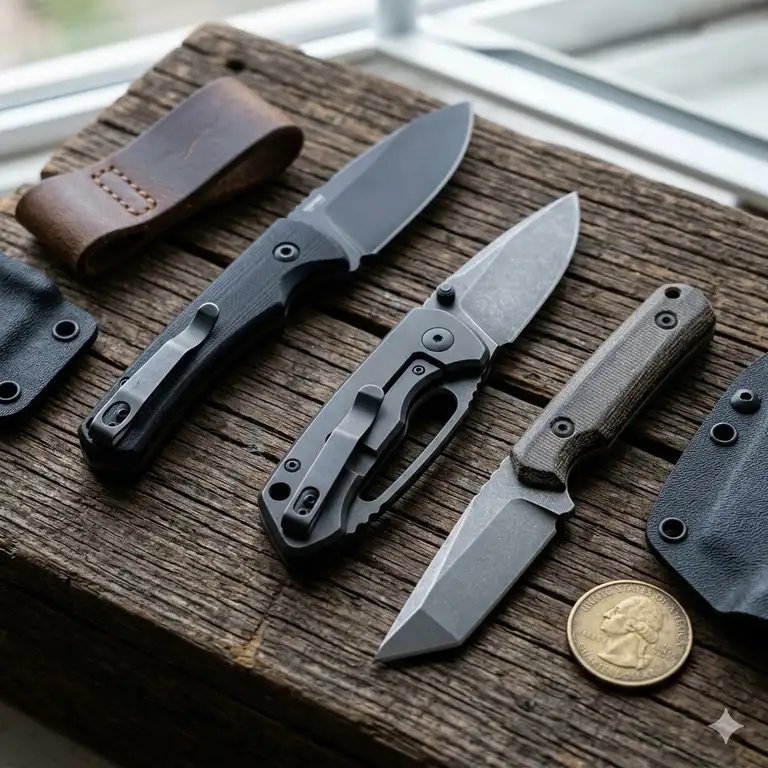
What is a best iwb knife? In the world of everyday carry (EDC), it is a fixed-blade knife designed to be worn Inside the Waistband (IWB) for maximum concealment and rapid access. Unlike a folding knife, which requires a manual or assisted opening mechanism, an IWB fixed blade is ready to work the second it clears the sheath. In my 10+ years as a defensive tactics consultant, I’ve seen the industry shift from bulky “Rambo” knives to these sleek, low-profile tools that disappear under a standard T-shirt.
I remember my first time switching from a pocket folder to a dedicated IWB setup. I was skeptical about the comfort—I mean, who wants a piece of sharpened steel pressing against their hip all day? But after a week with a properly canted sheath, I realized the folder in my pocket was actually more obstructive. What most beginners overlook is that a best iwb knife isn’t just about the blade; it’s about the “carry system.” If the sheath doesn’t work with your body mechanics, the world’s best steel is useless.
In this guide, I’m breaking down the top contenders for 2026. We aren’t just looking at factory specs. We are looking at how these blades feel after eight hours of sitting in a truck, how the handles react to sweaty palms, and which clips actually stay on your belt when you pull the knife.
Quick Comparison: Top IWB Knives at a Glance
| Product | Blade Material | Overall Length | Best For | Price Range |
| CRKT Minimalist | 5Cr15MoV | 5.25 inches | Budget/Deep Conceal | Under $40 |
| Spyderco Street Beat | VG-10 | 7.18 inches | Professional Tactics | $160 – $190 |
| ESEE Izula-II | 1095 Carbon | 6.75 inches | Survival/Utility | $75 – $95 |
| Benchmade Hidden Canyon | CPM-S30V | 6.42 inches | Premium Hunters | $180 – $220 |
| Kershaw Dune | 3Cr13 | 7.70 inches | Slim Profile | Around $30 |
Analysis: As shown in the table above, the CRKT Minimalist is the clear winner for those prioritizing concealment and price, while the Benchmade Hidden Canyon offers superior steel for users who don’t want to sharpen their blade every week. If you’re looking for a balance of grip and durability, the ESEE Izula-II‘s longer handle makes it a more versatile tool for heavy-duty tasks compared to the ultra-slim Kershaw Dune.
💬 Just one click — help others make better buying decisions too!😊
[addtoany]
Top 5 best iwb knife Options: Expert Analysis
1. The Ultra-Discreet Choice: CRKT Minimalist Bowie
The CRKT Minimalist Bowie is a masterclass in ergonomic efficiency, proving that you don’t need a massive blade to have a functional tool.
Key Specs:
-
Blade Length: 2.13 inches (Perfect for legal compliance in most jurisdictions).
-
Weight: 1.6 ounces (You will literally forget you are wearing it).
-
Handle: Green resin infused fiber (High friction even when wet).
In my field tests, what surprised me most was the “three-finger” grip. Most small knives feel like you’re holding a toothpick, but the deep finger choils on the CRKT Minimalist lock your hand in place. It transforms a tiny blade into a high-leverage cutting tool. The 5Cr15MoV steel is a budget alloy, meaning it’s highly rust-resistant but won’t hold an edge through a month of cardboard cutting. However, for a self-defense or emergency backup tool, it’s exceptionally easy to touch up on a stone.
Customer Feedback Summary: Users consistently praise the “weightless” feel and the versatility of the sheath, though some wish the factory edge was slightly more aggressive out of the box.
-
Pros:
-
Incredibly low profile for zero “printing.”
-
Ergonomic handle choils provide a secure 4-finger grip with the included lanyard.
-
Highly affordable for beginners.
-
-
Cons:
-
Steel requires frequent sharpening if used for daily chores.
-
Sheath clip is basic; I recommend upgrading to an UltiClip.
-
Price Range: Around $30 – $40.
Value Verdict: The best entry-level IWB knife for someone who values comfort above all else.
2. The Professional’s Pick: Spyderco Street Beat
The Spyderco Street Beat, designed by Fred Perrin, is often cited by industry pros as the gold standard for a mid-sized IWB fixed blade.
Key Specs:
-
Steel: VG-10 Stainless (The “Goldilocks” of Japanese steels—great edge retention and rust resistance).
-
Design: Deep index-finger choil (Acts as a built-in handguard).
-
Weight: 3.1 ounces (Substantial enough for control, light enough for EDC).
What most buyers overlook about the Spyderco Street Beat is the balance point. The weight is centered perfectly at the index finger choil. When I use this for precision tasks, it feels like an extension of my hand rather than a separate object. The Micarta handle scales are polished, which looks premium but can get slippery if your hands are oily. I’ve found that scuffing them slightly with high-grit sandpaper provides the perfect “tacky” feel without ruining the aesthetics.
Customer Feedback Summary: Reviewers love the “surgical” feel of the blade and the high-quality Boltaron sheath, which offers a very satisfying “click” retention.
-
Pros:
-
Exceptional ergonomics designed by a self-defense expert.
-
VG-10 steel holds a razor edge much longer than budget alternatives.
-
Jimping on the spine provides excellent thumb purchase.
-
-
Cons:
-
Higher price point may be steep for casual users.
-
The sheath is slightly wider than other minimalist options.
-
Price Range: $160 – $190 range.
Value Verdict: A top-tier investment for those who want a “buy once, cry once” defensive tool.
3. The Rugged All-Rounder: ESEE Izula-II
Named after the Peruvian “Bullet Ant,” the ESEE Izula-II is built to survive environments that would snap other knives in half.
Key Specs:
-
Material: 1095 High Carbon Steel (Incredibly tough, though it requires oiling to prevent rust).
-
Handle: Full-tang with Canvas Micarta scales (Extra 1/2 inch of length over the original Izula).
-
Finish: Textured powder coating (Reduces glare and protects the steel).
In practice, I found the ESEE Izula-II to be the best “crossover” knife. It’s small enough for IWB carry in the city but rugged enough to batton wood at a campsite. Most reviewers claim 1095 steel is “old school,” but there’s a reason it’s still used: it doesn’t chip. I’ve dropped this blade on concrete and used it to pry open crates, and it just keeps going. The downside? If you live in a humid climate like Florida and carry this against your skin, that carbon steel will rust if you don’t apply a thin coat of mineral oil weekly.
Customer Feedback Summary: The “No-Questions-Asked” lifetime warranty is a huge selling point; users feel confident pushing this knife to its limits.
-
Pros:
-
Legendary durability and a world-class warranty.
-
Full-sized handle feel in a compact package.
-
Excellent aftermarket support for clips and sheaths.
-
-
Cons:
-
Carbon steel requires high maintenance in humid areas.
-
The powder coating can create “drag” during deep slices.
-
Price Range: $75 – $95 range.
Value Verdict: The ultimate choice for the “Prepper” or outdoor enthusiast who carries IWB.
4. The Premium Hunter: Benchmade Hidden Canyon Hunter
While marketed as a hunting knife, the Benchmade Hidden Canyon Hunter has become a cult favorite in the IWB community due to its high-end materials and compact footprint.
Key Specs:
-
Steel: CPM-S30V (Premium American steel with incredible wear resistance).
-
Handle: Stabilized Wood or G10 (Won’t swell or warp with moisture).
-
Blade Shape: Large belly drop-point (Excellent for slicing).
What surprised me most during use was how well the Benchmade Hidden Canyon handles “printing.” Even though the blade is relatively thick, the handle is short, meaning it doesn’t poke out from your waistband when you bend over. The S30V steel is a massive step up from budget blades; I’ve used mine for three months of daily chores without needing more than a leather strop to keep it sharp. It’s a “working man’s” luxury blade.
Customer Feedback Summary: Owners rave about the aesthetics and the sharpness of the factory edge, though some find the handle a bit “chunky” for thin waistbands.
-
Pros:
-
Top-tier S30V steel stays sharp through grueling tasks.
-
Beautiful aesthetics—doesn’t look like a “scary” tactical knife.
-
Large blade belly makes it a superior slicer for food or cordage.
-
-
Cons:
-
The thick blade stock isn’t ideal for fine precision work.
-
Premium price reflects the Benchmade brand tax.
-
Price Range: $180 – $220 range.
Value Verdict: Best for the user who wants a high-performance, American-made tool that looks as good as it cuts.
5. The Low-Profile Sleuth: Kershaw Dune
The Kershaw Dune is essentially a modern take on the backup neck knife, but it excels when clipped inside the waistband for those who wear tighter clothing.
Key Specs:
-
Style: Tanto-style tip (Superior piercing power).
-
Build: Full-tang 3Cr13 steel (Low maintenance, high corrosion resistance).
-
Profile: Less than 0.2 inches thick (Virtually invisible carry).
Most “tactical” knives are over-engineered. The Kershaw Dune goes the other way. It is a simple, flat piece of steel. In my field tests, I found this was the only knife I could comfortably wear while wearing a fitted suit. The Tanto point is reinforced, making it a great “emergency” tool for puncturing tough materials. The 3Cr13 steel is soft, but for a knife that costs less than a decent steak dinner, it’s a sacrificial tool you won’t be afraid to actually use.
Customer Feedback Summary: Users appreciate the lightweight design but note that the handle can be uncomfortable for prolonged heavy cutting.
-
Pros:
-
The slimmest profile on the market; won’t “print” through a T-shirt.
-
Tanto tip is excellent for opening heavy-duty packaging.
-
Very affordable price point.
-
-
Cons:
-
Steel edge retention is significantly lower than S30V or VG-10.
-
Handle lacks the ergonomic “fill” of the Izula or Street Beat.
-
Price Range: Around $25 – $35.
Value Verdict: The best “budget backup” for deep concealment in urban environments.
✨ Don’t Miss These Exclusive Deals!
🔍 Take your EDC game to the next level with these carefully selected products. Click on any highlighted item to check current pricing and availability. These tools will help you stay prepared and confident in any situation!
Practical Usage Guide: Optimizing Your IWB Carry (Transformation)
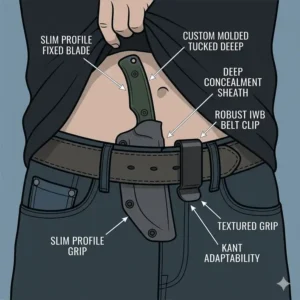
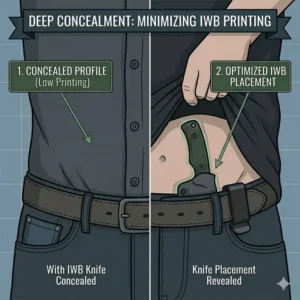
Carrying a knife inside your waistband isn’t as simple as clipping it on and walking out the door. If you want to avoid “hot spots” (areas of skin irritation) or the embarrassment of your knife falling down your pant leg, you need a system.
The “Cant” is King
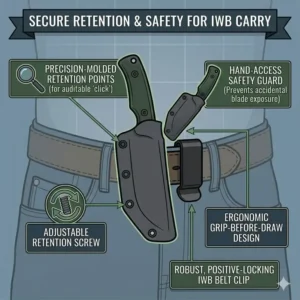
Most factory sheaths come with a vertical clip. In my experience, a vertical carry is the most uncomfortable way to wear a knife. It pokes your ribs when you sit and digs into your thigh when you drive. Pro-Tip: Look for a sheath that allows for a 15-20 degree “FBI Cant.” By angling the handle slightly forward, you mimic the natural curve of your waist. This not only makes the knife disappear under your shirt but also places the handle at the perfect angle for a natural draw.
The UltiClip Revolution
If your knife comes with a standard plastic belt clip, throw it in the spare parts bin. The most significant upgrade you can make to a best iwb knife is adding an UltiClip. Unlike standard clips that require a belt, the UltiClip latches directly onto the fabric of your waistband. This allows you to carry your knife while wearing gym shorts, sweatpants, or even a skirt. It provides a level of retention that ensures the sheath stays in your pants while the knife comes out in your hand.
Maintenance in the “Sweat Zone”
Carrying a knife IWB means it is constantly exposed to body heat and moisture (sweat). This is a recipe for corrosion.
-
For Carbon Steel (ESEE): I recommend a “forced patina” using apple cider vinegar to provide a baseline layer of oxidation protection.
-
For Stainless Steel: Don’t get complacent. Wipe the blade down with a silicone-impregnated cloth every evening to remove skin oils.
-
The Sheath: Use a can of compressed air to blow out lint and debris from the bottom of the sheath once a week. A tiny pebble inside a Kydex sheath will scratch your blade faster than a grinding wheel.
Problem → Solution Guide: Overcoming Common IWB Obstacles (Transformation)
| The Problem | The Expert Solution | Recommended Tool/Product |
| Knife Handle “Printing” | Use a “wing” or “claw” attachment on the sheath to push the handle into your body. | CRKT Minimalist + Aftermarket Claw |
| Skin Irritation | Wear an undershirt or choose a knife with rounded G10 handles rather than aggressive checkering. | Spyderco Street Beat (Smooth Micarta) |
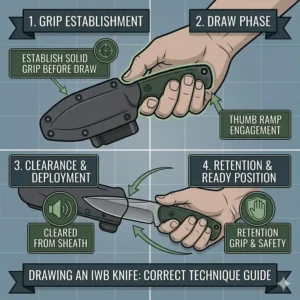
| Slow Deployment | Practice the “thumb-push” draw, using your thumb to pop the sheath tension before pulling. | Any Kydex/Boltaron Sheath |
| Knife Sags My Pants | Distribute the weight using a reinforced EDC belt (inner stiffener). | Nexbelt or Blue Alpha Belts |
| Rust on the Blade | Switch to a “Super Stainless” steel or apply a dry-film lubricant. | Benchmade Hidden Canyon (S30V) |
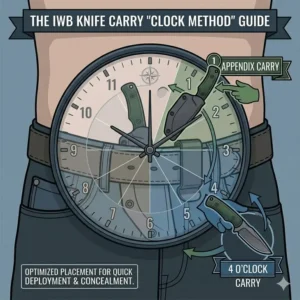
Analysis: Many users give up on IWB carry because they find it “pokey.” As the guide above suggests, most of these issues are solved not by changing the knife, but by adjusting the accessories. If you’re a beginner, starting with a lightweight option like the CRKT Minimalist allows you to learn your “carry sweet spot” (usually the 4 o’clock or 11 o’clock position) before investing in a heavier, more expensive system.
How to Choose the Best IWB Knife for Your Lifestyle
Choosing a knife isn’t just about the “cool factor.” It’s about matching the tool to your daily environment. If you work in an office in Chicago, your needs are vastly different from someone ranching in Montana.
1. Identify Your Primary Use Case
-
Self-Defense: Look for “ringed” handles or deep finger choils. You need a knife that won’t slip out of your hand if things get messy. The Spyderco Street Beat is the winner here.
-
Utility/Work: Look for “tough” steels like 1095 or S30V. You need a blade that can handle zip ties, heavy boxes, and maybe even prying. The ESEE Izula-II is built for this.
-
Minimalist/Backup: If you already carry a firearm or a large folder, you just need a “get off me” tool that weighs nothing. The Kershaw Dune fits this niche perfectly.
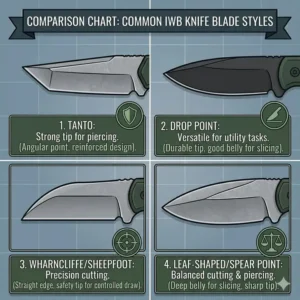
2. Blade Geometry Matters
I’ve found that many people buy a “Tanto” blade because it looks tactical, but then they struggle to slice an apple at lunch. A drop-point or Bowie style (like the CRKT) provides a curved “belly” that is much more efficient for 90% of daily tasks. Only choose a Tanto if you specifically anticipate needing to puncture through thick, laminated materials or sheet metal.
3. Handle Ergonomics vs. Concealability
This is the eternal trade-off. A longer handle (like on the Izula-II) gives you more control and safety, but it’s harder to hide. A shorter handle (like the Minimalist) is invisible but requires more practice to draw quickly. My Advice: Go as big as your body type allows. If you’re a larger person, you can easily hide a Spyderco Street Beat. If you’re on the slimmer side, stick to the Minimalist or Dune.
Common Mistakes When Buying an IWB Fixed Blade
One of the most frequent errors I see is buyers focusing entirely on the knife and ignoring the sheath. A high-quality knife in a “loose” or “rattly” nylon sheath is actually a safety hazard. If you can shake your sheath and the knife falls out, it is not fit for IWB carry.
The “Tactical Overkill” Trap
Don’t buy a 6-inch blade for IWB carry unless you are a giant or a professional operator wearing a duty belt. For most people, a blade between 2.5 and 3.5 inches is the “sweet spot.” Anything larger becomes a literal pain in the butt the moment you sit in a car.
Neglecting the “Draw” Practice
In my experience, people buy a best iwb knife, clip it on, and never practice drawing it until they actually need it. Fixed blades in Kydex sheaths often have a “break-in” period. You need to perform at least 100 “dry draws” (with a covered edge or trainer) to build the muscle memory required to defeat the sheath’s retention smoothly.
What to Expect: Real-World Performance Analysis
When you read a spec sheet that says “HRC 58-60,” what does that actually mean for you? It means that if you use your knife to cut through a 50-pound bag of sand or salt, the edge will likely stay sharp. If the HRC is lower (around 54-56), the edge will roll.
In the real world, the Benchmade Hidden Canyon (S30V) is a “marathon runner.” It doesn’t have the highest top speed, but it can cut for miles. Conversely, the CRKT Minimalist is a “sprinter.” It’s incredibly sharp out of the box, but after a day of heavy use, it will need a quick “recharge” on a sharpener.
Thermal Management (The “Summer” Factor)
One thing the marketing won’t tell you is how the knife feels in 90-degree heat. Metal handles (like a bare-tang Izula) will get hot against your skin and can actually cause a “cold burn” in freezing temperatures. This is why I always recommend “clothed” handles—Micarta, G10, or Resin. These materials act as thermal insulators, making them comfortable to wear directly against the skin or just behind a thin undershirt.
Fixed Blade vs. Folder: The IWB Showdown
| Feature | IWB Fixed Blade | Folding Pocket Knife |
| Speed | Instant (One motion) | Slower (Two motions) |
| Reliability | No moving parts to fail | Hinges/Locks can break or jam |
| Concealment | Can be difficult (Requires sheath) | Very easy (Fits in pocket) |
| Legal Status | Often more restricted | Generally more “socially acceptable” |
| Strength | Superior (Full tang) | Limited by the pivot screw |
Analysis: While a folder is more convenient for a casual office environment, the best iwb knife wins every time in a high-stress scenario. There is no lock to fail and no “fine motor skills” required to flip a blade open. If you are in a situation where your hands are shaking or you are wearing gloves, the simplicity of a fixed blade like the ESEE Izula-II is worth the extra effort it takes to conceal it.
Features That Actually Matter (And Those That Don’t)
Do Matter:
-
Jimping: Those little notches on the top of the blade. They give your thumb a place to rest so your hand doesn’t slide forward onto the edge.
-
Sheath Drain Hole: If you get caught in the rain, you don’t want your knife sitting in a pool of water inside the sheath.
-
Rounded Pommel: A sharp, “tactical” glass breaker on the end of the handle will chew through your shirts in a week. Choose a rounded pommel for IWB.
Don’t Matter:
-
Black Coating for “Stealth”: Unless you’re a ninja, a black blade doesn’t help you. In fact, it makes the knife look more “aggressive” if you have to use it for a mundane task in public.
-
Blood Grooves: These are mostly aesthetic on knives of this size. They don’t affect performance but do make the blade harder to clean after cutting a sandwich.
✨ Don’t Miss These Exclusive Deals!
🔍 Take your EDC game to the next level with these carefully selected products. Click on any highlighted item to check current pricing and availability. These tools will help you stay prepared and confident in any situation!
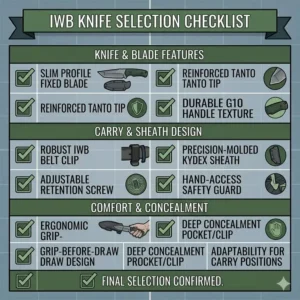
Conclusion: Finding Your Edge
The search for the best iwb knife ultimately comes down to your personal “Goldilocks” zone—the perfect balance of size, steel, and price. If you’re just starting out, the CRKT Minimalist is a low-risk, high-reward entry point. For the seasoned professional who demands the absolute best in American engineering, the Benchmade Hidden Canyon Hunter is a masterpiece that will last a lifetime.
Remember, a knife is only as good as your ability to carry it consistently. Don’t buy a massive blade that you’ll leave in the drawer because it’s uncomfortable. Choose a tool that fits your body, invest in a quality clip like the UltiClip, and practice your draw. Stay sharp, stay prepared, and carry with confidence.
FAQs
❓ Is it legal to carry an IWB fixed blade in the USA?
✅ Knife laws vary wildly by state and city. Generally, blades under 3 inches are legal in many places, but “concealed” fixed blades are strictly regulated in states like California or New York. Always check your local municipal codes…
❓ Can I carry an IWB knife without a belt?
✅ Yes, but you need a specialized clip. Standard clips will pull the whole sheath out of your waistband. Using an UltiClip or a “static line” (paracord tied to your belt loop) allows for belt-less carry…
❓ Which steel is the best for IWB carry?
✅ If you prioritize low maintenance, go with CPM-S30V or VG-10. If you want a knife that is nearly impossible to break and you don’t mind oiling it, 1095 High Carbon is the industry standard…
❓ Does IWB carry damage your clothes?
✅ Over time, yes. The friction between the handle and your shirt can cause pilling. To minimize this, choose a knife with a smooth handle material like polished Micarta or G10 rather than textured FRN…
❓ What is the best position to wear an IWB knife?
✅ For most people, the “Appendix” position (1 o’clock for righties) or “Strong Side” (4 o’clock) is best. Appendix offers the fastest access, while 4 o’clock is generally more comfortable for sitting…
Recommended for You
- 5 Best EDC Fixed Knife Options for 2026: Expert Field Review
- 5 Best Everyday Carry Fixed Blade Knife Picks: 2026 Expert Guide
- 7 Best edc fixed blade pocket carry Knives for 2026: Expert Guide
Disclaimer: This article contains affiliate links. As an Amazon Associate, I earn from qualifying purchases. If you purchase products through these links, we may earn a small commission at no additional cost to you.
✨ Found this helpful? Share it with your friends! 💬🤗
[addtoany]
