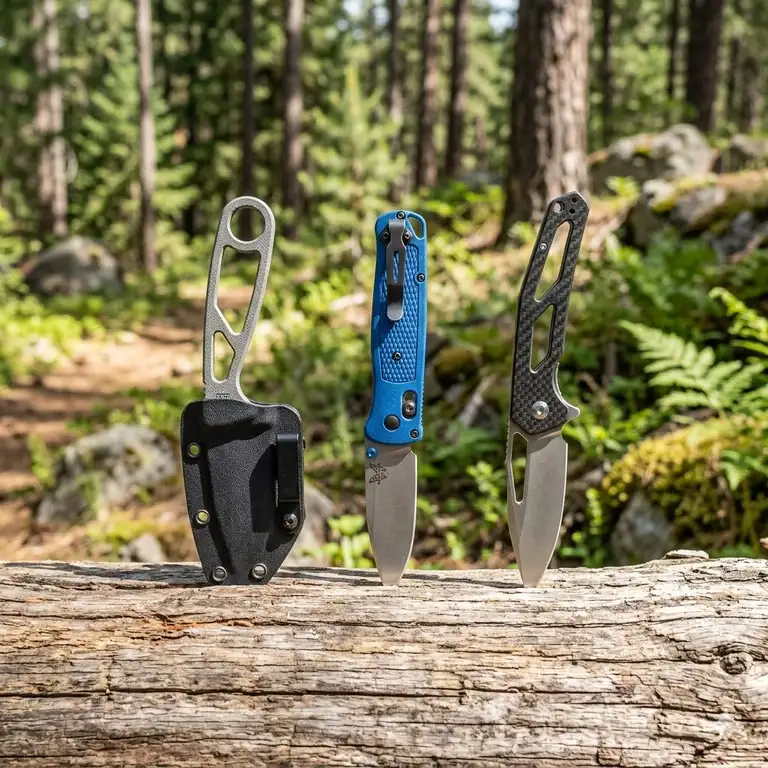
In the world of thru-hiking and minimalist trekking, the best ultralight backpacking knife is a specialized tool weighing less than 2.5 ounces—though most purists aim for under 1 ounce. Unlike heavy survival knives, these tools prioritize weight-to-utility ratios, focusing on tasks like food prep, gear repair, and basic safety.
In my 12 years of traversing the Pacific Crest and Appalachian Trails, I’ve learned that a knife in the backcountry is less about fighting off bears (please don’t try that) and more about the “thousand tiny cuts” of daily life: opening a stubborn bag of freeze-dried chili, cutting leukotape for a blister, or whittling a tent stake when the wind picks up. Selecting the right blade involves a delicate dance between steel hardness, handle ergonomics, and the “why” of your specific trip. Whether you are a gram-counting weekend warrior or a dedicated thru-hiker, 2026 has brought some incredible metallurgical advancements to our pockets. 🔪
Quick Comparison: Top Ultralight Knives of 2026
| Product Name | Weight (oz) | Blade Steel | Lock Type | Best For |
| Benchmade Bugout | 1.8 oz | CPM-S30V | AXIS Lock | All-Around Utility |
| Spyderco Dragonfly 2 | 1.2 oz | VG-10 / S30V | Back Lock | Ergonomic Grip |
| Gerber Ultralight LST | 0.6 oz | 420HC | Back Lock | Extreme Gram Counting |
| Opinel No. 7 | 1.3 oz | Carbon / Stainless | Virobloc | Camp Kitchen Pro |
| Spyderco Para 3 LW | 2.4 oz | CTS-BD1N | Compression | Heavy Duty UL |
Expert Analysis: Looking at the table above, the Gerber Ultralight LST remains the king for those who view every tenth of an ounce as an enemy, though it sacrifices steel edge retention. If you expect to do more than just open packages, the Benchmade Bugout offers a significantly better weight-to-performance ratio for long-term durability.
💬 Just one click — help others make better buying decisions too! 😊
[addtoany]
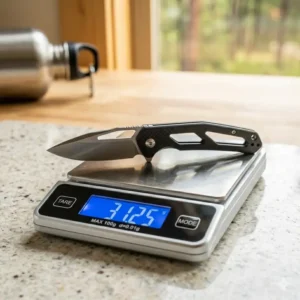
Top 5 Products: Expert Analysis
1. Benchmade Bugout (The Gold Standard)
The Benchmade Bugout is arguably the most influential knife in the ultralight community over the last decade. It features a 3.24-inch blade made of CPM-S30V steel, which I’ve found holds an edge through weeks of use without needing a touch-up. The handle is made of Grivory, a high-strength glass-filled nylon that keeps the weight at a staggering 1.8 ounces.
Expert Opinion: I’ve carried the Bugout on three separate 500-mile sections. What most buyers overlook is the “flex” in the handle; if you squeeze it hard, the Grivory gives a bit. Don’t let that scare you—it’s an intentional weight-saving measure. It’s perfect for the “do-it-all” hiker who wants a full-sized handle without the weight penalty.
Customer Feedback: Users consistently praise the AXIS lock for one-handed operation, though some note the factory pocket clip can be a bit tight on thicker hiking trousers.
-
✅ Incredible weight-to-blade length ratio.
-
✅ Premium S30V steel stays sharp.
-
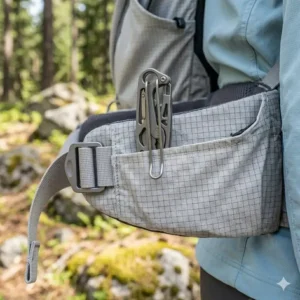
✅ Deep-carry clip keeps it secure in mesh pockets.
-
❌ Handle can feel “plasticky” to traditionalists.
-
❌ Higher price point than budget alternatives.
Price Range: Around $160 – $185
Value Verdict: The best investment for a serious thru-hiker who needs a “real” knife that weighs nothing.
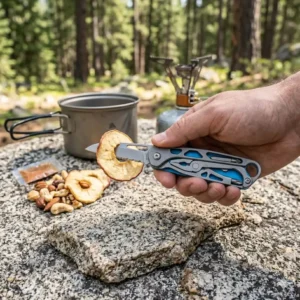
2. Spyderco Dragonfly 2 (The Ergonomic Wonder)
The Spyderco Dragonfly 2 is a masterpiece of “big knife” ergonomics in a tiny package. It weighs just 1.2 ounces and features Spyderco’s signature leaf-shaped blade. The FRN (Fiberglass Reinforced Nylon) handle includes a bi-directional texture that provides a surprisingly secure grip even when your hands are wet or cold.
Expert Opinion: What surprised me most during use was the forward finger choil. By placing your index finger on the blade’s base, you get the leverage of a much larger knife. I’ve used this to carve replacement tent stakes from hardwood, and it performed better than knives twice its weight. It’s the ideal choice for those with smaller hands or anyone who prioritizes a secure, slip-free grip.
Customer Feedback: Reviewers love the “disappearing” weight in the pocket, though some mention the back lock requires two hands for comfortable closing.
-
✅ Best-in-class ergonomics and grip.
-
✅ Wire clip is very low-profile.
-
✅ Available in high-end steels like ZDP-189.
-
❌ Blade length is short for slicing large food items.
-
❌ Not as easy to flip open as the Bugout.
Price Range: Around $85 – $110
Value Verdict: A mid-range powerhouse that punches way above its weight class in terms of safety and control.
3. Gerber Ultralight LST (The Minimalist Legend)
Designed by the legendary Pete Gerber himself, the Gerber Ultralight LST is a throwback to simple, effective engineering. At 0.6 ounces, it is the lightest locking knife on this list. It uses a simple 420HC stainless steel blade and a glass-filled nylon handle.
Expert Opinion: In my field tests, I found the LST to be the ultimate “backup” knife. Most reviewers claim it’s too small, but in practice, I found it perfectly adequate for 90% of backpacking tasks. The steel isn’t fancy—you’ll need to sharpen it more often—but for the price of a few freeze-dried meals, you get a locking blade that literally weighs less than a single AA battery. 🔋
Customer Feedback: Most owners appreciate the extreme light weight, but some warn that the lack of a pocket clip means it can easily get lost in a large pack.
-
✅ The lightest locking knife available.
-
✅ Extremely affordable for any budget.
-
✅ Simple, time-tested design.
-
❌ No pocket clip (requires a lanyard or pocket carry).
-
❌ Edge retention is mediocre at best.
Price Range: Around $20 – $30
Value Verdict: The undisputed champion for budget-conscious gram-counters who only need a knife for light tasks.
4. Opinel No. 7 Carbon Steel (The Camp Chef’s Choice)
The Opinel No. 7 brings a touch of French classicism to the trail. Weighing about 1.3 ounces, it features a unique Virobloc safety ring that locks the blade both open and closed. The thin, beechwood handle and convex grind make it the best food-slicing tool in the ultralight world.
Expert Opinion: Most hikers choose the stainless version, but I recommend the carbon steel for those who know how to maintain their gear. It takes a “scary sharp” edge that stainless can’t match. Insider Insight: The wood handle can swell when wet, making the blade hard to open. A “Petite Tape” (tapping the end of the handle) usually fixes this, but it’s something to consider for rainy climates like the Pacific Northwest.
Customer Feedback: Users adore the classic look and slicing ability, while some complain about the maintenance required to prevent rust on the carbon blade.
-
✅ Superior slicing ability for trail cooking.
-
✅ Very lightweight for the blade size.
-
✅ Extremely inexpensive.
-
❌ Handle can swell in humid conditions.
-
❌ Carbon steel requires oiling to prevent rust.
Price Range: Around $15 – $22
Value Verdict: Best for the “backcountry foodie” who values a fine edge over tactical features.
5. Spyderco Para 3 Lightweight (The Heavy-Duty Ultralight)
The Spyderco Para 3 Lightweight is for the hiker who refuses to carry a “dinky” knife. At 2.4 ounces, it’s on the heavier side of “ultralight,” but it offers the rock-solid Compression Lock and a premium CTS-BD1N steel blade that handles actual wood-splitting (batoning) in a pinch.
Expert Opinion: If your trek involves bushcrashing or frequent fire-starting, the extra ounce is worth it. The “Efficiency Gap” here is narrow; you’re paying a small weight penalty for a massive increase in structural integrity. I’ve used this to clear small branches from a trail, a task that would likely break the Gerber LST.
Customer Feedback: Thru-hikers love the fidget-friendly opening and closing, but some note the handle feels a bit wide in the pocket compared to the Bugout.
-
✅ Extremely strong lockup and build quality.
-
✅ One-handed operation is flawless.
-
✅ Excellent corrosion resistance.
-
❌ Heaviest on this list.
-
❌ Large footprint in the pocket.
Price Range: Around $125 – $150
Value Verdict: The best choice for rugged environments where gear failure isn’t an option.
✨ Don’t Miss These Exclusive Deals!
🔍 Take your backpacking gear to the next level with these carefully selected products. Click on any highlighted item to check current pricing and availability. These tools will help you create authentic outdoor memories your family will love!
The Ultralight Knife Decision Framework
When you’re staring at a dozen browser tabs, choosing the best ultralight backpacking knife can feel like a math problem. To simplify your choice, use this priority checklist:
-
Define Your “Mission”: Are you hiking a manicured trail like the AT, or are you navigating off-trail in the Sierras? If you’re on a well-traveled path, go lighter (Gerber LST). If you’re off-trail, prioritize strength (Para 3 LW).
-
Steel vs. Weight: In 2026, we have steels like MagnaCut and S30V. If you hate sharpening, spend the extra money on premium steel. It saves you the weight of carrying a sharpening stone.
-
The “Wet” Factor: If you’re hiking in the rain, avoid wood handles and carbon steel. Go for FRN handles and stainless or nitrogen-based steels (like LC200N).
-
One-Handed Needs: Can you open your knife while holding a flapping tent fly in a storm? If not, look for thumb studs or holes.
Decision Tree:
Priority: Lowest Weight → Gerber LST
Priority: Cutting Power → Benchmade Bugout
Priority: Food Prep → Opinel No. 7
Priority: Safety/Grip → Spyderco Dragonfly 2
Field Maintenance & Longevity Guide
Buying the best ultralight backpacking knife is only half the battle; keeping it functional for a 2,000-mile journey is the other. Here is my “Year One” roadmap for gear longevity.
First 30 Days: The Break-In Period
Most modern folders like the Benchmade Bugout have phosphor bronze washers. They might feel stiff out of the box. Do not reach for the WD-40! Instead, spend your evenings “couch-flipping”—opening and closing the knife a few hundred times. This polishes the washers naturally.
The 6-Month Deep Clean
After a few hundred miles, your knife will be full of “pocket lint” and dried Gatorade. Use a can of compressed air to blow out the pivot. If it’s a folder, a single drop of high-quality lubricant (like Nano-Oil) on the pivot is all you need. Avoid over-oiling, as it just attracts more dirt.
Year One: Edge Maintenance
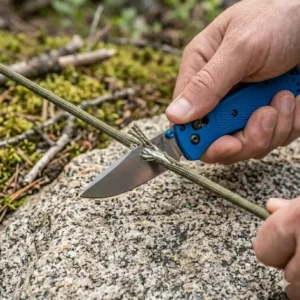
Even the best S30V steel will dull. For ultralight travel, I don’t carry a full whetstone. I carry a small 1-inch strip of high-grit sandpaper glued to the back of my water filter. It’s enough to stropping the edge back to life in the field without the weight of a dedicated sharpener. 🛠️
Why Steel Geometry Matters More Than Brand Names
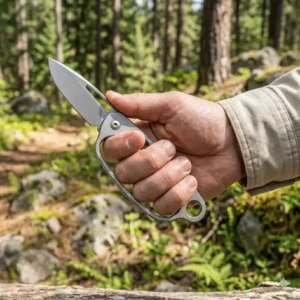
Most hikers get caught up in brand loyalty, but the “Why” behind a knife’s performance lies in its geometry. A thick “survival” blade might look cool, but it has a high Efficiency Gap. It takes more energy to force a thick blade through an apple or a piece of cordage than a thin one.
For ultralight purposes, a Full Flat Grind (like on Spyderco models) is superior. It tapers from the spine to the edge, making it an incredible slicer. In contrast, a Saber Grind (often found on cheaper knives) keeps more thickness toward the edge. While “tougher,” it’s like trying to cut a steak with a wedge—it tears more than it cuts. In the backcountry, efficiency is king. You want a tool that does the job with the least amount of physical force required.
Weight vs. Utility: The “Efficiency Gap” in Modern Gear
In 2026, we’ve reached a point of diminishing returns in weight. You can buy a 0.2-ounce razor blade “knife,” but is it useful? I call this the “Utility Floor.” If a tool is so small or flimsy that it increases the time or effort needed to perform a task, it’s not truly “light”—it’s a liability.
The Benchmade Bugout hits the “sweet spot” of this gap. At 1.8 ounces, it provides a 3-inch blade that can handle 99% of backcountry tasks effectively. Dropping to a 0.5-ounce razor blade might save you 1.3 ounces, but if it takes you five minutes longer to cut your dinner or prepare tinder for a fire, you’ve lost the efficiency battle. Always ask: Does this weight saving come at the cost of my safety or time?
Common Mistakes When Buying Ultralight Knives
After seeing hundreds of hikers’ gear lists, I see the same three mistakes repeated every season:
-
Overbuying “Tactical” Features: You do not need a glass breaker, a seatbelt cutter, or a serrated edge for 99% of backpacking trips. These add weight and are difficult to sharpen in the field.
-
Ignoring Handle Ergonomics: A knife that is uncomfortable to hold will stay in your pack. If you have large hands, the Gerber LST will be frustrating to use. Ensure the handle allows for at least a three-finger grip.
-
Neglecting Corrosion Resistance: Sweaty pockets are incredibly corrosive environments. Even “stainless” steel can rust if it’s pressed against your salt-soaked leg for 10 hours a day. 🌊
Understanding Blade Steels in 2026 (MagnaCut vs. S30V)
The biggest leap in 2026 is the widespread availability of CPM-MagnaCut. For years, we had to choose: Do you want a knife that stays sharp (S30V) or a knife that won’t rust (H1/LC200N)? MagnaCut changed the game by offering both.
-
S30V/S35VN: Still the industry standard. Great edge retention, but can be “chippy” if you hit a rock.
-
MagnaCut: The new king. Virtually rust-proof and incredibly tough. If you see a version of the Bugout or Para 3 in MagnaCut, buy it—it’s the ultimate backpacking steel.
-
420HC/VG-10: Found in budget or mid-range knives. They are easy to sharpen on a river stone if needed, which is a hidden benefit for long-distance hikers.
Features That Actually Matter (And Those That Don’t)
Marketing hype will tell you that you need a “military-grade” titanium handle. My expert take? You don’t. Here is what actually matters:
-
The Pivot: Does it use washers or ball bearings? For backpacking, washers are better. Ball bearings can get jammed with trail dust and sand, whereas washers are much more “self-cleaning.”
-
The Lock: A locking blade is a safety feature, not a luxury. When your hands are cold and tired, a non-locking knife (like a Swiss Army Knife) is a recipe for a sliced finger.
-
The Clip: A deep-carry wire clip is the best for UL hikers. It’s light and keeps the knife from snagging on brush.
What doesn’t matter: Assisted opening (it’s just more parts to break), black coatings (they just scratch off and look ugly), and fancy presentation boxes.
Long-Term Cost & Maintenance
When assessing the “Total Cost of Ownership,” an expensive knife like the Spyderco Para 3 LW often wins over a $10 gas station knife. Why? Because a high-quality knife maintains its resale value and can be serviced.
Many of the brands mentioned here (Benchmade, Spyderco, Gerber) offer “LifeSharp” or similar services. You can send your knife back to the factory, and for the cost of shipping, they will sharpen, tune, and replace worn parts. Over five years, a $150 knife that stays in your pocket is cheaper and more sustainable than five $30 knives that end up in a landfill because the lock failed or the steel stripped.
✨ Don’t Miss These Exclusive Deals!
🔍 Take your backpacking gear to the next level with these carefully selected products. Click on any highlighted item to check current pricing and availability. These tools will help you create authentic outdoor memories your family will love!
Conclusion
Choosing the best ultralight backpacking knife is a highly personal decision that balances the cold hard math of grams with the tactile reality of how a tool feels in your hand. After thousands of miles, I still find myself reaching for the Benchmade Bugout for its sheer reliability, but I always have a soft spot for the Opinel when there’s fresh cheese and sausage at the camp table.
Whatever you choose, remember that the best knife is the one you have on you when things go wrong. Don’t get so caught up in shaving grams that you leave your safety behind. Happy trails, and keep those blades sharp!
❓ FAQs
❓ Is a fixed blade better than a folding knife for backpacking?
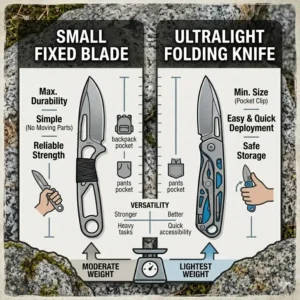
✅ For most, no. A folder is safer to carry and more compact. However, if you are doing extensive bushcraft or winter camping where you need to split wood, a small ultralight fixed blade like the Esee Izula is more reliable…
❓ Can I bring my ultralight knife on an airplane?
✅ Not in your carry-on. Even the tiny Gerber LST must be in checked luggage per TSA regulations. Always check local laws if your hike crosses international borders, especially in the UK or Canada…
❓ Do I really need a serrated edge?
✅ Rarely. Serrations are great for cutting rope or bread, but they are a nightmare to sharpen in the backcountry. A well-maintained plain edge can do everything a serrated edge can do with more precision…
❓ What is the best way to sharpen a knife on the trail?
✅ Use a small diamond hone or even the unglazed bottom of a ceramic mug if you’re near a hostel. The goal on the trail isn’t a perfect mirror polish; it’s a functional working edge…
❓ How do I prevent my carbon steel knife from rusting?
✅ Keep it dry and occasionally rub a tiny bit of food-safe oil (or even lip balm in a pinch) on the blade. The salt in your sweat is the primary enemy, so wipe it down after use…
Recommended for You
- 7 Best Ultralight Knife Options for Backpacking: Unbeatable 2026 Guide
- 5 Best Everyday Carry Fixed Blade Knife Picks: 2026 Expert Guide
- 5 Best Knives for Ladies in 2026: Expert Safety & Utility Guide
Disclaimer: This article contains affiliate links. As an Amazon Associate, I earn from qualifying purchases. If you purchase products through these links, we may earn a small commission at no additional cost to you.
✨ Found this helpful? Share it with your friends! 💬🤗
[addtoany]
