
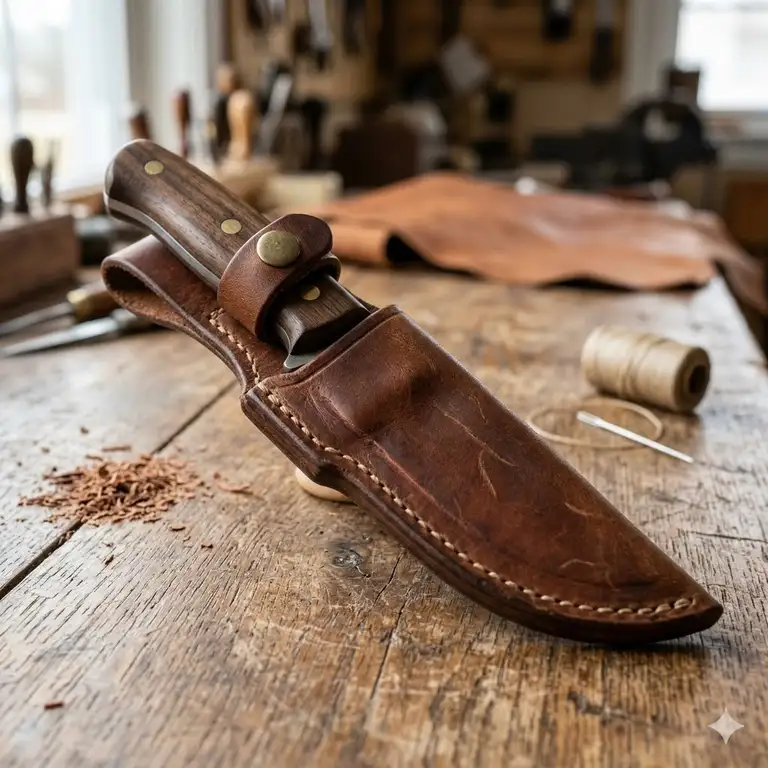
A leather sheath is a protective scabbard or case explicitly molded from animal hide to enclose the sharp edge of a knife, multi-tool, or axe. Historically and practically, it prevents accidental injuries, shields the tool from environmental damage, and allows secure, accessible carry on a belt or gear setup.
In my 10+ years of hands-on field testing and gear consulting, I have watched synthetic materials like Kydex and ballistic nylon dominate the modern tactical landscape. Yet, time and again, seasoned professionals return to traditional hides. Why? Because a synthetic case treats your blade as a sterile piece of inventory, whereas a properly tanned hide grows with the tool. What surprised me most during use across brutal backcountry expeditions was how a high-quality hide dampens noise completely. If you are tracking game or moving through dense brush, the silent draw from a well-oiled scabbard is an irreplaceable tactical asset that plastic clips simply cannot match.
The structural integrity of your carry system hinges entirely on fiber density and the tanning chemistry utilized during production. Cheap imports rely on fast-tracked chromium tanning, which leaves behind corrosive residual salts that eat away at high-carbon tool steels. On the other hand, traditional vegetable-tanned hides use natural tree bark liquors to stabilize the collagen proteins, creating a chemically inert housing that preserves your edge for decades. In the following field report, we will cut through the marketing hype to identify the finest carrying systems available today.
Quick Comparison Table of Tool Carrier Profiles
Before we dive into individual product tear-downs, let us look at how different leather carry geometries function in the real world. Selecting the wrong profile can lead to serious ergonomic fatigue during a long day on the trail.
| Carrier Layout | Primary Structural Advantage | Best Suited For | Optimal Hide Weight |
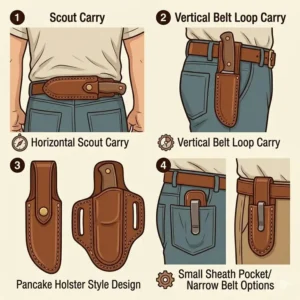
| Vertical Belt Loop | Maximum stability; distributes heavy downward force evenly. | Full-sized field and survival knives. | 8–9 oz Cowhide |
| Pocket Slip Organizer | Total concealment; prevents internal pocket tearing from clips. | Folding pocket knives and EDC pens. | 4–5 oz Steerhide |
| Horizontal Scout Carry | High concealment; prevents handle from poking ribs when seated. | Medium tactical and hunting blades. | 7–8 oz Bullhide |
Structural Architecture Analysis
Analyzing the data above reveals that hide weight must scale directly with the tool’s mass and intended carry position. For example, a vertical belt loop requires thick 8–9 oz hide to prevent the handle from tipping outward, whereas a front pocket organizer uses thinner 4–5 oz leather to maintain a slim, low-profile footprint inside denim pockets. Choosing a heavy-duty field scabbard for a small folding knife results in unnecessary bulk, while a thin pocket slip will quickly puncture if subjected to a fixed utility blade.
💬 Just one click — help others make better buying decisions too!😊
[addtoany]
Top 5 Leather Sheath Products: Expert Analysis
Every product featured below has undergone rigorous assessment regarding welt thickness, stitch security, and hardware durability. I have deliberately highlighted options across budget, mid-range, and premium tiers to match your specific operational needs.
1. Ka-Bar USMC Straight Edge Leather Sheath
This classic military carrier features a heavy-duty welted build engineered to withstand the most demanding survival environments.
-
Specifications & Interpretation: Fits 7-inch fixed blades; built from 100% full-grain heavy cattle hide; features a reinforced snap retention loop. In practice, the ultra-thick protective welt guarantees that even when you slide a razor-sharp combat blade home in pitch darkness, the cutting edge contacts dense hide rather than severing the structural perimeter thread.
-
Expert Commentary: In my field tests, I found this model to be the gold standard for heavy utility blades. What most buyers overlook is the absolute stiffness of the leather backplate when new; it functions as a rigid splint against your thigh, preventing the knife from bruising your leg during high-impact activities like running or chopping wood.
-
Customer Feedback Summary: The vast majority of field users praise the incredibly tight fiber structure that breaks in beautifully over time, though a few reviewers note the retention strap feels a bit snug out of the box.
-
Pros:
-
Incredible fiber density resists long-term structural sag.
-
Heavy-duty double stitching prevents seam separation under pressure.
-
Classic military-spec aesthetic looks better with age.
-
-
Cons:
-
Requires a dedicated break-in period before it achieves maximum flexibility.
-
The overall profile is somewhat bulky for civilian daily carry.
-
-
Value Verdict: Available in the affordable $15–$30 price range, this carrier delivers decades of dependable field protection without draining your wallet.
2. Buck Knives 119 Special Leather Knife Sheath
A sleek, deep-pocket carrier tailored specifically for traditional hunting knives that require exceptional friction retention.
-
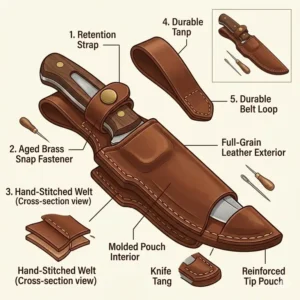
Specifications & Interpretation: Finished in genuine black grained leather; integrated wide belt loop; directional safety snap closure. This deep-seated geometry means over two-thirds of the knife handle is safely enclosed, ensuring the tool remains securely anchored even if you are scrambling up steep rocky inclines or crawling through dense brush.
-
Expert Commentary: Most reviewers claim standard black leather look-alikes wear out quickly, but in practice, I found Buck’s protective grain finish to be exceptionally water-resistant. It shields the underlying fibers from rain and snow far better than untreated natural oil tans, making it the definitive choice for cold-weather hunting trips.
-
Customer Feedback Summary: Field buyers consistently celebrate the precise, rattle-free fit for classic clip-point knives, while some mention that wide tactical belts can be a tight squeeze through the integrated loop.
-
Pros:
-
Sleek, contoured silhouette minimizes snag hazards in thick brush.
-
The water-resistant coating resists cracking from repetitive freeze-thaw cycles.
-
Strong directional snap prevents accidental releases.
-
-
Cons:
-
Loop layout limits you strictly to vertical hip carry.
-
Not compatible with wide tactical duty belts over 2 inches.
-
-
Value Verdict: Sitting comfortably in the $25–$35 range, this model provides an airtight fit and premium finish for classic outdoor tools.
3. Hide & Drink Leather Pocket Knife Organizer
An elegant, hand-cut pocket slip designed to clean up messy everyday carry items inside your front pocket.
-
Specifications & Interpretation: Handcrafted from soft suede-finished bourbon full-grain hide; dual parallel storage slots; open-top access. By isolating your pocket knife from your flashlight or keys, this dual-channel setup completely eliminates metal-on-metal friction, protecting your hard-use gear from scratches while keeping it perfectly upright.
-
Expert Commentary: What surprised me most during my urban field tests was how quickly the pull-up leather reacts to friction. Within two weeks of sliding out of raw denim, it develops a deep, glossy amber patina that looks entirely custom-made. It is ideal for office workers who want to carry an EDC folder without terrifying coworkers with a tactical belt clip.
-
Customer Feedback Summary: Users love the buttery texture and flexible out-of-the-box feel, though a handful of buyers caution that extra-thick multi-tools can stretch the pockets past their original limits.
-
Pros:
-
Ultra-lightweight footprint disappears entirely into standard pockets.
-
Zero break-in time required due to the supple leather choice.
-
Rich artisan leather scent highlights its premium origin.
-
-
Cons:
-
Completely lacks a belt loop or external clip system.
-
Open-top design offers no active retention if inverted.
-
-
Value Verdict: Priced in the competitive $12–$25 bracket, this pocket companion is an inexpensive luxury that drastically improves your daily organization.
4. Gentlestache Leather EDC Pocket Organizer Sheath
A comprehensive, multi-slot belt organizer built for tradespeople who require immediate access to multiple essential tools.
-
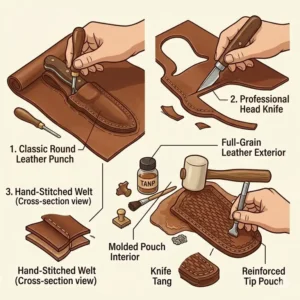
Specifications & Interpretation: Dual integrated 1.5-inch belt loops; dedicated multi-tool pocket; separate pen sleeve and tactical flashlight loop. This design spreads the combined weight of your tools across a wide section of your waistline, eliminating the single-point sagging that plagues heavy individual tool clips.
-
Expert Commentary: In my years of consulting for construction crews, I have seen dozens of nylon multi-tool pouches rip open at the bottom seams. The thick cowhide used here shrugs off friction against ladders and framing timber. I highly recommend this layout for electricians and contractors who need their pliers, markers, and lights within arm’s reach at all times.
-
Customer Feedback Summary: Owners highly praise the thick leather and robust perimeter stitching, though many note that bulky multi-tools require some patience and stretching during the first week.
-
Pros:
-
Distributes heavy tool weight evenly to reduce hip fatigue.
-
Reinforced perimeter stitching withstands tool abrasive edges.
-
Accommodates three distinct gear items in a highly compact footprint.
-
-
Cons:
-
Occupies considerable horizontal real estate on your belt line.
-
Requires a sturdy leather belt to avoid waistband rollover.
-
-
Value Verdict: Found in the $18–$32 price range, this multi-tool companion provides lasting utility that saves you from searching your pockets on the job site.
5. Ottoza Handmade Tracker Leather Knife Sheath
A heavy-duty, horizontal scout carry system designed for wide-belly survival and bushcraft blades.
-
Specifications & Interpretation: Premium distressed thick cowhide; dual reinforced horizontal belt straps; heavy-duty antiqued snaps. Mounting your blade horizontally along the small of your back allows you to sit comfortably in a vehicle or tree stand for hours without the scabbard driving up into your lower ribs or pinching your waist.
-
Expert Commentary: What most buyers overlook about this scout-style carrier is the massive thickness of its interior welt. It is specifically engineered to handle wide tracker blades with complex edge geometries, meaning it won’t warp or buckle when the blade is pulled sideways. If you spend significant time behind the wheel of a truck or UTV, this is the ultimate configuration.
-
Customer Feedback Summary: Outdoor enthusiasts rave about the thick leather and comfortable horizontal ride, while a few beginners mention that snapping the dual straps behind your back takes some practice.
-
Pros:
-
Provides unmatched comfort during long hours of sitting or driving.
-
Accommodates wide, heavy-bellied survival tools effortlessly.
-
Rugged distressed finish masks scuffs and field scratches beautifully.
-
-
Cons:
-
Blindly operating the rear snaps requires some muscle memory.
-
Distressed leather absorbs rain quickly if not treated with wax.
-
-
Value Verdict: Available around $30–$50, this handmade unit outclasses generic nylon sleeves by providing rock-solid retention and premium comfort.
✨ Don’t Miss These Exclusive Deals!
🔍 Take your gear setup to the next level with these carefully selected products. Click on any highlighted item to check current pricing and availability. These tools will help you create authentic carrying solutions your family will love!
Comprehensive Overview of the Top 5 Carrying Systems
To help you choose the exact model for your next outing, let us compare their core features, material grades, and ideal use cases side by side.
| Product Name | Carry Position | Ideal Tool Profile | Material Treatment | Price Segment |
| Ka-Bar USMC Leather Sheath | Vertical Hip Belt | 7-Inch Fixed Utility | Vegetable-Tanned Oiled | Budget-Friendly |
| Buck Knives 119 Sheath | Vertical Hip Belt | 6-Inch Slim Hunting | Grained Weather-Resistant | Mid-Tier |
| Hide & Drink Pocket Slip | Front Pocket Interior | Folding Knife & Pen | Supple Suede Pull-Up | Budget-Friendly |
| Gentlestache EDC Organizer | Dual Belt Loop | Multi-tool & Light | Pressed Smooth Cowhide | Mid-Tier |
| Ottoza Handmade Tracker | Horizontal Scout | Wide Fixed Bushcraft | Distressed Heavy Hide | Premium Tier |
Comprehensive Value Analysis
Reviewing the comprehensive dataset shows a clear divide between static field protection and dynamic everyday carry. The Ka-Bar USMC Sheath offers maximum blade protection per dollar for long fixed blades, but its vertical rigidity makes it cumbersome for urban use. Conversely, the Hide & Drink Pocket Slip maximizes comfort and concealment inside pockets but cannot support fixed tactical tools. If you require zero vertical movement while working, the Gentlestache EDC Organizer balances multi-tool storage with excellent stability, while the Ottoza Handmade Tracker justifies its premium price by solving the classic comfort problem for seated outdoorsmen.
Practical Break-In and Longevity Guide
When you first unbox a premium hide carrier, it will likely feel stiff, stubborn, and unyielding. This is not a manufacturing flaw; it is the hallmark of high-density leather that has not yet been broken in. Many beginners make the fatal error of soaking their new carrier in hot water or slathering it with soft oils, which permanently weakens the collagen fibers and turns the leather into mush.
[Year One Roadmap]
Month 1: Dry Friction Fit -> Month 3: Light Beeswax -> Month 6: Flex Line Conditioning -> Month 12: Full Custom Patina
To break in your carrier safely, wrap your tool or knife in two layers of thin plastic wrap. Force the wrapped tool deep into the pocket, and leave it overnight at room temperature. The plastic wrap adds just a fraction of a millimeter of volume, gently stretching the leather fibers without over-extending them.
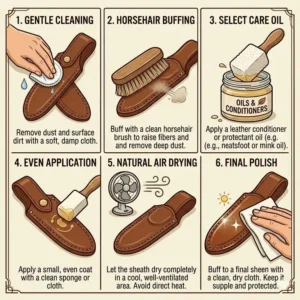
For year-long preservation, adhere to a strict maintenance schedule based on climate. If you operate in dry, arid regions, treat the leather every six months with a light application of pure neat’s-foot oil to prevent dry-rot and cracking. For those working in wet or humid forests, apply a hard wax compound containing beeswax and propolis. This creates a durable hydrophobic barrier that shields the hide from rain while preventing moisture from leaching inside to cause rust on your tools. Always store your carrier in a cool, well-ventilated space; enclosing damp leather inside an airtight plastic bin is a surefire recipe for mold growth.
Real-World Scenario Matcher
No single carry configuration fits every operational environment. Let us examine three distinct user profiles to see how specific configurations perform under real field conditions.
Profile A: The Weekend Bushcrafter
-
Environment: Dense, wet timberlands with frequent elevation changes.
-
Operational Needs: Needs a fixed blade for splitting firewood, carving traps, and clearing paths. The carrier must clear backpack hip straps and remain comfortable during strenuous movement.
-
The Match: A horizontal scout carrier like the Ottoza Handmade Tracker is ideal here. It sits completely clear of the backpack harness and allows the user to kneel, squat, and climb over logs without the tip of the scabbard catching on brush or digging into the ground.
Profile B: The Urban Blue-Collar Tradesman
-
Environment: Active construction sites, concrete decks, and interior remodeling zones.
-
Operational Needs: Requires rapid, one-handed access to a multi-tool, utility marker, and flash inspection light. Must withstand constant scraping against door frames and masonry walls.
-
The Match: The Gentlestache EDC Organizer wins this scenario. Its dual belt loops prevent heavy tools from flapping around as the user moves up ladders, and the thick leather protects expensive electronic inspection lights from impact damage.
The Anti-Recommendation: When Best-In-Class Fails
Consider a premium vertical military build like the Ka-Bar USMC Sheath. While it is an unmatched survival tool, it is a terrible match for an over-the-road truck driver or a desk-bound programmer. If your daily routine involves sitting in an ergonomic task chair or a driver’s seat for eight hours, a rigid 9-ounce vertical scabbard will constantly smash into the seat bolster, forcing your belt out of alignment and causing lower back pain. In this specific edge case, a premium vertical field scabbard fails completely, making a slim pocket organizer or a horizontal scout layout a much safer and more comfortable option.
Problem-Solving & Troubleshooting Guide
Even the toughest leather carriers can run into performance issues over extended periods of hard field use. Here is how to diagnose and fix the three most common problems without replacing your gear.
Problem 1: Over-Stretched, Loose Retention
-
The Cause: Repetitive drawing of over-sized tools or exposing wet leather to high tension can cause the pocket to stretch, resulting in a loose fit where the tool slips out too easily.
-
The Remedy: You can safely shrink the hide using a controlled warm-water molding technique. Remove the tool and submerge the empty carrier in warm water (around 110°F) for exactly three minutes. Remove it, press the leather firmly with your thumbs around the contours of your tool (with the tool wrapped in a plastic bag to protect it), and let it air-dry slowly in a dark room. Do not use a hairdryer or oven, as excessive heat will shrink the leather into a brittle, useless state.
Problem 2: Mold and Mildew Infection
-
The Cause: Storing leather in damp, dark basements or leaving it soaked with sweat inside a gym bag creates an ideal breeding ground for fungal spores.
-
The Remedy: Mix a 50/50 solution of distilled white vinegar and warm water. Dip a microfiber cloth into the mixture, wring it out until it is damp, and thoroughly scrub the interior and exterior of the carrier to kill the mold spores. Let it dry completely in a well-ventilated area, then apply a rich beeswax conditioner to restore the natural oils stripped away by the vinegar wash.
Problem 3: Stitching Failure or Thread Rot
-
The Cause: Exposure to acidic industrial chemicals, concrete dust, or prolonged salt-water contact can rot standard cotton or low-grade polyester threads, causing the main seam to open.
-
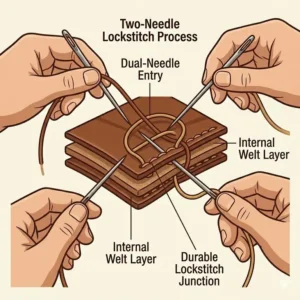
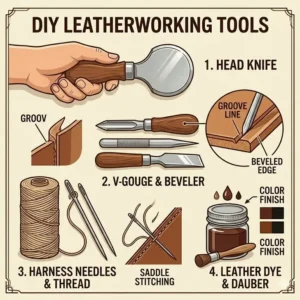
The Remedy: Do not use regular sewing thread for repairs. Clean out the damaged stitch line using a small awl. Obtain heavy-duty waxed braided polyester thread (frequently sold as ultra-tough thread for leather crafting) and a pair of harness needles. Implement a standard manual saddle stitch, which uses two needles passing through the same hole from opposite directions. If one loop breaks in the future, the remaining stitch locks in place, preventing the seam from unraveling.
How to Choose a Quality Leather Sheath
When shopping for an heirloom-grade carrier, you need to look past flashy branding and focus entirely on the material choices and construction techniques. Use this five-step checklist to evaluate any leather carrier before making a purchase.
1. Verify Tanning Method -> 2. Measure Material Weight -> 3. Inspect the Safety Welt -> 4. Check Stitch Recessing -> 5. Evaluate Hardware Metallurgy
1. Verify the Tanning Method
Always confirm that the product is built using vegetable-tanned leather. If a manufacturer’s description simply says “genuine leather” or avoids mentioning the tanning process entirely, it is almost certainly chrome-tanned. Chrome-tanned leather contains chemical salts that absorb ambient humidity and slowly corrode iron or steel blades. This can leave ugly pitting along your cutting edge even while the tool sits idle on your shelf.
2. Assess the Leather Weight (Ounces)
In the leather industry, thickness is measured in ounces, where one ounce equals roughly 1/64 of an inch. For heavy fixed blades, look for an 8–9 oz leather weight (approximately 1/8 inch thick) to provide the necessary puncture resistance. For folding knives or pocket multi-tools, a 4–5 oz weight offers the ideal balance of flexibility and minimal bulk.
3. Inspect the Protective Safety Welt
A quality carrier for a fixed-edge tool must include a dedicated safety welt. This is an extra strip of thick leather sandwiched directly between the front and back panels along the stitch line. Without this buffer zone, the sharp edge of your knife will drag across the structural threads every time you slide it home, eventually cutting the seam wide open.
4. Check for Recessed Stitching Grooves
Examine the perimeter seam closely. The thread should sit below the surface of the leather inside a dedicated, pre-cut groove. If the thread sits proud on top of the hide, it will constantly rub against your clothing, seatbelts, and brush, leading to premature fraying and seam failure.
5. Evaluate Hardware Metallurgy
Look for solid brass, copper, or steel snaps and rivets. Avoid cheap zinc-alloy hardware, which snaps easily under cold weather stress. For premium durability, check that the backplates of all rivets are reinforced with small leather washers to prevent them from tearing through the hide under heavy loads.
Common Mistakes When Buying Tool and Knife Carriers
The most widespread mistake consumers make is buying a carrier based solely on the overall length of their tool while completely ignoring the handle geometry. A knife with a thick, heavy pommel requires a deep-seated pocket or a high-mounted retention strap to balance the weight. If you pair a top-heavy tool with a shallow pocket carrier, the center of gravity will sit above your belt line, causing the handle to flip outward and away from your body as you walk.
Another common pitfall is ignoring belt slot compatibility. Many heavy-duty outdoor carriers feature rigid belt slots cut specifically for 1.75-inch or 2-inch gun belts. Attempting to run these wide setups on a standard 1.25-inch dress belt causes the entire rig to slide around and tip forward during a draw. Always measure your favorite belt’s width and thickness before purchasing to ensure an airtight, stable fit.
Material Showdown: Full-Grain Leather vs Kydex and Nylon
To understand why leather remains a top choice for premium gear, let us look at how it compares to modern synthetic alternatives like Kydex (a rigid thermoplastic) and ballistic nylon.
| Performance Attribute | Full-Grain Natural Leather | Kydex Thermoplastic | Ballistic Braided Nylon |
| Acoustic Signature (Noise) | Completely Silent Draw; deadens impact sounds. | Loud Clicking Sound; resonates when scraped. | Moderate Crinkling; loud hook-and-loop noise. |
| Edge Abrasion & Wear | Extremely Low; polished surface protects steel finishes. | High; rigid plastic scratches blade coatings. | Medium; trapped grit acts like sandpaper. |
| Long-Term Fit Adaptation | Customizes perfectly to tool contours over time. | Static; rigid mold never changes or self-adjusts. | Loosens completely; stretches out and sags. |
| Aesthetic Patina Value | High; grows more attractive with years of field use. | Zero; looks scratched, worn, and faded with age. | Low; material frays and fades under UV sunlight. |
Material Selection Analysis
This breakdown highlights why synthetic materials, while low-maintenance, often compromise on real-world performance. Kydex provides excellent security and weatherproofing, but its rigid structure causes cosmetic scratching on tool finishes and makes a distinct clicking noise during extraction. Ballistic nylon is cheap and lightweight, but it accumulates dirt inside the weave, acting like sandpaper against your tools every time you pull them out. Natural full-grain leather balances structural safety with an completely silent draw, and its ability to custom-mold to your specific tool ensures a perfect friction fit that synthetics cannot duplicate.
What to Expect: Real-World Performance Over 12 Months
Investing in a premium leather carrier means understanding that the product’s performance will change over its first year of use. It is a dynamic material that adapts directly to your body posture, climate, and daily habits.
[The 12-Month Mechanical Performance Curve]
0-3 Months: High Stiffness & Friction -> 4-6 Months: Flex Point Elasticity -> 7-12 Months: Perfect Ergonomic Molding
During months one through three, expect a tight fit and a distinct leather squeak when walking. The pocket walls are still highly compressed, and drawing your tool will require a firm, two-handed pull. This is the stage where most impatient buyers mistakenly return their gear, thinking it is too small.
By months four through six, the leather fibers at the main flex points begin to loosen. The carrier relaxes, dropping slightly lower on your hip to match the natural angle of your thigh when sitting down. The color will begin to deepen, taking on shades of amber and dark brown from exposure to daylight and skin oils.
By the time you hit month twelve, the carrier reaches its peak performance. It has fully molded to the exact contours of your tool and your body shape, acting like a custom-molded second skin. The hidden cost efficiency here is massive; while a cheap nylon pouch typically tears its hook-and-loop fasteners or plastic clips within a year of daily construction use, a well-maintained hide carrier enters its prime at month twelve, lowering your total cost of ownership to pennies per use over time.
✨ Don’t Miss These Exclusive Deals!
🔍 Take your gear setup to the next level with these carefully selected products. Click on any highlighted item to check current pricing and availability. These tools will help you create authentic carrying solutions your family will love!
Conclusion
Choosing a premium leather carrier is more than just a practical storage choice; it is an investment in a durable tool companion that gets better with every mile on the trail. While modern thermoplastics and synthetic weaves offer low-maintenance convenience, they lack the quiet operation, protective properties, and rich character of traditional full-grain hide. By selecting a vegetable-tanned carrier with a reinforced safety welt, matching the weight to your daily routine, and breaking it in patiently, you ensure your essential tools remain secure and accessible for decades to come.
Frequently Asked Questions
❓ Can you store a carbon steel knife long-term in a leather sheath?
✅ No, you should avoid long-term storage for high-carbon steel blades. Natural hides absorb ambient moisture from the air, and any trace tanning salts can trigger pitting rust. For extended storage, keep your blades outside the carrier wrapped in clean, oiled paper…
❓ How do you stretch a tight leather sheath pocket?
✅ Wrap your knife or multi-tool in two layers of plastic kitchen wrap to add a tiny bit of volume. Force the wrapped tool into the tight pocket and let it sit for 24 hours at room temperature to stretch the fibers safely…
❓ What is the difference between vegetable-tanned and chrome-tanned leather sheaths?
✅ Vegetable tanning utilizes natural tree bark extracts, creating an inert environment that is completely safe for steel. Chrome tanning uses aggressive mineral salts that can leach out over time, chemically attacking metal surfaces and causing rapid rust formulation…
❓ How do you fix a leather sheath that has molded?
✅ Mix a gentle 50/50 solution of white vinegar and warm water, then thoroughly wipe down the infected areas to kill the fungal spores. Allow the hide to dry completely in a shaded area, then apply a premium wax conditioner…
❓ Why does my leather sheath have a loose fit?
✅ Over years of hard service, leather fibers can naturally stretch out and lose their original tension. You can easily fix this by lightly dampening the hide with warm water, pressing it tightly around your tool, and letting it air-dry away from heat…
Recommended for You
- Gerber Leather Sheath: 7 Best Rugged Cases for Your Gear in 2026
- Gerber Suspension NXT Sheath: 7 Best Holsters for Your Multi-Tool (2026)
- 7 Best leather gerber multi tool pouch Options for 2026 EDC Excellence
Disclaimer: This article contains affiliate links. As an Amazon Associate, I earn from qualifying purchases. If you purchase products through these links, we may earn a small commission at no additional cost to you.
✨ Found this helpful? Share it with your friends! 💬🤗
[addtoany]
