As an Amazon Associate I earn from qualifying purchases. Links in this article may be affiliate links. How we choose gear
A titanium pry bar such as the Mighty Bar LT is the safest first buy among the best titanium edc tools. A plier-based titanium multitool only earns its extra weight if pliers are part of your normal day. Titanium wins on corrosion resistance and strength for its weight, yet it is softer than hardened steel. The blades, bits, and screws in nearly every tool below therefore remain steel. Built from maker spec sheets, reviews in The Gadgeteer and Outdoor Life, retailer pages, and USGS materials data, this 2027 shortlist runs from a 6-gram keyring bar to a full set of pliers.
What a titanium multitool is, and how the five compare
A titanium EDC multitool is a pocket-carry tool with titanium alloy handles or body, usually Grade 5 (Ti-6Al-4V), and steel for the parts that cut, grip, or turn. The category splits into slab tools, a single machined plate that pries, scrapes, and drives a few fasteners, and plier tools, which fold open into pliers with titanium scales over a steel frame.
Four of the five picks are slab-style pry tools, because that is where titanium makes the most sense. The part is thick enough to take a prying load, and a corrosion-resistant body can ride in a wet jacket pocket or on a keyring without staining. The fifth is a full plier tool for readers who need pliers more than they need low weight.
| Pick | Format | Titanium part | Size or weight | Main limit |
|---|---|---|---|---|
| Mighty Bar LT (MBLT1) | Clip-on pry bar | Tumbled titanium body, steel clip | 4.9 in, 0.634 oz | Blunt edge, no bit driver |
| KeyUnity KR01 | Keyring pry bar | Ti-6Al-4V body | 1.77 in, 6.3 g | Light prying only |
| KANSEPT PryMate G008A1 | Pry bar with hex wrenches | Machined body | 5.09 in long, 0.24 in thick | No blade or bit storage |
| ResafeLY Titanium Pry Bar | Pry bar with ratchet driver | Body | – | One-way ratchet, no pocket clip |
| BIBURY BI2049TI | Plier multitool | Handles | About 314 g (11 oz) | Heavy, knife and scissors |
Weight is the widest gap in the table, since the KeyUnity KR01 is listed at 6.3 grams and the BIBURY plier tool at about 314 grams, roughly fifty times as much. That spread explains why the five are not interchangeable, and why a reader searching for the best titanium multitool should first decide between a slab bar and pliers.
None of the four slab tools carries a knife blade, a design choice The Gadgeteer highlights for the KANSEPT PryMate, which it describes as a deliberately non-knife carry tool. Keeping prying work away from a pocketknife edge protects the knife, and the missing blade also makes travel simpler, as the buying section below explains.
What titanium actually brings to a pocket tool
The headline argument is strength for weight, which HiConsumption calls the alloy’s biggest selling point, with titanium at roughly twice the strength of aluminum. It adds that titanium is about 45 percent lighter than steel at equal strength. MakeItFrom’s materials data supports the weight side, listing Grade 5 near 4.4 grams per cubic centimeter against 7.7 for 440A stainless steel.
Corrosion is the second argument, and the U.S. Geological Survey describes titanium as known for corrosion resistance and a high strength-to-weight ratio. A USGS-authored summary in Earth magazine calls titanium alloys nearly immune to corrosion in seawater. For a tool that rides in a work jacket, a truck door pocket, or a gym bag, a damp day does not start a rust spot, although the metal still scratches.
Calling the metal rugged needs a qualifier, because knife retailer Knife Art lists Grade 5 titanium at about 36 on the Rockwell C scale against 56 to 61 for hardened blade steels. It also warns that the softer metal can show wear at lock surfaces over long periods. Titanium flexes more as well, with a stiffness of roughly 110 to 160 GPa against about 200 for steel, according to the materials writers at Metmo.
Grade matters as much as the metal itself. Knife retailer Urban EDC puts commercially pure Grade 2 at about 345 MPa tensile strength and Grade 5 above 895 MPa. That explains why Grade 2 turns up in pocket clips and budget scales while Grade 5 handles multitool frames. A listing that says 6Al-4V indicates Grade 5, and the same retailer says plain “titanium” with no grade more often means Grade 2.
The price multiple depends on whom you ask, since MakeItFrom’s relative base-metal price index puts Grade 5 at 36 against 9 for 440A, about four times. HiConsumption cites up to 100 times the cost of common steels once refining and machining are counted. At retail, Urban EDC reports that a titanium folding knife often costs about $100 more than its steel twin. On a thin pocket knife, it adds, most of that gap buys appearance rather than a better tool. On a pry bar sold at around $25, the metal premium is small enough that weight and rust resistance decide the purchase.
Three beliefs about titanium tools that the numbers do not support
Titanium is always stronger than steel
MakeItFrom lists Grade 5 titanium at 1,000 to 1,190 MPa ultimate tensile strength. A precipitation-hardening stainless steel (S45503) reaches 1,610 to 1,850 MPa and 46 to 54 on the Rockwell C scale, against titanium’s 33. Metmo makes the same point in plainer terms, saying titanium is generally stronger than steel but not always. The real advantage is strength per gram, not raw strength.
Titanium does not scratch
HiConsumption states that titanium is not scratch proof by any means, and it says the natural oxide layer and tumbled or stone-washed finishes hide marks better than a polished surface would. Urban EDC adds that Grade 2 scuffs faster than Grade 5 when it rides with keys and coins, which matters for the keyring bars in this guide.
A titanium tool is titanium all the way through
No tool in this guide is, since The Gadgeteer reports that the Mighty Bar LT carries a stiff stainless steel pocket clip. Retailer listings for Big Idea Design’s Titanium Pocket Tool name a stainless steel insert blade and stainless Torx screws, and HiConsumption notes that the multitool inside Titaner’s titanium wallet is 440C stainless. Titanium forms the body, while steel does the cutting, driving, and fastening.
How many grams a titanium swap really saves
Take the Mighty Bar LT, listed at 0.634 ounces, which is about 18 grams. Assume, for the calculation, that the same shape were cut from 440A stainless steel. With MakeItFrom’s densities of 7.7 and 4.4 grams per cubic centimeter, the steel version would weigh about 31 grams, a difference of roughly 13 to 14 grams. The same arithmetic puts a steel twin of the 6.3-gram KeyUnity KR01 near 11 grams, saving about 5. Both figures assume identical geometry, whereas a steel maker could thin the part to close some of the gap.
Carried together, the two titanium pieces form a lightweight titanium tool kit that saves about 18 grams over its steel equivalents, which is real but hard to feel in a pocket. The stronger arguments are corrosion resistance and a bare, tumbled finish that hides scuffs. Plier tools tell the opposite story, since the BIBURY BI2049TI is listed at roughly 314 grams. Leatherman lists its titanium-handled Charge+ TTi at 8.89 ounces, about 252 grams, so titanium scales alone do not guarantee a light multitool.
Matching a tool to your pocket and your hardware
Where a tool rides decides more than what it is made of. A keyring bar such as the KeyUnity KR01, at 1.77 inches, lives with the keys and never leaves the pocket. A clip-on bar of 4.9 to 5.1 inches sits at the edge of a shirt or trouser pocket, while a plier tool needs a belt sheath, a bag, or a vehicle.
Clips are the most repeated weak point in reviews of slab tools. Outdoor Life’s reviewer bent the pocket clip on the Griaitus pry bar multitool outward, and it snapped when he tried to bend it back. A buyer on Big Idea Design’s own product page called the TPT Slide’s clip too rigid to use, after which the maker offered a free replacement. Two reports across two brands are thin evidence, yet they fit the material, because a clip must flex repeatedly and Urban EDC names the more ductile Grade 2 for that job.
Compatibility decides whether a tool is useful on day one:
- Bits: the ResafeLY takes standard 1/4-inch hex bits in a magnetic recess, and Outdoor Life’s reviewer found short bits awkward, so a small extension helps.
- Wrenches: the KANSEPT PryMate covers M4, M8, and M10 hex sizes, which The Gadgeteer links to flat-pack furniture, bike hardware, and budget shelving, and the KeyUnity KR01 adds a 6 mm hex.
- Cutters: the BIBURY uses replaceable wire cutters and a T-shank interchangeable system, so spares have to match that design.
- Rings: the KR01 has a ring hole, and a separate shorter Mighty Bar sells for the keychain at around $15.
Before ordering, hold the bit sizes already in your drawer against the tool’s drive.
Air travel adds a second filter, and the TSA’s multi-tool entry carries special instructions for carry-on bags and allows scissors shorter than 4 inches. Its Swiss Army knife entry sends knife blades to checked bags, and the agency says the final decision rests with the officer at the checkpoint. A plier tool with a knife and scissors, such as the BIBURY, therefore belongs in checked luggage whatever its handles are made of. A blade-free pry bar raises fewer questions, though the officer’s judgment applies to every item.
When steel, aluminum, or a cheaper tool is the better call
Anyone whose main task is cutting gets more from a steel tool. Hardened blade steels reach 56 to 61 on the Rockwell C scale against about 36 for Grade 5 titanium, per Knife Art. Even the BIBURY’s knife, scissors, and cutters sit inside titanium handles rather than being made of them. The same hardness gap makes stainless or hardened steel the practical runner-up for drive tips, bits, and anything that takes torque, at about 1.75 times the density.
Aluminum is the usual compromise when a maker wants low weight at a lower price. Titaner’s EDC wallet launched on Kickstarter at about $100 in aluminum and about $180 in titanium, according to Yahoo Tech. HiConsumption lists Dango’s titanium Adapt A10 wallet at around $250, roughly three times the aluminum version. Larger tools lean on aluminum too, since Gerber’s E-Tool shovel uses a 7075 aluminum shaft rather than titanium, per a Public Lands listing.
Titanium is also a poor fit for anyone who lends tools freely or loses pocket items, because the premium disappears with the tool. Even the best titanium edc tools leave heavy leverage to steel, and The Gadgeteer says outright that the KeyUnity KR01 will not replace a shop pry bar. The downsides in short are higher cost, a softer surface, more flex, and wear at lock faces, set against lower weight and rust resistance.
Reading “titanium” on a listing: alloy, plated, and 100% titanium tools
Listings use the word in three different ways. “Titanium handles” or “TC4 titanium” describes solid alloy, and TC4 on a listing generally corresponds to Ti-6Al-4V. “Titanium-plated” describes a surface treatment, which is a different thing from a solid alloy, and it appears on retailer pages for the BIBURY 21-in-1 and in a roundup entry for the Rocktol SK02.
Claims of 100% titanium tools deserve the most caution. They usually describe the body alone, because every titanium multitool covered in this guide pairs the alloy with steel for blades, bits, clips, or screws. A listing that names the alloy as 6Al-4V is saying something checkable, while a bare word with no grade is more likely Grade 2, according to Urban EDC and HiConsumption.
The BIBURY BI2049TI is described by retailer pages as having titanium alloy handles with a Damascus-pattern main blade, whereas other BIBURY plier models are described as titanium-plated. Those are distinct versions of one product line, and their reviews should not be mixed.
Made in USA, premium brands, and what each price band buys
Leatherman builds its plier tools in Portland, Oregon. Its Charge+ TTi, with titanium handles and an S30V blade, sells for close to $200 at Leatherman’s US store and several retailers, although the company’s international pages label the model as no longer in production. Smaller US makers cover the slab tools, and Carryology describes a Grade 5 titanium pocket tool made in the USA by Koch Tools Co. BladeHQ lists Griffin’s 15-in-1 Pocket Tool XL as made in the USA at about 1.23 ounces and around $70. BladeHQ also lists EOS’s Mako keychain tool as USA-made, while DLT Trading sells a 4-inch titanium pry bar from Tool Every Day, made in the USA, at around $40 and 0.3 ounces.
Brands that anchor the premium end are easy to name. Big Idea Design’s TPT sells for roughly $85 to $105 at retailers, and The Gadgeteer says the titanium TPT Slide runs over $90. Prometheus Design Werx’s Ti-BarT sits near $65, with Off Grid Web calling a price close to $70 pricey for a small tool, and KANSEPT’s PryMate fills the middle.
The price bands below follow what the cited sources report:
- $15 to $30: keyring and clip bars, including the Mighty Bar LT at around $25 and the KeyUnity KR01 at roughly $24 to $30.
- $40 to $70: the KANSEPT PryMate at around $44, the Ti-BarT at around $65, and Griffin’s pocket tool at around $70.
- $85 and up: Big Idea Design’s pocket tools.
- Around $200: the titanium-handled Leatherman plier tool.
Titanium tool boxes, a light kit, and the e-tool question
Searches for a titanium edc tool box mostly lead to small cases rather than boxes that hold tools. A titanium edc tool box of that kind protects a few bits or a spare blade rather than a full set. CountyComm’s Titanium Pocket Strong Box Gen 2 is a machined titanium slide box with a spring-loaded plunger, sold by the maker for around $40, and wallet-style organizers fold a few tools into a card carrier. Titaner’s titanium EDC wallet weighs just over 2.5 ounces, according to Yahoo Tech, and hides a five-function steel multitool in a chamber.
Reviews of titanium-first brands, a group that includes the maker Titaner, share a pattern worth reading for. Coverage in Gear Patrol and HiConsumption describes premium pricing and a titanium shell around steel working parts, so edc titan reviews are most useful when they say what the steel parts do. Anyone reading edc titan reviews for a specific tool should look for comments on the clip, the fasteners, and the edge rather than the titanium itself.
A lightweight titanium tool kit can be built in layers. The KeyUnity KR01 on the keys and the Mighty Bar LT in a pocket together weigh about 24 grams, or 0.86 ounces. Adding the BIBURY for a glovebox or bag raises the total to about 338 grams, roughly 11.9 ounces, and nearly all of that is the pliers.
A titanium e tool can mean two different products. The entrenching-tool meaning, a folding shovel, is rarely titanium. Gerber’s E-Tool pairs a 7075 aluminum shaft with a powder-coated boron carbon steel blade, weighs 37.3 ounces according to a Public Lands listing, and costs around $95 from the maker. The pocket-tool meaning is the Antdesign E-One, a titanium multitool The Gadgeteer reviewed in 2023 at between $44 and $59 on the maker’s site. A search for a titanium e tool therefore splits between a shovel that is mostly aluminum and steel and a pocket tool that is titanium.
The five tools, from keyring weight to full pliers
1. Mighty Bar LT Long Titanium Edition Pry Bar — pocket-clip bar at 0.6 ounces
It is the tool the shortlist leans on first. At 4.9 inches and 0.634 ounces, model MBLT1 is long enough to get leverage on a lid or a trailer document holder, yet light enough that reviewers describe forgetting it is there until needed. The Gadgeteer reports it at around $25 on Amazon with a 4.7-star average across 242 reviews and an Amazon’s Choice badge. One buyer who works as a mechanic called it “actually long enough to pry things”. Other reported uses include lifting fuel-tank cover handles and opening warehouse packages.
The titanium body has a heavy tumbled finish that hides scratches, and a stiff stainless steel clip holds it at the pocket edge. A D2 steel version sells at the same price for readers who prefer a harder metal, which is a fair reminder that titanium is a weight choice rather than a strength one.
Pros:
- 0.634 ounces with a bare tumbled titanium body
- Steel clip stays put in a shirt pocket, according to a buyer cited by The Gadgeteer
- A D2 steel option at the same price for harder use
Cons:
- Blunt working end, so it cannot cut or drive a screw
- The clip is steel, so the tool is not titanium throughout
2. KeyUnity KR01 Titanium Pry Bar — 6.3-gram keyring prying tool
The KR01 does one job and says so. According to The Gadgeteer, it pries and stops there: it will not replace a shop pry bar, and unlike Koch Tools’ PryOfSorts it does not drive screws. What it offers is 6.3 grams of Ti-6Al-4V in a 1.77-inch body. The working end has a pry edge, a box-opening edge, and a flathead profile, and a 6 mm hex wrench is cut into the waist between the tip and the ring hole.
The same outlet says nothing at that weight has displaced it from its keychain-tool picks. Each tool in that set is chosen for one job only, so the KR01 reads as a companion to other keyring tools rather than a stand-alone kit. Pricing runs roughly $24 to $30, going by the $23.99 it reported against a $29.99 starting figure. Grade 5 is also the better-wearing choice for a tool that lives among keys and coins, going by Urban EDC’s note that Grade 2 scratches more readily.
The compromise is leverage, because at 1.77 inches the KR01 suits a taped carton, a paint-can lid, or a stuck battery cover, while anything stubborn needs a longer bar such as the Mighty Bar LT.
3. KANSEPT PryMate G008A1 Titanium Pry Bar — pry bar with three hex wrenches
Fastener work is the PryMate’s reason to exist. KANSEPT lists a pry bar, bottle opener, nail puller, flat-head screwdriver, and M4, M8, and M10 hex wrenches worked into the body. The Gadgeteer notes that those three sizes cover a lot of flat-pack furniture, bike hardware, and fasteners on cheap shelving.
Designed by Sebastian Irawan as a deliberately non-knife carry tool, it measures 5.09 inches long and 0.24 inch thick, with a finger hole in the handle for grip. Because it has no edge, it pairs naturally with a folding knife that should stay out of prying jobs, which The Gadgeteer presents as the design’s whole point.
The Gadgeteer prices the plain titanium version at around $44 and the green anodized finish at about $45, and says Amazon stocked seven of the eight finishes when it wrote. It calls the PryMate a heftier answer than the Mighty Bar LT, so the extra capability costs some pocket comfort.
The weak spots are clear: there is no blade, scissors, file, or bit storage, and the three wrenches only help with hex hardware in those sizes. Anodized finishes also wear differently from bare titanium, a point The Gadgeteer raises, which affects appearance more than function.
4. ResafeLY Titanium Pry Bar EDC Tool — ratchet driver in a slim bar
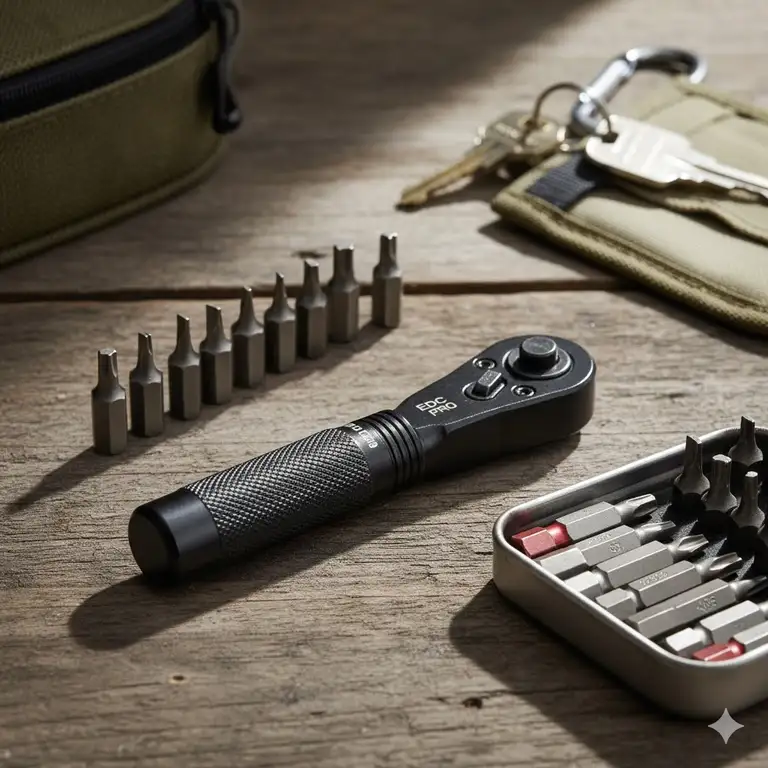
Anyone who tightens small bolts often is the target buyer here, according to Outdoor Life’s reviewer, who found the wrench works efficiently and fits it into his daily routine. The titanium bar combines a pry wedge with a nail notch, a spring-loaded universal wrench, and a 1/4-inch ratcheting driver. A magnetic recess holds two 1/4-inch bits (Phillips and flat included), and the bar adds a magnetic driver socket, a bottle opener, and a lanyard hole.
The same review raises two caveats. The ratchet works in one direction only, so the tool must be flipped over to switch between tightening and loosening. Short standard bits are hard to use unless a small extension is added. The reviewer also prefers a pocket clip, whereas this design relies on the lanyard hole, so it suits a bag, a desk, or a vehicle better than a trouser pocket.
Because the driver takes standard 1/4-inch bits, the tool can reuse a bit set already owned, which makes it more adaptable than the other slab tools here when screw heads vary. Readers who want a flat tool in a trouser pocket will find the PryMate or the Mighty Bar LT easier to carry.
5. BIBURY BI2049TI Titanium Multitool Pliers — full-size pliers with titanium handles
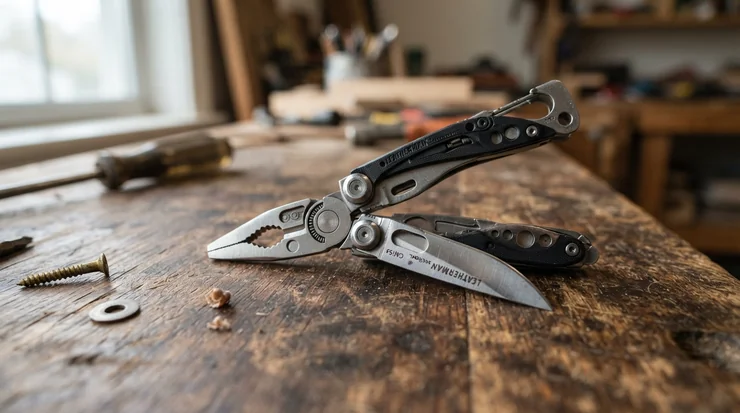
Weight is the first thing to understand about this tool. Retailer pages list the BI2049TI at about 314 grams, heavier than Leatherman’s 252-gram Charge+ TTi. The titanium covers the handles, and retailer descriptions list a Damascus-pattern main knife, spring-loaded pliers, large scissors, replaceable wire cutters, a T-shank interchangeable system, an 8-piece magnetic bit kit, and a nylon sheath.
On build quality, The Gadgeteer’s review of an earlier BIBURY 19-in-1 pliers model, a different version, reports that the cutters handled a coat hanger, 12-gauge wire, and a small zinc bolt without damage. It also reports that all the tools lock in place. Leatherman’s titanium-handled plier tool costs close to $200, yet the BIBURY offers the same handle material to readers who want pliers in a glovebox or tool bag.
Pros:
- Titanium handles with replaceable wire cutters and a full bit kit
- Knife, scissors, and pliers in one folded tool
- All tools lock open, per The Gadgeteer’s review of an earlier model
Cons:
- About 314 grams, more than Leatherman’s titanium-handled tool
- Knife and scissors mean it belongs in checked baggage under TSA rules
Titanium grades, 100 percent claims, flights, and cheaper metals
Is the best titanium multitool worth more than a stainless one?
What does 100% titanium mean on a tool listing?
Can a titanium multitool go through airport security?
What is the next best material if titanium costs too much?
Where can I find titanium EDC tools made in the USA?
A sensible order for a first titanium purchase
Among the best titanium edc tools, the Mighty Bar LT is the logical opening purchase, and the KeyUnity KR01 is the inexpensive companion that rides with the keys. The KANSEPT PryMate or the ResafeLY makes sense once a specific fastener job keeps interrupting the day, three hex sizes in one case and a ratchet driver in the other. The BIBURY belongs in a glovebox or checked bag where its 314 grams cost little. Titanium trims weight and rust rather than hardness, so any job that needs an edge or serious torque still belongs to steel. A single tool carried for a few weeks will show which of the others deserves the pocket space.
Recommended for You
- Titanium EDC tools: 7 top picks for your 2025 carry
- Titanium Tools: 7 Best High-Performance Gear for 2026
- Multi tool with utility blade: 7 top EDC picks for versatility
Buy a single titanium tool first, carry it long enough to learn what it cannot do, and let those gaps decide what comes next.
SEO TITLE: Best titanium edc tools: 5 Picks to Start With (2027)
SLUG: best-titanium-edc-tools
META DESCRIPTION: Best titanium edc tools for 2027: four pry bars and one plier multitool, with weights, grades, trade-offs, and what to leave out.
FOCUS KEYWORD: best titanium edc tools
A titanium pry bar such as the Mighty Bar LT is the safest first buy among the best titanium edc tools. A plier-based titanium multitool only earns its extra weight if pliers are part of your normal day. Titanium wins on corrosion resistance and strength for its weight, yet it is softer than hardened steel. The blades, bits, and screws in nearly every tool below therefore remain steel. Built from maker spec sheets, reviews in The Gadgeteer and Outdoor Life, retailer pages, and USGS materials data, this 2027 shortlist runs from a 6-gram keyring bar to a full set of pliers.