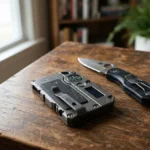
The Wallet Ninja 18-in-1 is the safest first tool wallet for most people in 2027, because Vat19 lists it at 1.5 mm thick while Victorinox gives the SwissCard Lite a height of 4 mm. That 2.5 mm gap decides more purchases than the tool count does, since a card slot that already holds four payment cards has very little spare depth. Slim wallets, elastic bands and thin card sleeves all punish a tool that is thicker than the cards around it.
Maker spec sheets, US retailer listings, Pack Hacker and SlashGear reviews, summarized Amazon owner reviews and the TSA’s screening rules supply the findings below. Three models earn a numbered place, and each one comes with a stated limit. Several other cards are mentioned only for context, and the phrase itself also appears on software pages, which the middle of the article separates from the physical gear.
What every source agrees on: flat steel, light weight, small jobs
Reviewers disagree about brands, but they agree on the physical facts. A wallet-sized tool is a thin plate of steel or plastic, it weighs about an ounce, and its tools are shaped to fit inside a card outline. Everything else follows from those three facts.
Thickness sets the carry, and the function count does not
Specification pages express thickness in different ways, yet the ranking never changes. Vat19 lists the Wallet Ninja at 1.5 mm and calls it thinner than two credit cards. Victorinox lists the SwissCard Lite at 82 mm long, 55 mm wide, 4 mm high and 26 g. A Sun & Ski listing gives the 7-in-1 Nite Ize Financial Tool as 3.6 by 2.3 by 0.14 inches, which is about 3.5 mm.
Pack Hacker’s review of the Ekster Tool Card reports about 0.29 inches, or 7.4 mm, and warns that this depth can stretch thin wallet pockets and does not suit smaller or minimalist wallets. A tool wallet card that thick is a separate product class from a 1.5 mm card, even though both share a credit-card outline. The thinner the plate, the more cards survive beside it.
Function counts describe shapes cut into the steel
SlashGear counts 18 advertised functions on the Wallet Ninja, 43 on the W4W Widget, and 24 wrenches plus a bottle opener, box opener, ruler and several more shapes on the Lever Gear Toolcard Pro. Those numbers describe outlines, not jobs. Pack Hacker’s reviewers found eight functions on the Ekster Tool Card and report that they rarely used it for anything beyond opening drinks and boxes.
All The Wallets reports no failures from the main Wallet Ninja tools, which it names as the bottle opener, the screwdrivers, a box cutter, a ruler and a can opener. The same review adds that the build does not match the premium range from Dango. A useful way to read any count is to ask how many of those shapes you would use in a normal month.
What wallet multi tool uses actually look like
The wallet multi tool uses that appear in every source are modest ones. The bottle opener is the most praised feature, and Pack Hacker calls the Ekster’s opener easy to use, unlike the openers on many multitools. Tape and box opening comes next, and Loadout Room credits the Nite Ize’s tape cutter with letting you open boxes without a knife.
Light screwdriver work, a ruler, a SIM pin and a phone stand fill out the list. SlashGear notes that the Wallet Ninja stand needs a spare card you do not mind scuffing, and Pack Hacker found that the Ekster stand folds under flimsy cards while a metal credit card worked best. Wrenches fare worse: Pack Hacker reports that the Ekster’s largest wrench is too small for jobs such as bike wheels.
The Canadian Centre for Occupational Health and Safety advises against using a screwdriver for prying, punching, chiseling, scoring or scraping, and says the tip should match both the size and the type of the screw head. A card tool tempts every one of those misuses, because its edges look like a scraper and a pry bar. The screwdriver tips are meant for screws, and scraping belongs to the edge shaped for it.
Cost per function and added thickness, computed
The comparison below is arithmetic that no product page prints. It assumes the midpoint of the price range each source gives and the function count each maker or reviewer states. Wallet Ninja prices run from about $12 (All The Wallets) to about $15 (SlashGear), a midpoint of $13.50, which across 18 functions is about $0.75 per function.
The SwissCard Lite sits around $50 on Newegg and GP Knives listings. Across Victorinox’s 13 functions, that is about $3.85 each. The Nite Ize ranges from about $10 to $16 across Pack Hacker’s Amazon entry, Tractor Supply and REI, a midpoint of $13. Across Pack Hacker’s seven tools that is about $1.85 per function, and across REI’s count of ten it is $1.30.
Weight gives a second ratio. Victorinox’s 26 g across 13 functions is 2.0 g per function, while Pack Hacker’s 29.8 g across seven Nite Ize tools is about 4.3 g. Thickness gives a third: 1.5 mm for the Wallet Ninja, 4 mm for the SwissCard Lite, and 3.5 mm or more for the Nite Ize. The cheapest and thinnest card is also the one with the most generous count, which is a reason to read its count with care.
A slot-depth example with stated assumptions
The example is hypothetical. Assume a front-pocket wallet whose card slot stretches to 6 mm in total, and assume each payment card measures 0.8 mm, a figure chosen to agree with Vat19’s statement that the Wallet Ninja is thinner than two cards. Four cards then take up 3.2 mm of the slot.
Adding a Wallet Ninja brings the stack to 4.7 mm, which leaves 1.3 mm of slack. Adding a SwissCard Lite brings it to 7.2 mm, which is 1.2 mm over the limit. The wallet would need to drop to two cards, a stack of 5.6 mm, before the Victorinox fits with 0.4 mm to spare. The arithmetic is simple, but it shows why thickness belongs ahead of function count in any purchase.
Cards that stay in the background
Three other cards come up repeatedly and are mentioned here for context only. The Ekster Tool Card earns 6.8 out of 10 from Pack Hacker, costs around $50, and is made of 304 stainless steel, but its 7.4 mm depth and eight functions make it a harder case for slim wallets. The Lever Gear Toolcard Pro is listed by SlashGear at around $20, in 420 heat-treated stainless steel, and SlashGear notes it has no sharp or jagged edges to catch on wallet notches.
The Rugged Material Ranger takes a different route, combining a steel body, a removable 12-tool card and a 1.5-inch woven elastic band, according to Touch of Modern. One Amazon reviewer quoted in a Fakespot summary reports the matte finish chipping after about a year, especially on the bottle opener. Each of these is a reasonable alternative, but none fits the thin-card or budget logic as cleanly as the three numbered models below.
How solid each finding is
The evidence is uneven, and the sources say so by their size. Knife Center’s Wallet Ninja rating rests on only seven reviews. Pack Hacker’s verdicts are single-publication reviews, and Fakespot’s summaries compress hundreds of Amazon comments into short fragments. Thickness, weight and warranty terms are firm because they come from makers and retailers, while durability claims are softer.
That is why the band complaints deserve more weight than any single score. They recur in Pack Hacker’s review and in the Amazon owner comments Fakespot summarizes, whereas praise for the tools themselves rests on a handful of reviewers who mostly used the bottle opener.
One product, three weights: where specifications and security claims collide
The sources split in three places, and each split changes what a buyer should expect. The first is a spec sheet, the second is a legal line at an airport, and the third is the meaning of the search phrase itself.
Two Nite Ize wallets sold under one name
Listings for the Nite Ize Financial Tool give weights of 1.05 oz (Pack Hacker), 1.16 oz or 33 g (Sun & Ski) and 1.7 oz or 49 g (Evike and a Bass Pro Shops listing). The heaviest figure is about 64 percent above the lightest, and the thicknesses of 3.5 mm and 5.1 mm differ by 1.6 mm. Tool counts split the same way, with Pack Hacker, Tractor Supply and LA Police Gear saying seven and REI saying ten.
The pattern points to two versions. The REI page describes an RFID-blocking 10-in-1 that includes a money clip, nail remover and protractor, and the Evike dimensions of 2.3 by 3.6 by 0.2 inches match that heavier build. The 7-in-1 appears to be the lighter plate. Figures from one version should not be applied to the other, and any comparison has to say which of the two is meant.
Airport wording: “approved” on a retailer page, “officer decides” on the TSA page
Vat19 describes the Wallet Ninja as one of very few multi-tools approved by the TSA. The TSA’s own page for multi-tools states the opposite emphasis: a multi-tool with a blade of any length cannot go in a carry-on, scissors under 4 inches are allowed, and the final decision rests with the TSA officer.
Pack Hacker words the Ekster as compatible with TSA guidelines while noting that agents have the final say. Adorama’s question board for the SwissCard shows both outcomes: one owner says it passes security, and another says forgetting it in a purse at the checkpoint meant replacing it many times. Because All The Wallets names a box cutter among the Wallet Ninja tools, and Victorinox lists a small blade on the SwissCard, the safe reading is that a flat tool with any blade belongs in checked luggage when a flight is involved.
A search term that also names software
Searches such as tool wallet ai, tool wallet extension and tool wallet veo3 lead to a different kind of page. A site at toolwallet.in lists access to AI tools such as Google Veo 3 Ultra and Google Flow AI Studio, and the Chrome Web Store carries several Veo 3 automation extensions that queue prompts inside Google Flow.
One of those listings states that it handles personally identifiable information, web history and user activity. None of it relates to the steel cards in this article, and this site reviews physical gear only. A reader who landed here from a tool wallet ai query should read the privacy disclosure on any extension and the official Google pages for the service before installing or paying for anything.
Three tool wallets and what each one gives up
Each entry below is written in prose, since the numbers above already carry the comparison. The order follows the verdict: the thinnest tool wallet card comes first, the premium Swiss case second, and the wallet with tools built into its body third.
This is the pick for anyone who wants the tool to disappear into a normal card slot. Vat19 lists it at 1.5 mm, made from steel heat-treated four times, with a lifetime guarantee against rust, bending and dulling. SlashGear counts 18 labeled functions and puts the price near $15, while All The Wallets lists it near $12.
The owner evidence is mildly positive. All The Wallets reports no failures from the main tools, and Knife Center shows 3.9 out of 5 stars across seven reviews, with a traveler praising it for carry-on-only trips. One reviewer quoted in Fakespot’s summary of Amazon feedback says it is heavy for a wallet item, so the thin profile does not guarantee a light one.
Its shortcomings are specific. The phone stand needs a spare card that will get scuffed, the finish does not match Dango’s premium range according to All The Wallets, and the box cutter edge complicates any flight with a carry-on. Buyers who expect a pliers-grade tool will find nothing here to grip, because the handles are the card itself.
Wallet Ninja 18-in-1 Multitool CardCheck the current price, sizes and reviews on Amazon.
At around $50 on Newegg and GP Knives listings, the SwissCard Lite costs roughly four times as much as the Wallet Ninja, and the extra money buys different tools. Victorinox lists 13 functions, including a small blade, scissors, tweezers, two flat screwdrivers, a Phillips driver, a pressurized ballpoint pen, a magnifier, rulers and an LED. The case is ABS and cellidor, and the whole unit is made in Switzerland.
Victorinox guarantees its tools against defects in material and workmanship for life, with a two-year term for the electronic parts. An Adorama reviewer of the Lite reports using the previous one almost daily for about ten years, which is a long service record for a pocket item. The same Adorama question board also records an owner who replaced the card many times after leaving it in a purse at security.
The blade is not lockable and does not open one-handed, per Victorinox, so cutting is a light-duty affair. At 4 mm the case also needs real room in a wallet, as the slot-depth example showed. For flyers who want scissors and an LED but not pliers, it is a strong option, though the blade pushes it out of a carry-on.
Victorinox SwissCard LiteCheck the current price, sizes and reviews on Amazon.
Unlike the first two, this model replaces the wallet itself. A stainless plate and an elastic band hold cards and bills, and the tools sit on the plate: a bottle opener, three wrenches in the quarter-, five-sixteenth- and three-eighth-inch sizes, two screwdriver heads, and a ruler, according to Pack Hacker. That review gives it 7.0 out of 10 and a price of roughly $10 on its Amazon listing.
Pack Hacker found it comfortable with fewer than five cards plus a few folded bills, and noted that more than that stretches the band. Tools become hard to reach when the wallet is loaded, the wrenches need clearance, and the sharp corners can poke holes in pockets and bags. Tractor Supply shows 3.8 out of 5 from about 90 reviews.
The tool wallet band is where the complaints concentrate. Fakespot’s 2023 summary of 893 Amazon reviews includes owners saying the rubber straps break after about two years, that the band cannot be ordered separately, and that metal can damage cards. A buyer who carries ten cards will exceed what the band was designed for, and a buyer who wants a flat card instead should look at the Wallet Ninja.
Nite Ize Financial ToolCheck the current price, sizes and reviews on Amazon.
Ownership cost and fit checks: bands, guarantees, and what each tool must match
Purchase price understates the real cost of a wallet tool, because the part that fails first is rarely the steel. The band, the case and the owner’s habits determine how many years a tool earns its pocket space.
Cost over two years
Assume a two-year horizon, which matches the break point Amazon reviewers report for the Nite Ize band in Fakespot’s summary. A $13 Nite Ize replaced at that interval costs about $6.50 per year, and the band cannot be bought alone according to those reviewers. Ridge sells its replacement elastic for about $7 on its own store page, which shows how a separable band changes the arithmetic for a wallet built around one.
The Wallet Ninja, at a $13.50 midpoint, carries a lifetime guarantee against rust, bending and dulling per Vat19, and that guarantee does not cover loss. The SwissCard Lite carries Victorinox’s lifetime defect guarantee, which also does not cover a checkpoint surrender. A lost SwissCard costs around $50, which is more than three Nite Ize wallets. Over the same two years, the Wallet Ninja at that midpoint works out to about $6.75 per year if it is replaced at the end, and the SwissCard Lite to about $25 per year on the same assumption.
Pairing check: wallet, cards, screws, and bags
A flat tool must match four things. The first is slot depth, covered above in millimeters. The second is the cards beside it, since Amazon reviewers in Fakespot’s summary report damage from metal edges, and Pack Hacker notes that a phone stand collapses with thin cards. The third is the screws it will meet, because CCOHS says the driver should match the screw head in both size and type.
The fourth is the bag it travels in. A tool with a blade, a box cutter or a scraping edge goes into checked luggage for a flight, and sharp items there should be sheathed or securely wrapped per the TSA. Elastic bands add a fifth match, since Pack Hacker puts the Nite Ize comfortable at under five cards, while the Ridge Wallet’s retailer pages list up to twelve cards. Pairing a heavy card load with a small band shortens the band’s life.
Airport rules, phone stands, wallet bands, and software lookalikes
Can a wallet multi tool go through airport security?
The TSA bars a multi-tool with a blade of any length from carry-on bags, allows scissors under 4 inches, and leaves the final decision to the officer. Bladeless cards are likelier to pass, but checked luggage is the safer place for any with a cutter.
What are the most realistic wallet multi tool uses?
Sources point to opening bottles and boxes, driving small screws, measuring with a short ruler and propping a phone with a spare card. Pack Hacker found the Ekster used for little beyond drinks and boxes, so heavy repairs remain a job for full-size tools.
How long does a tool wallet band last?
Amazon reviewers summarized by Fakespot report rubber straps on the Nite Ize breaking after about two years, and Pack Hacker warns that loading more than that stretches the band. Ridge sells replacement elastic for roughly $7, which helps with bands that are sold separately.
Are a tool wallet extension or a tool wallet veo3 listing related to these cards?
No. Those phrases lead to browser extensions and AI subscription pages, including Veo 3 automation tools for Google Flow. They are software, and one store listing discloses handling of personally identifiable information, web history and user activity, so privacy disclosures deserve a careful read.
Will a metal tool card damage the cards next to it?
Amazon reviewers summarized by Fakespot report card damage from the metal edges of the Nite Ize, and Pack Hacker says the Ekster can stretch or damage thin wallet pockets. Thinner plates such as the 1.5 mm Wallet Ninja leave more room and put less strain on slots.
Matching the steel to the pocket it must live in
The decision rule is short. Choose the Wallet Ninja when depth is scarce and the budget is low, the SwissCard Lite when scissors and light matter and the wallet has room, and the Nite Ize when the wallet itself is the part you want to replace. Every tool wallet in this article trades some thickness, some travel convenience or some band life for its tools, so the right one is the trade a given pocket can absorb.
Measure the depth of your busiest card slot in millimeters, subtract the cards already in it, and hold that remainder against each tool’s listed thickness.