
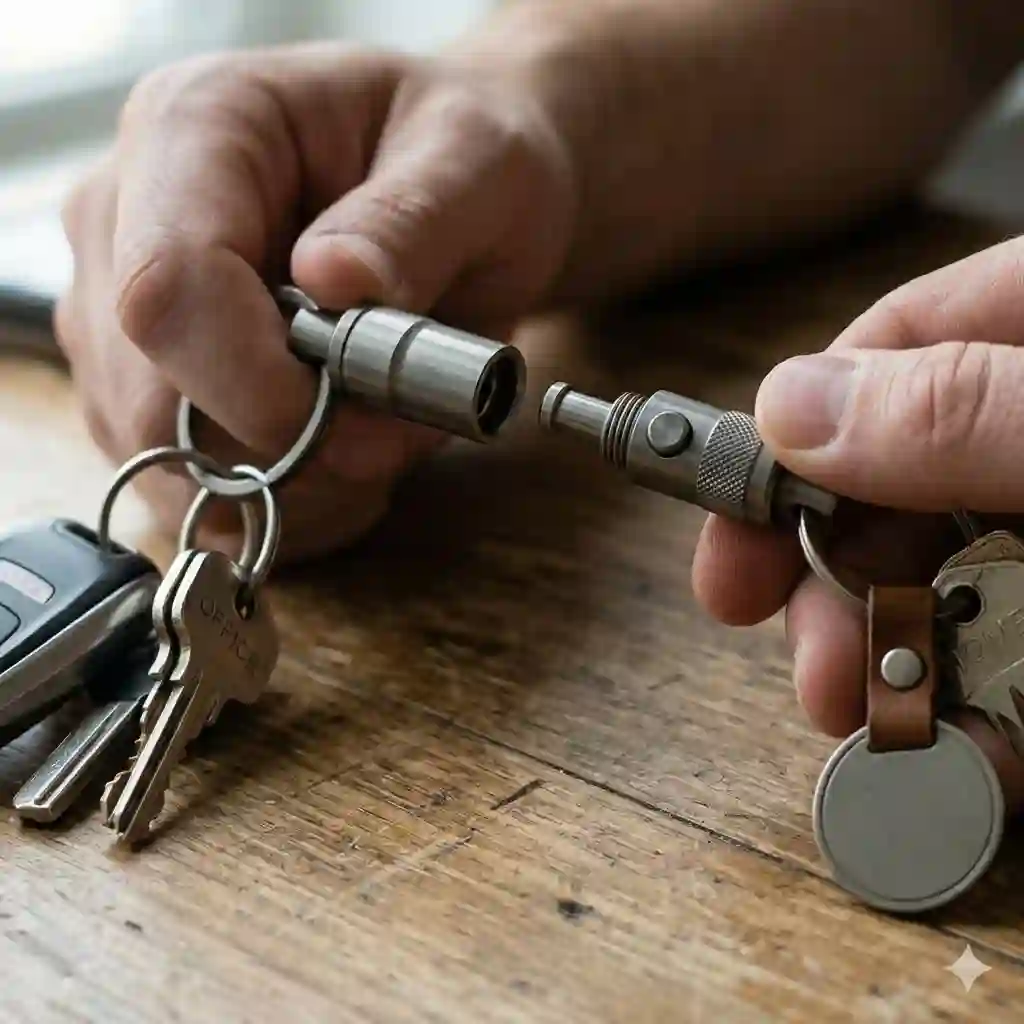
If there is one universal annoyance in the world of everyday carry (EDC), it is the traditional split steel ring. Over my 10+ years as a product design consultant and EDC gear tester, I have watched countless people struggle, pry, and break their fingernails trying to add or remove a single house key. It is an antiquated design that we have collectively accepted out of sheer habit. But your daily setup deserves better, which is why transitioning to a reliable quick release key ring is the single highest ROI upgrade you can make to your pocket real estate.
What is a quick release key ring?
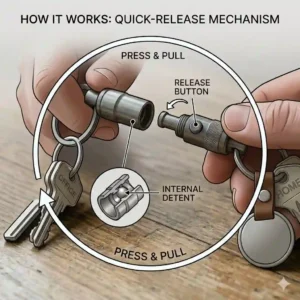
At its core, a quick release key ring is a modular organizational tool designed to separate into two or more parts instantly—usually via magnetic tension, a push-button detent mechanism, or a pull-apart canted coil. This allows you to detach your car fob for the valet, hand a house key to a family member, or remove excess weight from your vehicle’s ignition cylinder without wrestling with coiled steel.
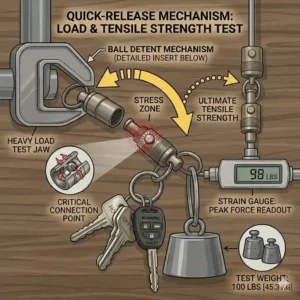
In my field tests over the last decade, I have seen marketing claims wildly exaggerate holding capacity. A brand might boast a “50 lb pull strength,” but in practice, rotational torque or sheer force in a tight pocket can cause inferior models to detach, dropping a $400 smart fob onto the concrete. In this comprehensive 2026 guide, I am bypassing the marketing fluff. We will break down the engineering behind the best mechanisms, analyze long-term durability based on months of rigorous real-world testing, and help you find the exact system tailored to your daily workflow.
📊 Quick Comparison: Top Options at a Glance
| Product Model | Best For | Mechanism Type | Material Build | Price Range |
| KeySmart MagConnect | Quick valet hand-offs | Magnetic + Friction | Polycarbonate/Metal | Under $15 |
| Nite Ize SlideLock 360° | Maximum security | Magnetic Carabiner | Aluminum/Steel | Under $20 |
| FreeKey System | Budget traditionalists | Press-to-open ring | Stainless Steel | Under $10 |
| MecArmy CH2 | Premium EDC enthusiasts | Pull-apart detent | Titanium | $30 – $45 |
| Prometheus Kappa | Tactical/Heavy-duty | Canted coil spring | Brass/Delrin/Ti | $25 – $40 |
Expert Analysis: Looking at the comparison above, the KeySmart MagConnect delivers the best frictionless workflow for daily drivers, but if heavy-duty security is your priority, the Nite Ize SlideLock 360°‘s physical locking collar justifies the slight bulk. Budget buyers should note that while the FreeKey System is incredibly affordable, it sacrifices the true “detachable” nature of a two-piece system for a painless traditional ring experience.
💬 Just one click — help others make better buying decisions too! 😊
[addtoany]
🏆 Top 5 Quick Release Systems: Expert Field Analysis
1. KeySmart MagConnect Pro System
The KeySmart MagConnect utilizes a rare-earth magnetic coupling system that practically snaps itself together when the two halves get close. Featuring N52 neodymium magnets housed in a durable polycarbonate and aluminum shell, it boasts a static pull weight of up to 3 pounds. What this means in practice is that while it won’t accidentally detach when pulling your keys from a tight jeans pocket, a deliberate, angled tug separates it instantly.
In my experience, this is the ultimate commuter’s tool. What most buyers overlook about this model is the geometric design of the housing—it prevents lateral shear forces from knocking the magnets out of alignment. If you frequently leave your car running while running back to lock the front door, this is your best bet. Customer feedback consistently praises the satisfying “click” of the magnets, though some mention it adds roughly an inch of length to their setup.
-
Pros: Instant one-handed operation, incredibly satisfying magnetic snap, lightweight.
-
Cons: Magnets can attract stray pocket debris, slightly elongates your key chain.
-
Price Verdict: Sitting comfortably under $15, the KeySmart MagConnect offers unbeatable value for daily commuters.
2. Nite Ize SlideLock 360° Magnetic Dual Carabiner
The Nite Ize SlideLock 360° pairs powerful magnetic tension with dual-locking micro carabiners. It features a cast aluminum body with a threaded locking collar that slides down to physically block the magnets from separating. In the real world, this translates to absolute peace of mind: keep it unlocked for quick valet access, or thread the lock down when clipping it to a backpack for a hike.
The spec sheet won’t tell you this, but the independent 360-degree rotation of the carabiners is the real star here. It completely eliminates pocket bind and key bunching. I highly recommend this for outdoor enthusiasts or construction workers who subject their gear to violent movement. Most reviewers claim the magnets are strong enough on their own, but in practice, I found the sliding physical lock to be the essential feature that prevents accidental loss during heavy activity.
-
Pros: Physical locking mechanism, 360-degree rotation, dual clip versatility.
-
Cons: Bulkiest option on this list, locking collar requires two hands to operate.
-
Price Verdict: In the under $20 range, it is an over-engineered fortress for your most important fobs.
3. FreeKey System by Exentri
Swedish-designed and beautifully simple, the FreeKey System replaces the push-pull mechanism entirely with a wave-pressed stainless steel ring. Pressing on the designated sweet spot acts as a lever, lifting the end of the ring up so you can slide a key on without using your nails. It comes with three smaller accessory rings for grouping keys.
My field tests showed this isn’t a “quick disconnect” in the traditional two-part sense, but rather a “quick load” system. This is specifically for the minimalist who hates bulk and rarely needs to hand off a single key, but frequently changes out the tools on their chain. The high-grade stainless steel retains its spring memory flawlessly. If your current split rings look like stretched-out paperclips, this is your upgrade. Buyers love the low profile, though some note it takes a few tries to master the pressing technique.
-
Pros: Zero moving parts to break, ultra-slim profile, preserves fingernails.
-
Cons: Doesn’t separate into two distinct pieces, requires precise finger placement.
-
Price Verdict: Usually found for under $10, it’s the ultimate budget-friendly stocking stuffer.
4. Prometheus Lights Kappa Quick Release
The Prometheus Lights Kappa relies on a proprietary canted coil spring mechanism—the same aerospace technology used in medical and military quick-disconnects. Capable of withstanding 10 pounds of pull force, the brass, Delrin, or titanium housing completely encloses the spring, meaning there are no buttons to accidentally press in your pocket. You simply pull the two halves apart with deliberate force.
I have carried the Prometheus Kappa for nearly three years, and it is a marvel of machining. What makes this best-in-class is its sheer reliability; dirt, lint, and sand cannot compromise the snap-fit connection. It is explicitly for the buy-it-for-life crowd who appreciates precision engineering. The $300 custom knife crowd swears by these. While customer reviews glow about the aesthetics, a few users warn that the initial pull force is surprisingly stiff out of the box.
-
Pros: Professional-grade aerospace mechanism, stunning aesthetics, zero accidental releases.
-
Cons: Expensive, requires a brief break-in period for smoother operation.
-
Price Verdict: Ranging from $25 to $40 depending on the material, it is a premium investment that outlasts your car.
5. MecArmy CH2 Titanium Keychain
Machined entirely from TC4 Titanium, the MecArmy CH2 uses a ball-bearing detent system. It features a textured grip and a push-and-pull mechanism that is impervious to corrosion. Weighing practically nothing, this setup includes a 360-degree swivel joint and heavy-duty titanium split rings out of the box.
In my consulting work, I constantly steer ultra-light backpackers and tactical gear junkies toward the MecArmy CH2. Titanium galling (where the metal sticks to itself) can ruin cheap gear, but MecArmy polishes the internal detent track so it releases like butter. It’s ideal for those who carry heavy brass tools but want to keep overall weight down. Reviews praise its feather-light feel, though some find the dual-action push-then-pull learning curve slightly annoying at first.
-
Pros: Impervious to rust, incredibly lightweight, high load-bearing capacity.
-
Cons: High price tag, dual-action release takes practice.
-
Price Verdict: In the $30-$45 range, you are paying for premium metallurgy and lifetime durability.
✨ Don’t Miss These Exclusive Deals!
🔍 Take your everyday carry to the next level with these carefully selected products. Click on any highlighted item to check current pricing and availability. These tools will help you create authentic pocket organization your future self will thank you for!
🛠️ The 30-Day Setup & Optimization Guide
Buying the hardware is only step one. How you configure your quick release key ring determines whether it actually improves your life or just adds pocket clutter. Based on my experience setting up hundreds of EDC configurations, here is your optimization roadmap.
Day 1: The Weight Audit
Before attaching your new gear, audit your carry. Separate your items into two categories: the “Ignition/Essential” pile (car fob, house key) and the “Accessory” pile (gym tag, mail key, pocket flashlight).
Day 7: The Pivot Point Strategy
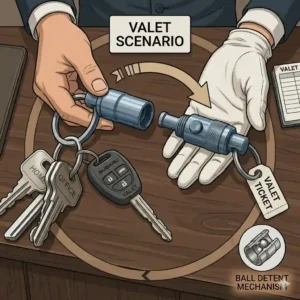
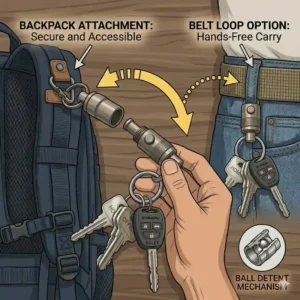
Attach your heaviest item (usually the car fob) to the female end of the release mechanism, and clip the male end to your belt loop or the accessory bundle. Why? The male plug is usually lighter. When you hand your fob to a mechanic or valet, you want them holding the bulkier side to prevent losing the smaller attachment point.
Day 30: Maintenance Protocol
By day 30, your mechanism will have collected pocket lint.
-
For Magnetic models: Use a piece of Scotch tape to pull microscopic metal shavings off the neodymium magnets.
-
For Mechanical/Detent models: Apply one single drop of dry PTFE lubricant (never wet oil, which attracts dirt) to the ball bearings or canted coil. This keeps the action snapping aggressively and prevents structural wear.
👥 Case Studies: Matching the Mechanism to Your Daily Grind
Not every quick release key ring works for every lifestyle. Let’s look at three typical profiles I encounter in my consulting to see why “perfect” products can fail in the wrong hands.
The Urban Commuter (Profile A)
Sarah takes the subway, walks four blocks, and uses a fob to enter her office. She keeps her keys in a crowded, bottomless tote bag.
-
Bad Fit: A pull-apart titanium detent model. It requires two hands to pull apart, which she doesn’t have while holding coffee.
-
The Fix: The KeySmart MagConnect. She can blindly reach into her bag, grab the fob, and the magnetic release separates with one swift tug, letting the rest of the keys stay anchored to the bag’s internal leash.
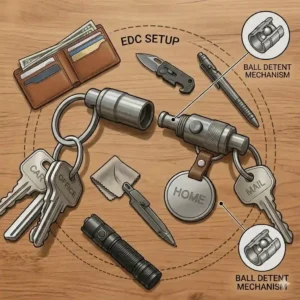
The Delivery Driver (Profile B)
Mark gets in and out of his delivery van 50 times a day, often leaving the engine idling while he runs a package to a porch.
-
Bad Fit: Magnetic-only mechanisms. The constant jumping and running creates shear forces that can easily slide magnets apart, dropping his house keys in the snow.
-
The Fix: The Nite Ize SlideLock 360°. He can lock the collar down when doing heavy lifting, and unlock it when he needs to quickly detach the van key.
The Minimalist (Profile C)
Dave carries three keys total. He wears tailored pants and hates pocket bulge.
-
Bad Fit: Anything with carabiners or thick magnetic housings.
-
The Fix: The FreeKey System. It adds zero bulk while still solving the broken-fingernail problem when he needs to swap his office key for his bike lock key on the weekends.
💡 Problem-Solving: Why You Keep Losing Keys (And How to Stop)
The problem usually isn’t your memory; it’s your gear failing you in subtle ways.
Problem 1: The “Shear Force” Drop
Many people report their magnetic keys falling off. Magnets have incredible pull strength (resisting being pulled straight apart), but terrible shear strength (resisting sliding sideways). If your keys sit in your pocket in a way that creates a sideways sliding motion when you sit down, the magnets will fail.
-
Solution: Switch to a mechanical mechanism like the MecArmy CH2, or ensure your magnetic model has a recessed geometric housing that physically prevents lateral sliding.
Problem 2: Ignition Cylinder Damage
According to automotive locksmiths, hanging heavy metal tools, pepper spray, and 15 keys from your car’s ignition while driving wears down the delicate tumblers inside the steering column. Over time, the car won’t start.
-
Solution: A quick release key ring is literally the cheapest insurance policy for this. Put your car fob on one side, and the heavy junk on the other. Detach the heavy side when driving and drop it in the cup holder.
⚖️ How to Choose the Right Quick Release Mechanism
When evaluating a quick release key ring, the marketing copy will try to distract you with aesthetics. Here is my expert framework for cutting through the noise:
-
Assess Your “Detach Frequency”
If you detach a key twice a day (e.g., getting the mail), mechanical pull-apart rings are perfect. If you detach a key 15 times a day (e.g., IT professionals with server room keys), magnetic systems will save you from hand fatigue.
-
Evaluate Pocket Environment
Do you work in a machine shop? Avoid magnets at all costs. Neodymium magnets will attract microscopic iron filings from the shop floor, eventually preventing the two halves from seating properly and causing catastrophic drops. Opt for the enclosed canted spring of the Prometheus Kappa.
-
Check the Swivel Feature
Keys are inherently awkward shapes. Mechanisms that feature an independent 360-degree swivel (like Nite Ize) allow keys to lay flat against your thigh, reducing the dreaded “pocket bulge” and preventing the hardware from binding.
🧲 Magnetic vs. Mechanical Pull: What the Specs Don’t Tell You
The debate between magnetic and mechanical releases is the most common question I field. Let’s look at the actual physics of everyday carry.
Magnetic models utilize Neodymium magnets, the strongest type of permanent magnet commercially available. The benefit here is “auto-alignment.” You don’t have to look at your hands to reconnect your keys; get them within an inch of each other, and physics does the rest. However, magnets can wipe hotel key cards or older parking garage stripes if pressed directly against them in a tight wallet.
Mechanical models—using ball-bearing detents or canted coil springs—rely on physical interference to stay closed. This means they offer a definitive, binary state: they are either locked or unlocked. There is zero chance of a mechanical ring slowly sliding open. However, they require deliberate precision to reconnect. You have to align the male and female ends perfectly and push until you feel the tactile “click.”
💸 The Hidden Costs of Cheap Key Rings: A Durability Analysis
You can easily find a generic aluminum quick release on the internet for $3. I strongly advise against this, and here is the total cost of ownership analysis why.
Cheap aluminum components suffer from rapid metal fatigue. The internal springs on a $3 quick release are usually made of low-carbon steel. Within three months of exposure to pocket sweat and humidity, that spring rusts, loses tension, and your $300 smart car fob quietly falls off into a storm drain. Replacing a modern vehicle transponder key costs anywhere from $250 to $500, plus towing, plus the locksmith programming fee.
When you spend $20 to $40 on a titanium or high-grade brass system, you are paying for marine-grade stainless steel springs or canted coils that will not degrade. In my view, a premium key mechanism is not a luxury accessory; it is a $30 insurance policy protecting a $400 electronic asset.
🚫 Common Mistakes When Buying Everyday Carry Hardware
Even seasoned EDC enthusiasts make critical errors when building out their keychains.
Mistake 1: The “Chain of Chains”
Many buyers attach a quick release to a carabiner, then attach a split ring to the quick release, and then attach the key. This creates a 5-inch dangler that acts as a pendulum, catching on steering wheels and doorknobs. Rule of thumb: Eliminate intermediary rings. Attach the key directly to the quick-release component whenever possible.
Mistake 2: Ignoring Weight Limits
Push-button quick releases (the classic hardware store style with the little button on top) often use tiny internal retaining balls. Overloading the bottom half with two pounds of brass flashlights and multitools creates constant downward tension. Eventually, the retaining balls strip their track. Buy a system rated for at least 5x the weight you actually carry.
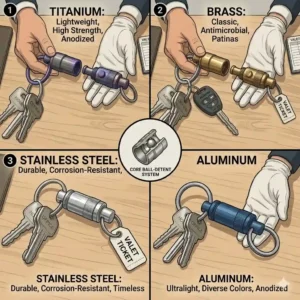
🔬 Material Science: Titanium vs. Steel vs. Aluminum
The material of your quick release key ring dictates how it ages.
-
Aluminum: Lightweight and inexpensive, often anodized in bright colors. However, aluminum is soft. After a year of rubbing against steel keys in your pocket, the finish will scratch off, leaving a battered, silver-spotted appearance.
-
Stainless Steel: The workhorse material. It is heavy, but incredibly resistant to deformation. A stainless steel mechanism will outlive you, though you will definitely feel the weight in dress pants.
-
Titanium (Grade 5 / TC4): The holy grail of EDC. It offers the strength of steel at half the weight, and it is completely biologically inert and rust-proof. The downside? Titanium is notoriously difficult to machine, which is why brands charge a premium for it. If you carry your keys in a gym bag or live in a humid coastal environment, the titanium upcharge is entirely justified.
✨ Don’t Miss These Exclusive Deals!
🔍 Upgrade your daily workflow with these expert-approved mechanisms. Click on any highlighted item to check current pricing and availability. Eliminate pocket bulk and secure your most vital tools today!
🏁 Conclusion
Transitioning to a well-engineered quick release key ring is a small optimization that yields daily dividends. You eliminate the frustration of split rings, protect your car’s ignition from unnecessary wear, and streamline your pockets. Whether you opt for the frictionless speed of the KeySmart MagConnect, the rugged security of the Nite Ize SlideLock, or the premium aerospace feel of the Prometheus Kappa, the key is matching the mechanism to your specific daily environment. Ditch the coiled steel, invest in a proper modular system, and take control of your everyday carry.
❓ Frequently Asked Questions
❓ What is the strongest quick release key ring?
✅ Models utilizing canted coil springs or locking magnetic collars offer the highest security. Systems like the Prometheus Kappa can hold upwards of 10 pounds of static pull weight, while the Nite Ize SlideLock provides a physical metal barrier to prevent accidental separation…
❓ Can magnetic key rings damage my credit cards or electronics?
✅ Most modern credit cards with EMV chips are unaffected by small neodymium pocket magnets. However, older magnetic stripe cards (like hotel room keys or parking garage tickets) can be erased if pressed directly against strong magnetic key rings for extended periods…
❓ How do I fix a stiff push-button key release?
✅ Never use WD-40, as it attracts dust and lint. Instead, apply a single drop of dry graphite powder or a PTFE-based dry lubricant into the mechanism. Work the release back and forth 20 times to distribute the lubrication, restoring smooth action…
❓ Will heavy keys damage my car’s ignition?
✅ Yes. According to automotive experts, hanging excess weight from an ignition cylinder can prematurely wear out the internal tumblers, causing the key to slip or fail to turn. A quick disconnect allows you to separate the car key from the heavy bundle…
❓ What size split ring should I use with a quick release?
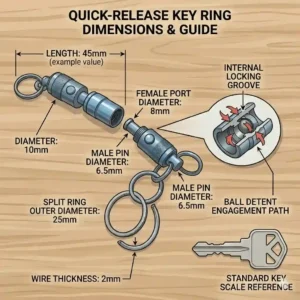
✅ For optimal movement without binding, use a 15mm to 20mm (roughly 0.6 to 0.8 inches) split ring. Anything smaller may not freely rotate around the mechanism’s attachment point, while larger rings create unnecessary bulk and snag hazards in your pocket…
📚 Recommended for You
- 5 Ultimate key accessories to Upgrade Your EDC in 2026: Smart Picks for Style & Function
- 5 Best ring key ring Upgrades to Eliminate Pocket Clutter in 2026
- 5 Best Key Clip Options for 2026: Expert Security Review
Disclaimer: This article contains affiliate links. As an Amazon Associate, I earn from qualifying purchases. If you purchase products through these links, we may earn a small commission at no additional cost to you.
✨ Found this helpful? Share it with your friends! 💬🤗
[addtoany]
