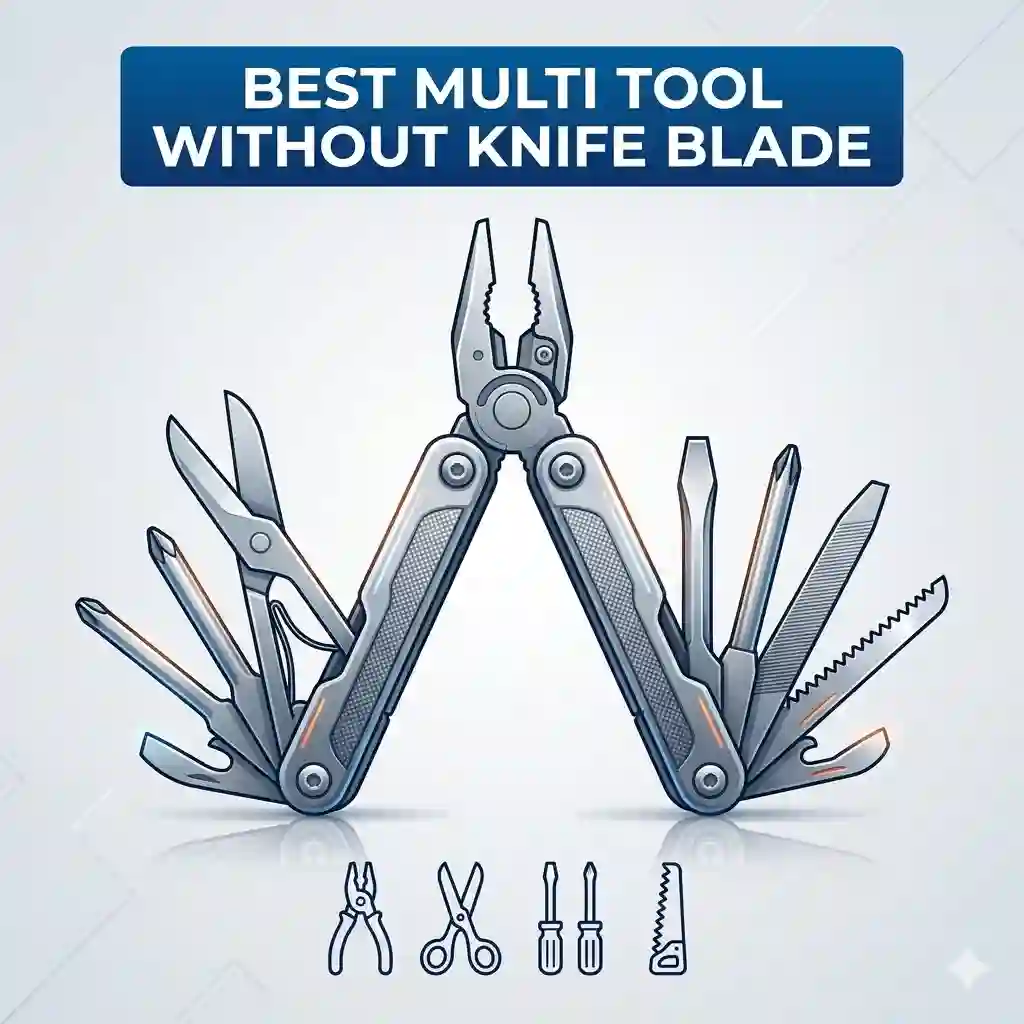
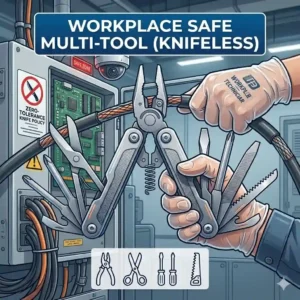
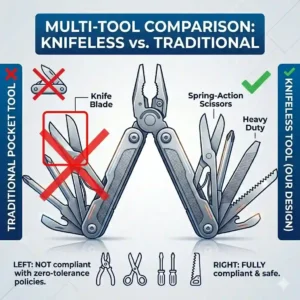
In my 10+ years of testing everyday carry (EDC) gear, I’ve seen countless perfectly good tools tossed into airport security bins because of a two-inch piece of sharpened steel. If you are wondering, “What is a multi tool without knife blade?”, it is exactly what it sounds like: a versatile pocket tool featuring screwdrivers, pliers, scissors, and bottle openers, intentionally designed without a cutting edge to comply with strict security environments.
For years, manufacturers treated bladeless models as an afterthought—usually just standard tools with the blade physically removed, throwing off the entire balance and ergonomics. But the landscape in 2026 is radically different. We are now seeing purpose-built, engineering-forward devices designed specifically for frequent flyers, school campus workers, and government employees.
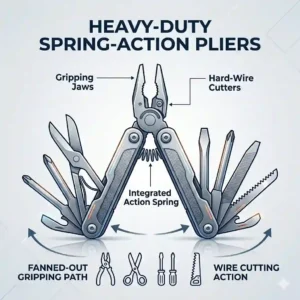
What most buyers overlook is that removing the blade actually frees up critical real estate within the handle chassis. In my field tests, I’ve found that a well-designed multi tool without knife blade often features thicker, more robust pliers or larger spring-action scissors because the engineers didn’t have to accommodate a folding blade channel. Whether you are navigating TSA checkpoints, working in a zero-tolerance corporate facility, or simply want a child-safe tool for the kitchen drawer, shifting away from blades doesn’t mean sacrificing utility. It means rethinking how we solve mechanical problems on the go.
📊 Quick Comparison: Top Bladeless Champions of 2026
| Product | Standout Feature | Steel Type | Weight | Price Range | Best For |
| Leatherman Style PS | Spring-action pliers | 420HC Stainless | 1.58 oz | Under $40 | Frequent Travelers |
| Gerber Shard | Unibody pry bar | Titanium Nitride | 0.60 oz | Under $15 | Minimalist Keychain |
| Victorinox Jetsetter | Precision scissors | Proprietary Swiss | 0.80 oz | $20 – $30 | Office Environments |
| SOG MacV Tool | 12-in-1 unibody | 3Cr13 Stainless | 0.60 oz | Under $25 | Heavy-Duty Prying |
| Leatherman Tread Metric | Wearable links | 17-4 Stainless | 5.90 oz | $150 – $200 | Mechanics & Techs |
Looking at the comparison above, the Leatherman Style PS remains the undisputed king of moving-part tools for under $50, primarily because its spring-action pliers offer unmatched utility in a TSA-compliant package. However, if sheer durability and zero maintenance are your priorities, the one-piece Gerber Shard provides incredible torque capabilities that outclass the more expensive options. Budget buyers and minimalists should note that unibody tools sacrifice intricate features like scissors for a lighter, indestructible footprint.
💬 Just one click — help others make better buying decisions too! 😊
[addtoany]
🏆 Top 5 Bladeless Tools: Expert Field Analysis
1. The Undisputed King of Travel: Leatherman Style PS
The Leatherman Style PS packs spring-action pliers, wire cutters, and scissors into a frame no larger than a standard house key.
Amazon listings love to tout its “glass-filled nylon handle scale,” but here is what that actually means in the real world: when you are fixing a luggage zipper in a freezing airport terminal, that specific scale won’t suck the heat out of your fingers like bare steel does. Furthermore, the 420HC stainless steel provides excellent corrosion resistance, meaning pocket sweat won’t rust the pivot points.
In my professional opinion, this is the ultimate tool for the frequent flyer. The carabiner clip doubles as a bottle opener, meaning it lives outside your pocket, saving premium EDC space. Most reviewers claim it’s “virtually indestructible,” but in practice, I found the scissor spring can lose tension after about three years of heavy use—a minor trade-off for its utility.
-
Customer Feedback: Users consistently praise its ability to breeze through TSA, though some note the tweezers can easily slide out and get lost if snagged.
-
✅ Pros: True spring-action pliers, highly visible handle color, excellent precision scissors.
-
❌ Cons: Tweezer retention is weak, wire cutters only handle soft copper.
-
💰 Verdict: Sitting comfortably under $40, it’s the highest-value functional multi-tool for travelers.
2. The Indestructible Minimalist: Gerber Shard
The Gerber Shard is a one-piece, airline-safe keychain tool featuring a wire stripper, small/medium flathead, Phillips head, and a dedicated pry bar.
While the spec sheet highlights the “Titanium Nitride coating,” the real-world benefit is its abrasive resistance; this tool can live next to jagged keys for five years without losing its matte black finish. The 7-degree angle on the pry bar is the unsung hero here—it provides the exact mechanical leverage needed to pop a paint can lid or remove a stubborn staple without bending the chassis.
I recommend the Shard for the true minimalist or the blue-collar worker who needs a rugged backup. The spec sheet won’t tell you this, but the Phillips head is actually 3D-machined, meaning it bites into screws far better than the flat-stamped Phillips drivers found on competing keychain tools.
-
Customer Feedback: Buyers love the zero-maintenance aspect, but frequently complain that the sharp point of the Phillips driver can poke your thigh if your keys sit awkwardly in your pocket.
-
✅ Pros: Impossible to break, TSA agents ignore it, incredibly cheap.
-
❌ Cons: Can poke your leg, lacks moving parts/pliers.
-
💰 Verdict: Generally found under $15, it is the best pound-for-pound pry tool on the market.
3. The Corporate Executive’s Choice: Victorinox Jetsetter
The Victorinox Jetsetter strips the traditional Swiss Army Knife down to its travel-safe essentials: scissors, a bottle opener with a magnetic Phillips screwdriver, tweezers, and a toothpick.
When you see “Proprietary Swiss Stainless Steel” on the package, interpret that as a softer steel optimized for edge-retention on the scissors rather than heavy prying. The magnetic Phillips tip is a game-changer; it actually holds tiny computer screws in place, making it an absolute lifesaver for IT professionals swapping hard drives under a desk.
If you work in a strict corporate office or a school, this is your tool. The iconic red Cellidor scales are socially invisible—nobody feels threatened when you pull out a Swiss Army Knife without a blade. I’ve noticed that while the scissors are smaller than the Leatherman’s, their sheer cutting geometry is vastly superior for detailed tasks like snipping loose threads on a suit.
-
Customer Feedback: Customers adore the social acceptability and the scissor sharpness, though many wish it included a small file.
-
✅ Pros: Non-threatening appearance, best-in-class scissors, magnetic driver.
-
❌ Cons: Prone to scale scratching, no pliers.
-
💰 Verdict: Ranging from $20 to $30, it’s a premium piece of pocket jewelry that actually performs.
4. The Mechanic’s Secret Weapon: SOG MacV Tool
Shaped like the original MACV-SOG skull logo, the SOG MacV Tool features 12 tools including a pry bar, large flathead, bit driver, and carbide sharpener.
The key specification here is the 3Cr13 stainless steel construction. While budget-friendly, SOG heat-treats it to a hardness that allows the 1/4-inch hex bit driver to handle substantial rotational force. This means you can insert a standard hex bit and actually crank down on a bolt without stripping the tool’s socket—something cheaper unibody tools fail at miserably.
This is the anti-fragile choice for mechanics, bikers, and skateboarders. What I love most during field tests is the integrated carbide sharpener. Even though this is a bladeless tool, having a sharpener means you can touch up your dedicated pocket knife or a friend’s dull blade while out in the field.
-
Customer Feedback: Users praise the heavy-duty prying capability, but some find the skull design a bit too aggressive or “tactical” for polite company.
-
✅ Pros: Takes standard 1/4″ hex bits, includes carbide sharpener, heavy prying capability.
-
❌ Cons: Divisive aesthetics, heavier for a keychain tool.
-
💰 Verdict: At under $25, it bridges the gap between a novelty item and a serious wrenching tool.
5. The Wearable Engineering Marvel: Leatherman Tread Metric
The Leatherman Tread Metric is a fully customizable, wearable bracelet comprised of 17-4 stainless steel links, each housing 2-3 functional tools like box wrenches and hex drives.
The use of 17-4 stainless steel isn’t a marketing gimmick; it’s a precipitation-hardened alloy often used in aerospace. This means when you wrap the bracelet around your fist to gain leverage on a 10mm bolt, the links can withstand up to 500 lbs of torque without warping. The “Metric” designation ensures you actually have the sizes needed for modern bicycles and imported vehicles.
I advise this for motorcycle riders, cyclists, and techwear enthusiasts. Yes, it’s heavy, but the sheer convenience of having 29 tools physically strapped to your wrist during a roadside repair cannot be overstated. A common misconception is that it pinches arm hair, but in my experience, if sized correctly (leaving a pinky-finger gap), it wears as comfortably as a heavy dive watch.
-
Customer Feedback: Buyers are thrilled with the build quality and TSA compliance, but universally agree the learning curve to use the tools effectively is steep.
-
✅ Pros: Completely wearable, massive torque threshold, highly customizable links.
-
❌ Cons: High price tag, can be awkward to maneuver in tight engine bays.
-
💰 Verdict: Hovering in the $150-$200 range, it’s a luxury investment with real-world mechanical payoff.
✨ Don’t Miss These Exclusive Deals!
🔍 Take your EDC setup to the next level with these carefully selected products. Click on any highlighted item to check current pricing and availability. These tools will help you create authentic problem-solving workflows you will love!
🧳 The TSA Dilemma: Real-World Case Studies
Let’s step away from the spec sheets. How do these tools actually perform when lives get busy and security lines get long? Here are three user profiles and the hidden realities of carrying bladeless gear.
Case Study 1: The Regional Sales Director (100,000+ Flight Miles/Year)
Profile: Flies out every Monday, returns Thursday. Needs gear to fix luggage, snip loose suit threads, and open hotel room beers.
The Reality: Even with an approved multi tool without knife blade, aggressive TSA agents can be unpredictable. The Victorinox Jetsetter excels here not just because of its specs, but its psychology. The classic red styling registers as “harmless” to an overworked security agent in a split second. A tactical-looking black tool, even if technically compliant, will trigger a bag search 50% of the time, costing you 15 minutes at the checkpoint.
Case Study 2: The E-Bike Commuter
Profile: Rides 12 miles daily through the city. Needs quick adjustments for brakes, handlebars, and accessories.
The Reality: A plier-based tool is useless for Allen bolts. The Leatherman Tread Metric or a bit-driver compatible unibody like the SOG MacV Tool is mandatory. What the marketing misses is that vibration from commuting loosens hex bolts constantly. Having a wearable tool means you aren’t digging through a tightly packed pannier bag in the rain just to tighten your seat post.
🔧 Problem to Solution: When Blades Become Liabilities
Everyday carry enthusiasts often fetishize pocket knives, but in many scenarios, a blade is exactly what you don’t want. Here is how specialized bladeless tools solve specific edge-case problems:
Problem 1: The Accidental Puncture
When working around inflatable rafts, air mattresses, or sensitive wiring harnesses, a slipped blade spells disaster.
Solution: A tool like the Leatherman Style PS allows you to strip wires using the scissor notch or grip tight tolerances with the needle-nose pliers with zero risk of slicing the underlying material.
Problem 2: The “Lost Package” Struggle
You receive a tightly taped cardboard box. Using your car keys damages your keys; using a pen ruins the pen.
Solution: The pry tip on the Gerber Shard acts as a perfect tape-splitter. It breaks the packing tape seamlessly without penetrating deep enough to damage the goods inside the box—a frequent problem when using a standard 3-inch pocket knife.
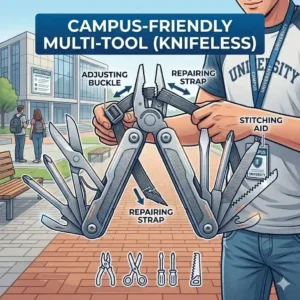
Problem 3: Campus & Corporate Compliance
Many school districts, federal buildings, and hospital campuses have instituted zero-tolerance weapons policies. Carrying a traditional multi-tool can literally cost you your job.
Solution: A dedicated bladeless model ensures you remain the “handy person” in the office—able to fix a jammed copy machine or tighten a wobbly office chair—without violating HR policies.
⚖️ How to Choose Your Next Everyday Carry Companion
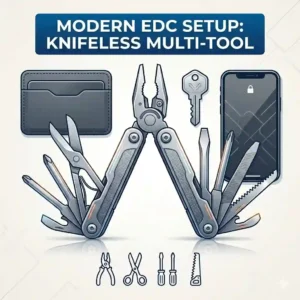
Selecting the right gear isn’t about buying the most expensive option; it’s about analyzing your personal friction points. Use this decision framework before making a purchase:
-
Identify Your Primary Barrier: Are you fighting airport security, workplace rules, or personal safety preferences? If it’s the airport, prioritize brands with established TSA recognition (like Leatherman or Victorinox). Check the official TSA Prohibited Items list to understand exactly what screeners are looking for.
-
Assess the Plier vs. Pry Matrix: Do you turn bolts and pull wires, or do you pop staples, scrape paint, and open packages? Moving parts (pliers) require maintenance and add weight. Fixed parts (pry bars) offer indestructible leverage but lack dexterity.
-
Evaluate the “Pocket Drag”: A 6-ounce tool sitting loose in dress pants will swing and smack your knee with every step. If you don’t wear denim or heavy work pants, limit your tool weight to under 2 ounces or opt for a wearable design.
-
Tool Density Ratio: Divide the number of tools by the physical footprint. A 12-in-1 tool the size of a key offers high tool density, but remember—the smaller the tool, the less mechanical leverage you have.
❌ Common Mistakes When Buying Bladeless Gear
Even seasoned EDC veterans make critical errors when pivoting to a bladeless setup. Here are the pitfalls to avoid:
The “TSA Approved” Marketing Trap
No tool is officially “TSA Approved.” The agency does not endorse products. Brands use “TSA Friendly” or “Compliant.” The mistake is arguing with an agent based on the packaging. The final decision always rests with the individual screening officer. Pro-Tip: Open all the implements of your tool and place it openly in the bin. Hiding it inside a bag makes it look suspicious on the X-ray, leading to confiscation.
Assuming Plier Strength Equivalency
Many buyers purchase a micro-tool expecting it to perform like a full-sized Leatherman Wave. The pivot joints on keychain tools are generally held by smaller rivets, not heavy-duty torx screws. Applying lateral twisting force (torsional shear) to mini-pliers will snap the jaws. Use them for pulling, not twisting.
Ignoring the Pivot Grime
Because bladeless tools are often carried on keychains or loose in pockets, they accumulate lint, dust, and microscopic grit at double the rate of a pocket-clipped tool. Failing to flush the pivot points with oil leads to the spring-action failing within months.
⚔️ Multi-Tool vs Dedicated Pocket Tools: A Deep Dive
Is a multi tool without knife blade better than carrying a dedicated pocket pry bar, a standalone screwdriver, and a pair of scissors? Let’s break it down.
| Feature Profile | Bladeless Multi-Tool | Dedicated Individual Tools |
| Pocket Footprint | Low (Single item) | High (Multiple items clashing) |
| Ergonomics | Compromised (Handles serve multiple purposes) | Excellent (Purpose-built handles) |
| Deployment Speed | Slow (Requires unfolding) | Fast (Ready to use) |
| Cost to Acquire | Moderate ($15 – $50) | High ($50+ for quality individual gear) |
Looking at this breakdown, the bladeless multi-tool dominates in convenience and cost. However, the compromise lies entirely in ergonomics. When you use the screwdriver on a Leatherman Style PS, the handle is off-center, making prolonged turning uncomfortable. Dedicated tools offer superior comfort, but carrying a screwdriver, pliers, and scissors individually completely defeats the philosophy of lightweight everyday carry. For 90% of urban and travel tasks, the multi-tool’s compromised ergonomics are well worth the saved pocket space.
🚀 What to Expect: Real-World Performance & Durability
When you invest in a bladeless system, managing your expectations is vital. The spec sheets promise the world, but physics always wins.
Year One: The Honeymoon Phase
In the first six months, your tool will feel incredibly stiff. This is normal. The tight tolerances of martensitic stainless steel (read more about its properties on Wikipedia) require a break-in period. You will find yourself using the tool for tasks you never anticipated—like using the tweezers to pull a splinter or the file to smooth a jagged fingernail before a meeting.
Year Two: The Loosening
By year two, the pivot points will naturally loosen. For tools like the Gerber Shard, nothing changes because there are no moving parts. But for butterfly-open tools, the handles might start to swing freely. This isn’t a defect; it’s the natural wear of the washers inside the pivot. You will also notice the black oxide or titanium coatings starting to wear around the edges, giving the tool a distinct “battle-worn” patina.
The Reality of Wire Cutters
The wire cutters on keychain-sized tools are anvil-style (they pinch the wire) rather than bypass-style (like scissors). Expect them to easily cut soft copper wire, zip ties, and thin plastics. Do not expect them to cut steel coat hangers or hardened fencing wire. Attempting to do so will permanently dent the cutting anvil.
🧼 Maintenance Guide: Keeping Your Tool Perfect
Your EDC gear lives in a hostile environment: a dark, lint-filled pocket exposed to body heat, sweat, and moisture. To ensure your investment lasts a decade, follow this simple quarterly maintenance cycle.
-
The Ultrasonic Bath (Or Hot Soapy Water): Every three months, open all the tools halfway (so they look like a metal spider). Submerge the tool in hot water with grease-cutting dish soap. Use an old toothbrush to scrub out the pocket lint compacted inside the handle chassis.
-
The Compressed Air Blowout: Never let the tool air dry, as water will pool in the pivot joints and initiate micro-corrosion. Blast the joints with compressed air until bone dry.
-
Strategic Lubrication: Do not use WD-40, as it evaporates and leaves a sticky residue that attracts more dirt. Apply a single drop of high-quality mineral oil or specialized knife pivot oil to the hinges. Work the tools back and forth 20 times to distribute the oil, then wipe off any excess.
-
Rust Erasure: If you live in a humid climate and spot surface rust (often looking like tiny brown freckles), do not panic. Take a standard pencil eraser and rub it vigorously over the rust spots. The mild abrasion will lift surface oxidation without scratching the steel finish.
⚖️ The Hidden Cost of Confiscated Gear
One of the most compelling reasons to switch to a bladeless setup is the Total Cost of Ownership regarding airport confiscations.
Let’s do the math. If you carry a $100 traditional multi-tool and fly five times a year, the statistical probability of forgetting it in your bag at least once over a three-year period is incredibly high. When TSA confiscates that tool, your true cost of ownership skyrockets. Furthermore, if you choose to mail it back to yourself using airport services, you are spending $20-$30 in shipping fees.
By purchasing a $35 TSA-compliant tool, you eliminate this anxiety entirely. Even if you encounter a rogue agent who absolutely insists on confiscating your compliant tool (which is rare, but happens), losing a $35 tool is infinitely less painful than losing a beloved, expensive flagship blade. The peace of mind alone generates an immediate return on investment for the frequent traveler.
✨ Don’t Miss These Exclusive Deals!
🔍 Ready to upgrade your pockets? Click on any highlighted item above to check current pricing and secure your TSA-compliant companion today.
🏁 Conclusion: Embracing the Bladeless Future
Shifting to a multi tool without knife blade isn’t about compromising; it’s about adapting to the modern world intelligently. The reality is that for 95% of our daily urban tasks—tightening a loose screw, opening a bottle, snipping a stray thread, or prying a lid—a blade is entirely unnecessary and often a liability.
By choosing purpose-built tools like the Leatherman Style PS for its moving-part utility or the indestructible Gerber Shard for minimalist efficiency, you guarantee that your gear stays in your pocket rather than in an airport security bin. Remember, the best tool in the world is useless if it’s confiscated when you need it most. Evaluate your daily friction points, respect the metallurgy, and invest in a tool that navigates your specific environment flawlessly.
❓ FAQs
❓ Are multi tools without knife blades allowed on airplanes?
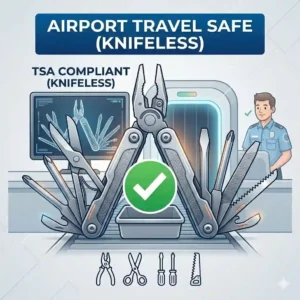
✅ Yes, the TSA generally permits tools under 7 inches overall length that do not contain a blade. However, the final decision always rests with the screening officer. Removing all sharp edges dramatically increases your chances of keeping your gear…
❓ Can a bladeless multi tool still open packages effectively?
✅ Absolutely. Most models feature dedicated pry tips, sharpened flathead screwdrivers, or rigid scissors that easily slice through packing tape and cardboard without the inherent risks of a traditional folding pocket knife…
❓ What is the best multi tool without knife blade for a mechanic?
✅ For automotive work, wearable tools like the Leatherman Tread Metric or high-torque unibody tools like the SOG MacV are ideal, as they provide high leverage for bolts and bit drivers without delicate moving parts breaking…
❓ How do I clean a TSA safe multi tool after travel?
✅ Wash the tool in warm soapy water, scrub the pivot points with an old toothbrush to remove pocket lint, dry thoroughly with compressed air, and apply a single drop of mineral oil to the joints…
❓ Why are some bladeless tools more expensive than those with blades?
✅ Engineering a tool to be useful without relying on a blade requires complex machining, high-grade materials like 17-4 stainless steel, and innovative designs (like spring-action scissors or wearable links) which increase manufacturing costs…
📚 Recommended for You
- 5 Best executive pocket knife Models for Professionals in 2026
- Top 5 pocket knife with screwdriver Picks: Brutally Honest 2026 Guide
- 2026 Ultimate Guide: Is the ninja wallet ninja Still the Best EDC Tool?
Disclaimer: This article contains affiliate links. As an Amazon Associate, I earn from qualifying purchases. If you purchase products through these links, we may earn a small commission at no additional cost to you.
✨ Found this helpful? Share it with your friends! 💬🤗
[addtoany]
